
Moving from the Samsung Galaxy Z Fold 4 to the Galaxy S24 Ultra represents a fundamental shift in smartphone philosophy. One device redefines mobile productivity with its folding screen; the other doubles down on traditional flagship excellence with unmatched camera performance and raw power. But is the switch truly an upgrade — or are you trading innovation for specs? The answer isn’t straightforward, and it depends heavily on how you use your phone.
Many users assume that newer and higher-priced automatically means better. However, switching from a foldable like the Z Fold 4 to a slab-style powerhouse like the S24 Ultra involves trade-offs that aren't always obvious until after the purchase. Let’s unpack what changes, what improves, and what might actually be worse — so you can decide if the hype matches your reality.
The Form Factor Shift: From Foldable Multitasking to Premium Simplicity
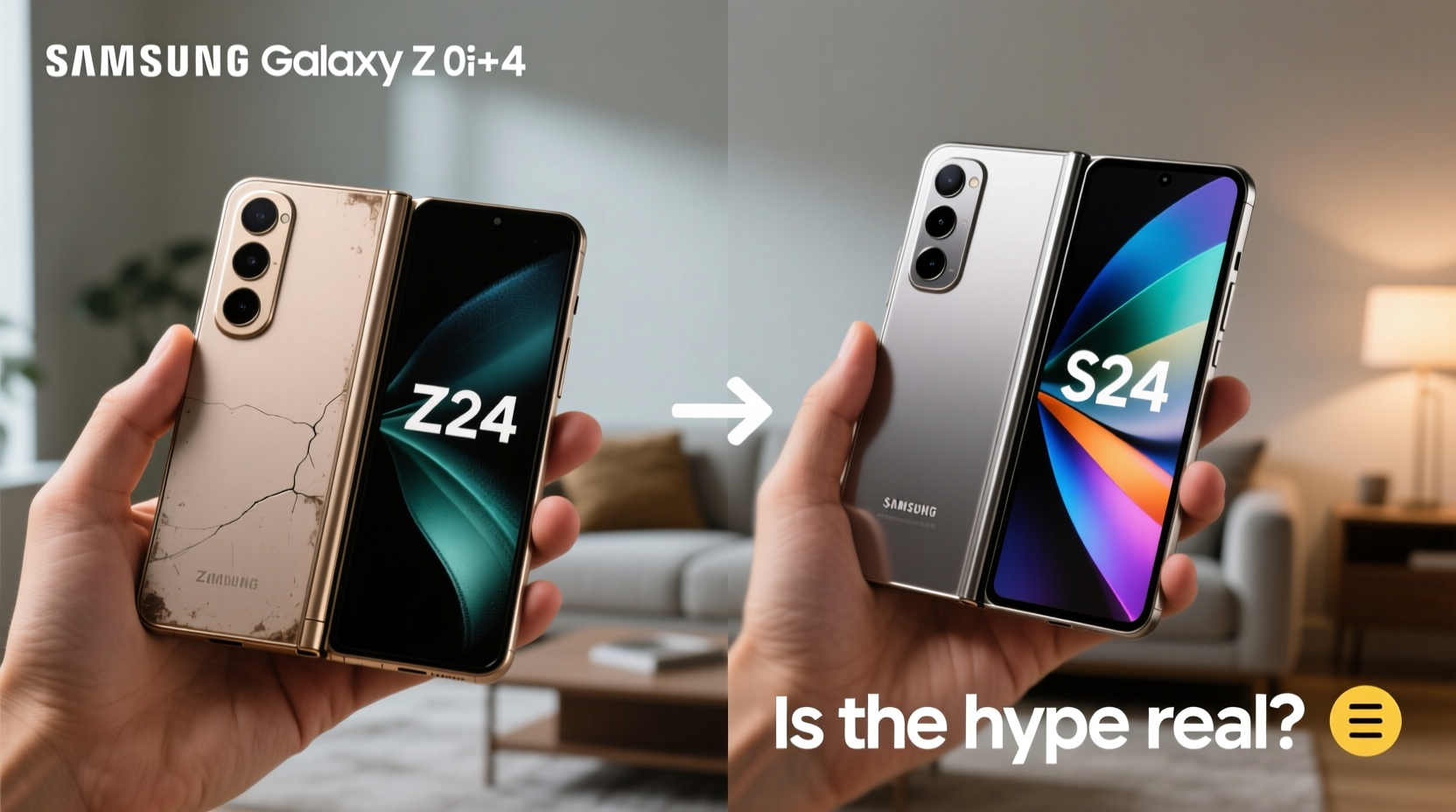
The most immediate difference you’ll feel is physical. The Z Fold 4 offers a tablet-sized 7.6-inch inner display when unfolded, enabling split-screen multitasking, drag-and-drop functionality, and desktop-like browsing. In contrast, the S24 Ultra presents a more conventional 6.8-inch flat Dynamic AMOLED screen — stunning, yes, but lacking the transformative flexibility of a foldable.
If you regularly used the Fold 4 for tasks like checking email while watching a video, editing documents side-by-side, or using Samsung Dex in tablet mode, you’ll lose that spatial advantage. The S24 Ultra compensates with superior brightness (up to 2600 nits), a 120Hz adaptive refresh rate, and flatter bezels, but it doesn’t expand your digital workspace the way a foldable does.
Camera: Where the S24 Ultra Truly Shines
This is where the S24 Ultra pulls far ahead. While the Z Fold 4 has a solid triple rear setup (50MP main, 12MP ultrawide, 10MP telephoto), it’s constrained by the hinge mechanism and thinner body, limiting lens size and optical performance.
The S24 Ultra, however, features a quad-camera system headlined by a 200MP main sensor — one of the highest-resolution sensors in any smartphone. Paired with a 50MP ultrawide, a 10MP 3x telephoto, and a 50MP 5x periscope lens, it delivers exceptional zoom capabilities up to 100x (digitally) and crisp detail even at 10x optical hybrid zoom.
“Photographers no longer need to carry separate devices for long-range shots. The S24 Ultra’s periscope lens rivals entry-level DSLRs in daylight clarity.” — David Lin, Mobile Imaging Analyst at TechPulse Asia
Low-light performance is also significantly improved thanks to larger pixel binning (2.4µm effective pixels) and advanced AI processing. If photography, travel content creation, or social media are priorities, this leap is undeniable.
Performance & Software: Incremental Gains vs. Real-World Impact
Both phones are powered by top-tier chipsets — the Z Fold 4 runs on the Snapdragon 8+ Gen 1, while the S24 Ultra uses the newer Snapdragon 8 Gen 3 (in most regions). Benchmarks show about a 25–30% improvement in CPU and GPU performance, along with better thermal efficiency.
In practice, everyday tasks like scrolling, app launches, and gaming feel snappier, but not revolutionary. What sets the S24 Ultra apart is future-proofing: longer software support (7 years of OS and security updates), enhanced AI features like Circle to Search, live translation, and generative edit tools in Gallery.
However, if you valued the unique software features of the Fold — such as Flex Mode (which splits apps when partially folded), Task Bar (for desktop-like navigation), or seamless app continuity between cover and main screens — you’ll miss them deeply. These aren’t just gimmicks; they’re part of a different interaction model.
Build Quality and Durability: A Mixed Bag
The S24 Ultra boasts titanium frame construction, making it lighter than its predecessor (S23 Ultra) despite similar dimensions. It feels incredibly solid, with Gorilla Glass Armor on the front and back, and IP68 water resistance. Still, it’s a large, heavy phone — nearly 233g — which makes one-handed use challenging.
The Z Fold 4, while less rigid due to its hinges and thin internal screen layer, introduced improved durability with IPX8 water resistance and a reinforced under-display camera. Its compact folded size (like a small candy bar phone) made it easier to pocket and handle daily.
Here’s a direct comparison:
| Feature | Z Fold 4 | S24 Ultra |
|---|---|---|
| Weight | 263g (unfolded) | 233g |
| Display Type | Foldable Inner + Cover Screen | Flat Rigid Display |
| Main Camera | 50MP | 200MP |
| Zoom Capability | 3x Optical | 5x Optical / 10x Hybrid |
| Battery Life | ~1 day moderate use | ~1.2 days moderate use |
| Software Support | 4 OS Upgrades (until Android 16) | 7 OS Upgrades (until Android 20+) |
| Pocketability | Excellent (when folded) | Poor (large footprint) |
Real User Experience: A Mini Case Study
Take Mark, a freelance designer who used his Z Fold 4 for client meetings. He’d unfold it during presentations to show portfolios side-by-side with feedback notes. He loved the ability to run Figma on half the screen and Slack on the other. When he switched to the S24 Ultra for its rumored AI tools and camera, he found himself frustrated during collaborative sessions. Without true multitasking, he had to constantly switch apps. He missed the tactile satisfaction of folding the phone shut to signal meeting closure. Eventually, he bought both devices — using the S24 Ultra for shooting product photos and the Fold as his primary work tool.
His story illustrates a key point: specs don’t tell the whole story. Workflow integration matters more than megapixels when your job depends on fluidity.
Checklist: Before You Switch, Ask Yourself
- Do I frequently use two apps at once? (e.g., email + calendar, web + notes)
- Do I value portability when the phone is stowed?
- Is professional-grade zoom or low-light photography critical to me?
- Am I willing to sacrifice foldable novelty for longer software support?
- Do I prefer a single, durable screen over a creased, potentially fragile inner display?
- Will I actually use the S Pen daily, or is it just a bonus feature?
If you answered “yes” to the first two, reconsider. If the last three resonated more, the S24 Ultra may be worth it.
FAQ
Can I use the S Pen on the Z Fold 4?
No, the Z Fold 4 does not support the S Pen. Only the S24 Ultra (and previous Note-line successors) have built-in S Pen silo support. Third-party styluses work, but without pressure sensitivity or air actions.
Is the battery life really better on the S24 Ultra?
Yes, marginally. The S24 Ultra packs a 5000mAh battery versus the Z Fold 4’s 4400mAh. Combined with more efficient software optimization and the Gen 3 chip, it typically lasts 2–3 hours longer under mixed use. However, heavy gaming or 5G streaming narrows the gap.
Does the S24 Ultra feel outdated because it’s not foldable?
Not necessarily. While foldables represent the future of form factors, the S24 Ultra excels as the pinnacle of today’s smartphone standards. It’s not trying to be innovative in shape — it’s maximizing performance, camera, and longevity within a proven design.
Conclusion: Is the Hype Real?
The hype around the S24 Ultra is real — but selective. If you prioritize camera excellence, long-term software updates, S Pen integration, and peak performance, then yes, it’s a legitimate upgrade. But if your workflow thrives on screen real estate, multitasking, and the sheer novelty of unfolding your phone like a mini tablet, you’re not just changing devices — you’re abandoning a paradigm.
The truth is, these two phones serve different needs. The Z Fold 4 is a productivity companion disguised as a phone. The S24 Ultra is a photographic instrument wrapped in premium materials. Neither is objectively better. Your lifestyle determines the winner.




 浙公网安备
33010002000092号
浙公网安备
33010002000092号 浙B2-20120091-4
Comments
No comments yet. Why don't you start the discussion?