
Twill silk is one of the most coveted textiles in fashion and interior design, prized for its soft drape, rich luster, and signature diagonal rib pattern. Yet as demand grows, so does the market for counterfeit versions—blends labeled as pure silk, synthetic imitations, or poorly finished fabrics that mimic the look but lack the substance. Distinguishing genuine twill silk from imposters isn’t just about protecting your investment; it’s about honoring craftsmanship and quality. This guide equips you with the knowledge and techniques used by textile experts, designers, and collectors to verify authenticity with confidence.
Understanding Twill Silk: What Makes It Unique
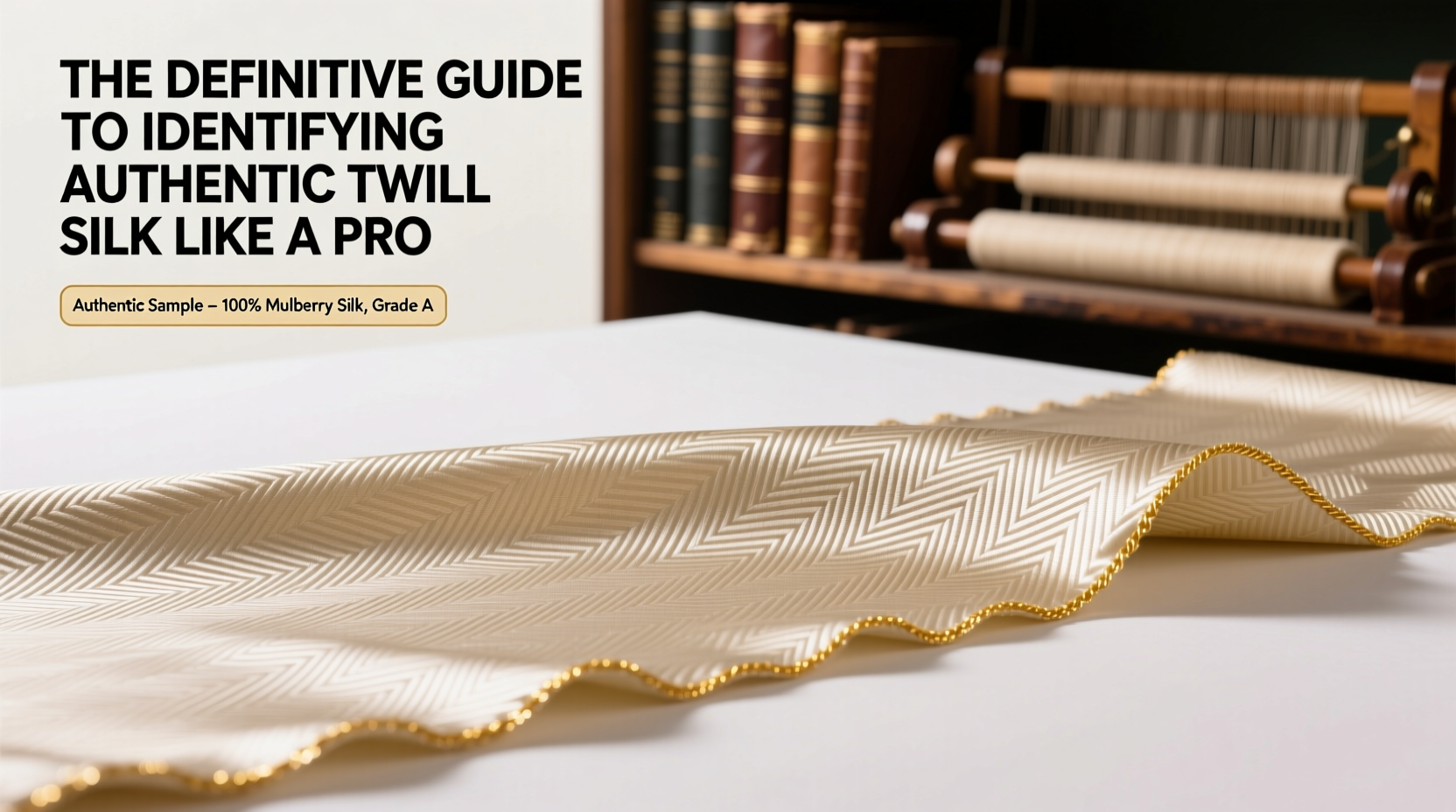
Twill silk is a variation of silk fabric woven using a twill weave structure, where the weft thread passes over one or more warp threads and then under two or more, creating a characteristic diagonal pattern known as a “wale.” Unlike plain-weave silks such as chiffon or habotai, twill silk has greater durability, a softer hand feel, and a subtle sheen that shifts in the light. Common types include silk crepe de chine (a lighter twill) and silk gabardine (a tightly woven, durable version).
The raw material must be 100% mulberry silk—the highest grade of natural silk—for the fabric to qualify as authentic twill silk. Anything blended with polyester, rayon, or other fibers may resemble the texture but fails to deliver the breathability, temperature regulation, and aging qualities of true silk.
“Twill silk ages beautifully when cared for properly. Its strength lies not just in tensile resilience but in how it develops a deeper luster over time.” — Clara Nguyen, Textile Archivist at The Fashion Conservatory
The Five-Sense Authentication Method
Experts rely on sensory evaluation before turning to lab tests. By engaging sight, touch, sound, smell, and even sight again under different conditions, you can quickly narrow down whether a fabric is likely real twill silk.
Sight: Analyze the Weave and Sheen
Hold the fabric under natural light. Authentic twill silk displays a consistent diagonal rib running across the surface. The lines should be smooth and evenly spaced. Look for irregularities: machine-made synthetics often have perfectly uniform patterns, while real silk may show slight variations due to natural protein fiber inconsistencies—this is a sign of authenticity, not defect.
The sheen of real silk is soft and luminous, never harsh or plastic-like. Imitations often reflect light too uniformly or appear overly glossy under direct light.
Touch: Evaluate Texture and Weight
Genuine twill silk feels cool to the touch initially and warms slightly when held. It should glide smoothly between your fingers without feeling greasy or stiff. Run your palm across the surface—you’ll notice a gentle resistance followed by a fluid drape. Fake silk tends to feel slippery in an artificial way, almost waxy, and lacks the subtle friction of natural protein fibers.
Sound: Listen for the \"Silk Rustle\"
Crumple the fabric lightly in your hand. Real silk produces a distinct, soft crunching sound known in the industry as the “silk rustle” or *scroop*. This is caused by sericin, a natural gum coating the fibers before degumming. While not all silk exhibits strong scroop, its presence is a positive indicator. Polyester and rayon remain silent or produce a plastic crinkle.
Smell: Conduct a Burn Test Safely
If you're testing a swatch or hidden seam, perform a cautious burn test. Snip a small thread (about 1 inch) and hold it with tweezers over a flame. Real silk burns slowly, curls away from the flame, emits a smell similar to burnt hair (due to its protein composition), and leaves behind a brittle, crushable black ash. Synthetic fibers melt, drip, and smell like burning plastic.
Caution: Only conduct this test in a well-ventilated area with fire safety measures in place. Never burn fabric attached to garments unless you intend to destroy them.
Comparative Analysis: How Twill Silk Stacks Up Against Imitations
| Feature | Authentic Twill Silk | Polyester Imitation | Rayon/Viscose Blend |
|---|---|---|---|
| Weave Pattern | Clear diagonal rib, slight irregularity | Perfectly uniform, flat appearance | Diagonal visible but duller |
| Sheen | Soft, multidirectional glow | Harsh, reflective shine | Muted, uneven luster |
| Touch | Cool, smooth with gentle grip | Slippery, sometimes static-prone | Smooth but heavier, less elastic |
| Burn Test Result | Burns slowly, hair-like odor, powdery ash | Melts, black smoke, plastic smell | Burns quickly, papery smell, light ash |
| Drape | Fluid, elegant fall | Stiff or unnaturally floaty | Heavy drape, prone to wrinkling |
Step-by-Step Guide to Verifying Twill Silk Authenticity
- Examine the Label: Check for fiber content. Anything less than “100% Mulberry Silk” raises suspicion. Be wary of vague terms like “silk-feel” or “silk-style.”
- Inspect the Weave: Use a magnifying glass if needed. Look for consistent diagonal lines and interlacing that shows slight variation—machine-perfect symmetry suggests synthetic origin.
- Feel the Fabric: Assess temperature response and texture. Does it warm slightly in your hand? Is there a subtle grip rather than artificial slip?
- Listen to the Crinkle: Lightly scrunch a section. A soft crunch indicates potential authenticity.
- Conduct a Discreet Burn Test: On an inconspicuous thread, observe burn behavior and residue.
- Test Water Absorption: Dab a drop of water on the back of the fabric. Real silk absorbs moisture slowly and darkens slightly. Synthetics bead water or absorb too quickly.
- Consult a Professional Appraiser: For high-value items, consider sending a sample to a textile lab for microscopic or chemical analysis.
Real-World Scenario: Spotting Fakes in a Luxury Market
A vintage clothing dealer in Lyon once acquired a batch of what appeared to be 1950s silk evening gowns labeled as “twill crepe.” Initial inspection showed good drape and a convincing diagonal weave. However, upon closer examination, the fabric lacked scroop and emitted a faint chemical odor. A burn test confirmed suspicions: the fibers melted and dripped, revealing a polyester construction designed to mimic vintage silk. Despite accurate styling and labeling, the materials were entirely synthetic—a common tactic in reproductions sold at premium prices.
This case underscores why sensory verification matters. Labels can lie; only physical testing reveals truth.
Essential Checklist for Buyers and Collectors
- ✅ Confirm 100% mulberry silk on the label
- ✅ Verify diagonal twill weave under natural light
- ✅ Feel for coolness and gradual warming in hand
- ✅ Listen for the characteristic silk rustle
- ✅ Perform a discreet burn test on a seam thread
- ✅ Check for natural imperfections in weave (a good sign)
- ✅ Avoid pieces with plastic-like sheen or stiffness
- ✅ When in doubt, consult a certified textile appraiser
Frequently Asked Questions
Can twill silk be blended with other fibers and still be considered authentic?
No. True twill silk refers exclusively to fabric woven from 100% silk fibers using a twill technique. Blends may offer cost savings but compromise breathability, durability, and care requirements. They should be clearly labeled as “silk blend” or “poly-silk,” not sold as pure silk.
Is there a difference between “twill silk” and “crepe de chine”?
Yes. Crepe de chine is a type of lightweight twill silk made with alternating S-twist and Z-twist yarns, giving it a slightly pebbled texture and excellent drape. All crepe de chine is twill-woven silk, but not all twill silk is crepe de chine—some are denser, like silk gabardine.
Why do some real silk fabrics fail the burn test?
Heavily treated, coated, or metallic-finished silks may behave differently during burning due to added chemicals. Always test untreated areas. If in doubt, combine multiple verification methods rather than relying solely on one.
Final Thoughts: Trust Your Senses, Then Verify
Identifying authentic twill silk is both a science and a skill refined through experience. While technology offers advanced tools like spectroscopy and microscopy, the foundation of authentication lies in observation, tactile awareness, and informed skepticism. Whether you’re purchasing a couture garment, restoring antique textiles, or sourcing fabric for design, the ability to distinguish real from replica empowers better decisions and preserves value.




 浙公网安备
33010002000092号
浙公网安备
33010002000092号 浙B2-20120091-4
Comments
No comments yet. Why don't you start the discussion?