
For vloggers, travel creators, and content producers, capturing crisp, vibrant footage in natural light is essential. Daylight offers the most consistent lighting conditions, but how well your gear takes advantage of it can make or break your video quality. While smartphones have made incredible strides in mobile photography and videography, dedicated vlogging cameras remain a staple for professionals. The debate isn’t just about convenience—it’s about image fidelity, control, and long-term usability.
This article dives deep into how vlogging cameras and modern smartphones perform when recording in daylight, analyzing sensor size, lens quality, dynamic range, stabilization, and more. Whether you're starting out or upgrading your kit, understanding these differences will help you choose the right tool for your content.
Sensor Size and Light Capture
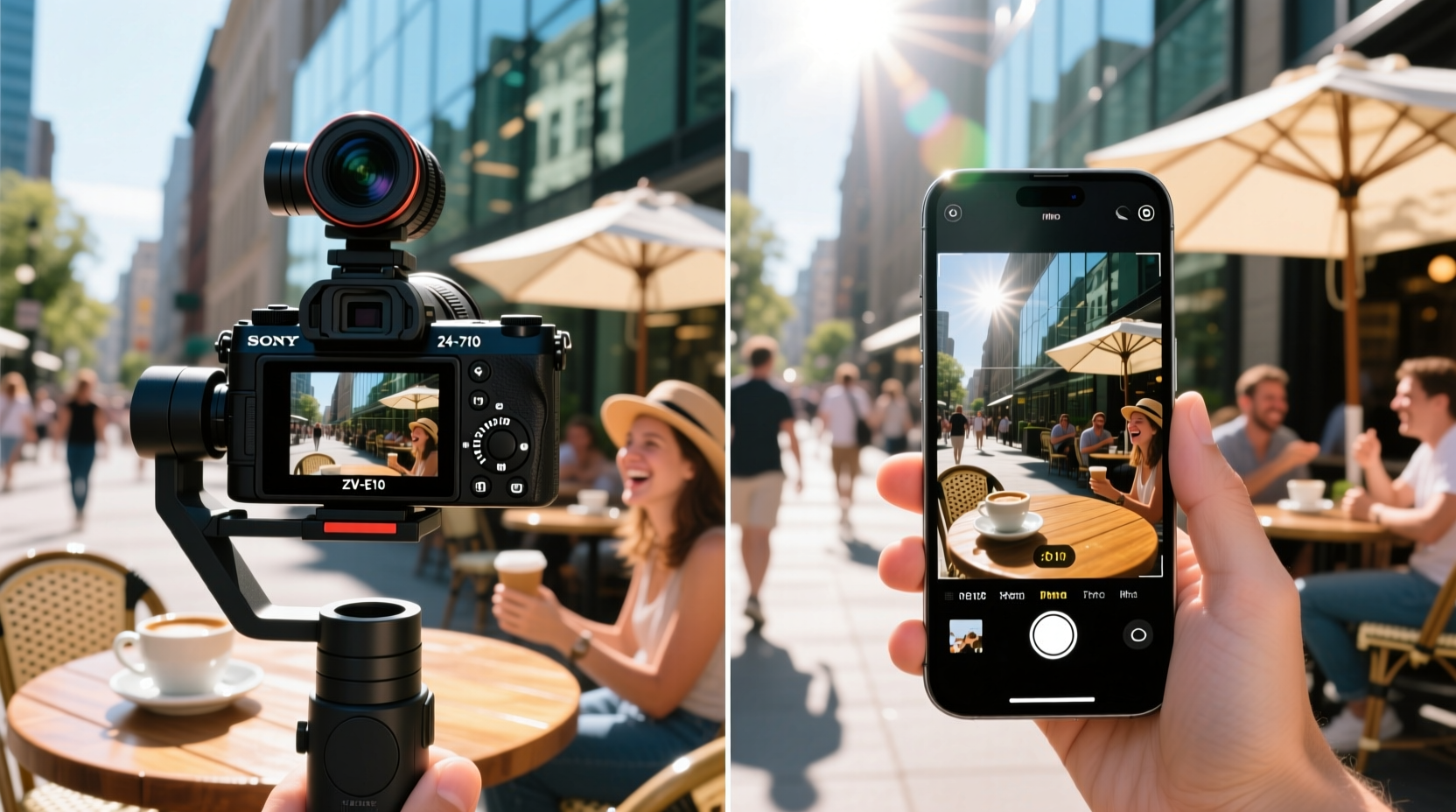
The foundation of any camera system—whether in a phone or a standalone device—is its image sensor. Larger sensors generally capture more light, offer better dynamic range, and produce less noise. In daylight, this translates to richer colors, finer details, and smoother gradations between highlights and shadows.
Vlogging cameras like the Sony ZV-1, Canon G7 X series, or DJI Pocket 3 typically feature larger sensors than even flagship smartphones. For example, the Sony ZV-1 uses a 1-inch type sensor (approximately 13.2 x 8.8 mm), while most high-end smartphones use smaller sensors around 1/1.3” to 1/1.5”. Though some phones now include larger sensors—like the Samsung Galaxy S24 Ultra with its 1/1.3” ISOCELL sensor—they still fall short of dedicated compact vlogging cameras in total surface area.
In direct sunlight, this difference becomes apparent. A vlogging camera can retain detail in bright clouds and dark clothing simultaneously, while a smartphone may blow out highlights or crush shadows without manual correction.
Lens Quality and Aperture Control
The lens is just as important as the sensor. Most smartphones use fixed-aperture lenses optimized for general use, often ranging from f/1.8 to f/2.4. While fast for low light, they lack versatility. Vlogging cameras, on the other hand, often feature variable aperture lenses (e.g., f/1.8–f/4.5) and higher-quality glass elements that reduce chromatic aberration and flare—common issues under harsh midday sun.
Smartphones rely heavily on computational photography to correct optical flaws. Algorithms simulate bokeh, correct distortion, and enhance contrast. But in bright conditions, lens flare and ghosting can still appear, especially when shooting toward the sun. Vlogging cameras with physical ND filters (like the Panasonic GH6 or Fujifilm X-S20) allow precise exposure control, preventing overexposure without sacrificing motion blur.
Moreover, dedicated vlogging cams usually have wider focal lengths ideal for solo creators—typically 24mm equivalent—and superior close-focus capabilities. This makes them excellent for framing both face and background clearly in outdoor shots.
Dynamic Range and HDR Performance
Daylight scenes often contain extreme contrasts: bright skies, shaded faces, reflective surfaces. How well a device handles this determines its dynamic range—the span between the darkest and brightest parts of an image it can capture simultaneously.
Modern smartphones use multi-frame HDR processing to merge several exposures into one balanced shot. This works impressively well in stills and increasingly in video (e.g., Apple’s Cinematic Mode or Google’s HDRnet). However, processed HDR video can sometimes look artificial, with inconsistent tone mapping across frames or “pumping” effects during exposure shifts.
Vlogging cameras, particularly those supporting log profiles (like S-Log3 on Sony or V-Log on Panasonic), capture flat, high-bit-depth footage designed for grading. They preserve up to 12+ stops of dynamic range natively, giving editors far more flexibility than compressed smartphone footage.
“Even in perfect daylight, a vlogging camera gives you headroom for post-production. Smartphones deliver pleasing results out-of-camera but leave little room for correction.” — Jordan Lee, Professional Videographer & Colorist
Stabilization: Optical vs. Digital Trade-offs
Stable footage is critical for professional-looking vlogs. Both smartphones and vlogging cameras employ stabilization, but their approaches differ significantly.
Smartphones use a combination of optical image stabilization (OIS) and aggressive electronic image stabilization (EIS), cropping into the frame to smooth movement. iPhones and recent Pixels excel here, offering near-gimbal-like smoothness. However, digital stabilization reduces resolution and introduces a “wobbly” or “jello” effect under rapid motion or vibration.
Dedicated vlogging cameras also use OIS+EIS hybrids, but with larger gyros and smarter algorithms tuned specifically for handheld vlogging. The Canon G7 X Mark III, for instance, features Dynamic IS that adjusts based on walking speed. The DJI Pocket 3 goes further with a 3-axis mechanical gimbal, eliminating shake entirely without digital cropping.
| Feature | Vlogging Camera | Smartphone |
|---|---|---|
| Sensor Size | 1-inch or APS-C (larger) | 1/1.3” – 1/2.3” (smaller) |
| Lens Flexibility | Variable aperture, ND filter support | Fixed aperture, no ND option |
| Dynamic Range | 10–13 stops (log capable) | 8–10 stops (processed HDR) |
| Stabilization | OIS + EIS or mechanical gimbal | Heavy EIS with frame cropping |
| Audio Input | Dedicated mic jack, external recorder support | Limited mic options, reliant on apps |
| Battery Life (continuous recording) | 60–120 minutes | 45–90 minutes (varies by model) |
Real-World Example: Travel Vlogger in Coastal Croatia
Consider a travel vlogger filming along the Dalmatian Coast. The scene includes bright white limestone buildings, deep blue Adriatic waters, and narrow shaded alleys. Using an iPhone 15 Pro, the footage looks vivid straight out of camera, with accurate skin tones and sharp detail. However, when reviewing clips, the sky appears washed out in several shots, and the stone walls lose texture due to overexposure.
Switching to a Sony ZV-1 with an ND filter attached, the same scenes show balanced exposure across all elements. Clouds retain definition, water reflects subtle gradients, and facial shadows are recoverable in post. Though the file requires minor color tuning, the raw quality provides creative freedom impossible with the smartphone’s compressed HEVC output.
The vlogger notes another advantage: continuous recording without overheating. After 45 minutes of nonstop filming, the iPhone warns of temperature issues, forcing a pause. The ZV-1 runs cool throughout, thanks to passive heat dissipation and efficient encoding.
When a Smartphone Wins in Daylight
Despite their technical limitations, smartphones hold distinct advantages. Their immediacy, connectivity, and app ecosystem make them unbeatable for spontaneous content. Features like instant social media upload, live streaming, and AI-powered autofocus (e.g., Face ID tracking) streamline production.
Additionally, newer phones like the iPhone 15 Pro and Samsung Galaxy S24 Ultra record 4K at 60fps with impressive bitrates and support ProRes or HDR10+. With careful exposure adjustment via manual mode apps, skilled users can achieve broadcast-ready results—especially if they don’t plan extensive editing.
For casual vloggers documenting daily life, family trips, or quick reviews, the smartphone remains sufficient. Its integration with editing apps (like LumaFusion or CapCut) allows end-to-end creation without switching devices.
Action Checklist: Choosing the Right Tool for Daylight Vlogging
- Evaluate your editing workflow: Do you grade footage professionally? Choose a vlogging camera with log profiles.
- Assess lighting variety: If you shoot in mixed sun/shade often, prioritize dynamic range over portability.
- Test stabilization needs: Walking tours demand superior stabilization—mechanical gimbals beat digital crop.
- Check audio requirements: External mics work better with vlogging cameras’ 3.5mm jacks.
- Consider battery and storage: Long shoots favor removable batteries and SD cards over sealed designs.
- Weigh sharing speed: Need instant uploads? Smartphones win with LTE and built-in platforms.
Step-by-Step Guide: Optimizing Daylight Footage
- Scout your location early: Visit during similar lighting conditions to test exposure challenges.
- Use histograms (if available): Enable on-screen histogram in camera settings to avoid clipping highlights.
- Set manual exposure: On smartphones, lock exposure on a neutral surface; on vlogging cameras, adjust shutter speed and aperture.
- Attach an ND filter (if possible): Essential for maintaining cinematic motion blur in bright light.
- Record in highest quality: Use 4K 30fps minimum, preferably 10-bit if supported.
- Monitor audio separately: Even if using a camera, pair with a lavalier mic for clean voice capture.
- Back up immediately: Transfer files after each shoot to prevent data loss.
Frequently Asked Questions
Can a smartphone really compete with a $700 vlogging camera in daylight?
Yes, for basic vlogs and social-first content. Modern flagships produce excellent out-of-camera footage with strong stabilization and color science. However, they lack the dynamic range, manual controls, and professional codec support needed for polished productions.
Do I need a vlogging camera if I edit on my phone?
Not necessarily. If your entire pipeline—from recording to editing to publishing—happens on a smartphone, sticking with one device simplifies workflow. But if you want to export high-resolution videos for YouTube or client work, investing in a vlogging camera pays off.
Why do some YouTubers still use smartphones outdoors?
Many prioritize convenience, stealth, and speed. For street interviews, event coverage, or behind-the-scenes snippets, pulling out a small phone is less intrusive and faster than setting up a dedicated rig. It’s a trade-off between quality and agility.
Conclusion: Match Your Gear to Your Goals
The choice between a vlogging camera and a smartphone in daylight ultimately depends on your priorities. If you value maximum image quality, creative control, and professional-grade output, a dedicated vlogging camera delivers superior results—especially in challenging lighting. Its larger sensor, better optics, and flexible settings ensure your footage stands out with depth and clarity.
However, if your focus is speed, simplicity, and seamless sharing, today’s smartphones are remarkably capable. They’ve closed much of the gap, offering stunning visuals with minimal effort. For many creators, the phone is not just good enough—it’s ideal.
Understanding the strengths and limits of each tool empowers you to make informed decisions. Whether you’re hiking mountain trails or exploring city streets, let your content goals guide your gear choices—not trends or marketing claims.




 浙公网安备
33010002000092号
浙公网安备
33010002000092号 浙B2-20120091-4
Comments
No comments yet. Why don't you start the discussion?