
When writing a recipe, drafting a grocery list, or discussing seasonal produce, you’ve likely paused to ask: what is the correct plural of “tomato”? While it may seem trivial, using the right grammatical form affects clarity, professionalism, and credibility—especially in culinary writing, food labeling, and restaurant menus. The answer isn’t always intuitive, particularly because English borrows from multiple language roots and applies inconsistent rules for pluralization. The correct plural of \"tomato\" is tomatoes, not \"tomatos.\" This rule stems from standard English conventions for nouns ending in -o preceded by a consonant, especially those with a vowel sound before the final syllable. Understanding this distinction ensures precision in both spoken and written communication, whether you're a home cook, chef, or food blogger.
The confusion often arises because some words ending in -o form their plural with just an -s (e.g., \"pianos,\" \"photos\"), while others require -es (e.g., \"heroes,\" \"potatoes\"). Tomatoes falls into the latter category. Beyond grammar, the word itself carries cultural and culinary weight. Tomatoes are foundational in global cuisines—from Italian sauces to Mexican salsas, Middle Eastern salads, and Indian curries. Referring to them accurately reflects not only linguistic correctness but also respect for the ingredient’s significance in cooking traditions worldwide.
Definition & Overview
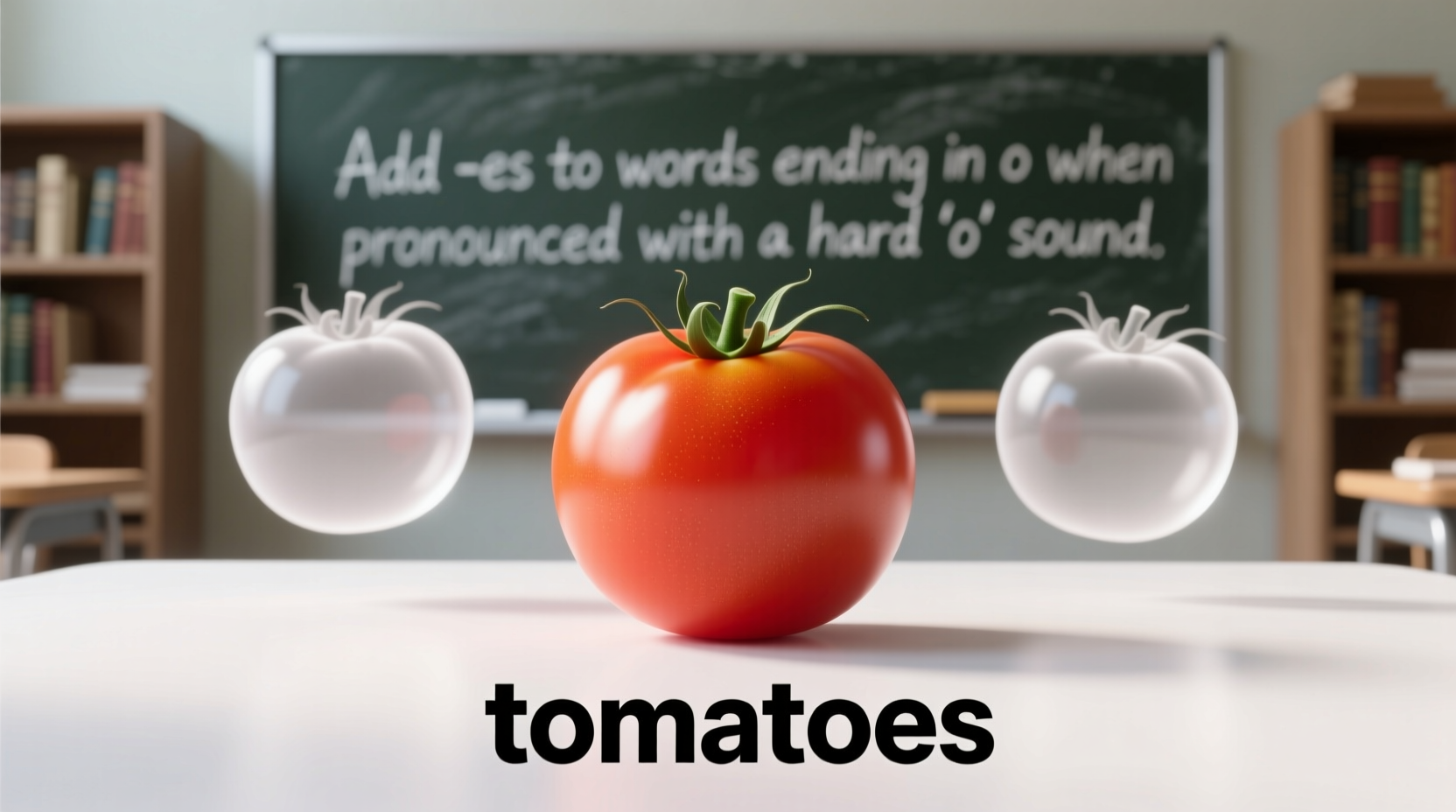
The tomato (Solanum lycopersicum) is a fruit botanically, though legally and culinarily classified as a vegetable in many jurisdictions, including the United States Supreme Court ruling of 1893 (*Nix v. Hedden*). Native to western South America, tomatoes were domesticated by indigenous peoples in modern-day Mexico and spread globally following European exploration. Today, they are one of the most widely cultivated and consumed crops in the world.
In culinary terms, a tomato is valued for its juicy flesh, tangy-sweet flavor, and vibrant color. It serves as a base for countless dishes, including sauces, soups, stews, salads, and condiments. Its acidity balances rich ingredients, while its natural umami enhances savory profiles. Though commonly red, tomatoes come in a spectrum of colors—yellow, orange, green, purple, and even black—each offering subtle differences in taste and texture.
The singular noun “tomato” refers to one whole fruit. When referring to more than one, proper English grammar requires the plural form: tomatoes. This follows the pattern of similar Latin- and Greek-derived words ending in -o that take -es in the plural when the preceding syllable is stressed or contains a vowel sound.
Key Characteristics
| Characteristic | Description |
|---|---|
| Flavor Profile | Bright, tangy, slightly sweet; varies by variety from earthy to citrusy |
| Aroma | Fresh, green, herbaceous; ripe specimens emit a warm, sun-baked scent |
| Color/Form | Round, oval, or ribbed; red most common, but yellow, orange, purple, green-stripe, and black exist |
| Heat Level | None — non-pungent, used to enhance flavor rather than add spice |
| Culinary Function | Base ingredient, acidulant, color enhancer, textural component |
| Shelf Life | 5–7 days at room temperature; up to 2 weeks refrigerated (though flavor degrades) |
Practical Usage
Using “tomatoes” correctly in recipes and conversation ensures clarity. For example:
- “Chop four ripe tomatoes for the bruschetta topping.”
- “These heirloom tomatoes have exceptional flavor and texture.”
- “San Marzano tomatoes are ideal for making smooth marinara sauce.”
In professional kitchens, precise language prevents miscommunication. A line cook reading “add three tomato” might pause, uncertain if it’s a typo or shorthand. Conversely, “add three tomatoes” is unambiguous and efficient. In menu descriptions, accuracy builds trust: “Grilled octopus with cherry tomatoes, fennel, and lemon vinaigrette” sounds polished and intentional.
When teaching cooking classes or publishing recipes online, consistent grammar reinforces authority. Readers notice errors, and repeated misuse—such as “tomatos”—can undermine perceived expertise, regardless of actual skill level. Search engines also favor well-written, grammatically correct content, so using “tomatoes” improves SEO performance for food blogs and culinary websites.
Pro Tip: When in doubt about pluralizing -o words, apply this quick test: if the word has a vowel immediately before the -o (like radio, studio, tomato), it typically takes -es. Exceptions include recent loanwords (e.g., “tacos,” “kimonos”) and abbreviations (e.g., “photos” from “photographs”).
Variants & Types
Tomatoes come in numerous varieties, each suited to specific culinary applications. Knowing these types helps determine how many you’ll need—and how to refer to them collectively.
Common Tomato Varieties
- Roma (Plum) Tomatoes – Dense, low-moisture flesh ideal for sauces and canning. Often sold in bulk; always referred to as “romano tomatoes” or “canned tomatoes” in plural contexts.
- Cherry Tomatoes – Small, round, sweet; perfect for snacking, roasting, or adding raw to salads. Typically purchased and used in quantity (“a pint of cherry tomatoes”).
- Beefsteak Tomatoes – Large, meaty, juicy; excellent for slicing and sandwiches. One beefsteak per sandwich, but multiple in a farmer’s market display.
- Heirloom Tomatoes – Open-pollinated, historically significant cultivars with diverse colors and complex flavors. Often labeled collectively: “Our heirloom tomatoes include Brandywine, Green Zebra, and Cherokee Purple.”
- Grape Tomatoes – Elongated, firmer than cherries, less sweet. Commonly used in pre-packaged salads and referred to in plural form on ingredient lists.
- Campari Tomatoes – Medium-sized, vine-ripened, available year-round in supermarkets. Marketed as “sweet mini tomatoes” but grammatically still “tomatoes.”
Regardless of type, all follow the same plural rule: tomatoes. Even when describing processed forms—diced, crushed, stewed—the plural remains consistent: “crushed tomatoes,” “sun-dried tomatoes,” “fire-roasted tomatoes.”
Comparison with Similar Ingredients
Some ingredients are frequently confused with tomatoes due to appearance or usage. Clarifying distinctions avoids substitution errors and reinforces correct terminology.
| Ingredient | Difference from Tomatoes | Plural Form |
|---|---|---|
| Peppers (Bell) | Sweeter, hollow interior, thicker walls; no acidity like tomatoes | peppers |
| Tomatillos | Encased in papery husk, tart flavor, essential in salsa verde | tomatillos |
| Persimmons | Fruit with similar shape when ripe, but much sweeter and gelatinous | persimmons |
| Red Apples | Firm, crisp, sugary; used in desserts, not savory bases | apples |
Note: “Tomatillo” is a Spanish diminutive of “tomate” (Spanish for tomato), yet its plural is “tomatillos,” not “tomatilloes.” This illustrates how loanwords adapt differently into English. Still, “tomato” adheres strictly to English plural rules: tomatoes.
Practical Tips & FAQs
Q: Why isn't the plural of tomato just \"tomatos\"?
A: While some nouns ending in -o use -s (e.g., “solos,” “kilos”), those with a preceding vowel sound or historical derivation from Romance languages typically add -es. “Tomato” comes from the Nahuatl word *tomatl*, passed through Spanish *tomate*, then adapted into English with phonetic stress on the first syllable (/təˈmeɪtoʊ/). This pronunciation pattern aligns it with “potato,” “hero,” and “echo”—all taking -es in the plural.
Q: Is \"tomatos\" ever acceptable?
A: Only in informal contexts, dialects, or poetic license. For instance, the song “You Say Tomato, I Say Tomahto” uses playful pronunciation, but even there, the plural would remain “tomatoes.” In formal writing, education, or culinary publishing, “tomatos” is considered incorrect.
Q: How do I remember which -o words take -es?
A: Use this simple checklist:
- Does the word end in -o preceded by a consonant? → Likely adds -es.
- Is it a common noun with Latin/Greek/Spanish roots? → Often -es.
- Can you hear a clear vowel sound before the -o? → Probably -es.
Examples: ✔️ Correct: tomatoes, potatoes, heroes, mosquitoes, volcanoes ❌ Incorrect: *tomatos*, *potatos*, *heros* ⚠️ Exceptions: pianos, photos, radios, autos (shortened forms accept -s)
Q: Does the plural change in different English dialects?
A: Standard British, American, Canadian, and Australian English all use “tomatoes.” Regional accents may pronounce it differently (“tuh-MAY-toes” vs. “tuh-MAH-toes”), but the spelling remains uniform. No major dialect accepts “tomatos” as standard.
Q: What about other food words ending in -o?
A: Here’s a quick reference guide:
Use -es: tomatoes, potatoes, avocados, embargoes, torpedoes, dominoes (when referring to the game pieces)
Use -s: logos, videos, memes, solos, studios, bungalows
Both accepted: zeros / zeroes (though “zeros” dominates in technical fields)
Q: Should I say “canned tomato” or “canned tomatoes”?
A: Always “canned tomatoes,” even when referring to a single can. The contents are multiple units. Similarly, we say “chopped tomatoes,” “diced tomatoes,” and “whole peeled tomatoes”—never “tomato” in these compound forms unless specifying one unit: “one whole peeled tomato.”
“Precision in language mirrors precision in technique. Just as a chef measures salt carefully, so too should they choose words with care. 'Tomatoes' isn’t pedantic—it’s professional.”
— Chef Elena Ruiz, Culinary Instructor, Institute of Gastronomic Arts
Summary & Key Takeaways
The plural of “tomato” is tomatoes. This rule is consistent across all forms of English and essential for clear, credible communication in cooking, writing, and food service. Misusing “tomatos” may seem minor, but it signals inattention to detail—a quality no serious cook or writer can afford.
Understanding why “tomatoes” is correct involves recognizing linguistic patterns: words ending in -o with a vowel sound or consonantal onset usually take -es. This applies equally to culinary staples like potatoes and tomatoes, ensuring consistency in recipes, menus, and labels.
From selecting the right variety at the farmers’ market to writing a blog post about summer salads, using the proper plural form strengthens your voice as a food communicator. Whether you’re instructing students, posting on social media, or developing a cookbook, accuracy builds authority.
Final Checklist: Using “Tomatoes” Correctly
- ✅ Always use “tomatoes” when referring to more than one.
- ✅ Apply the same rule to all types: cherry tomatoes, Roma tomatoes, heirloom tomatoes.
- ✅ Use “tomatoes” in compound terms: stewed tomatoes, sun-dried tomatoes, diced tomatoes.
- ✅ Avoid “tomatos” in formal, published, or educational contexts.
- ✅ Teach others the rule: “If it ends in -o and sounds like ‘toe,’ it probably needs -es.”
Mastering small details like the plural of “tomato” reflects a deeper commitment to excellence—one that resonates in every dish you prepare and every word you write.




 浙公网安备
33010002000092号
浙公网安备
33010002000092号 浙B2-20120091-4
Comments
No comments yet. Why don't you start the discussion?