
The phrase “86” carries a sharp, decisive weight in American English. When someone says “We’re 86ing that item,” or “He got 86’d from the club,” it’s clear: something—or someone—is being removed, rejected, or cut off. But how did a simple number come to mean “kill,” “refuse service,” or “eliminate”? The evolution of “86” is not just linguistic trivia—it’s a window into mid-century American subcultures, particularly the world of bars, restaurants, and underground slang. This article unpacks the origins, theories, and cultural journey of the term “86,” revealing why this numeric code became synonymous with exclusion and termination.
The Core Meaning of \"86\"
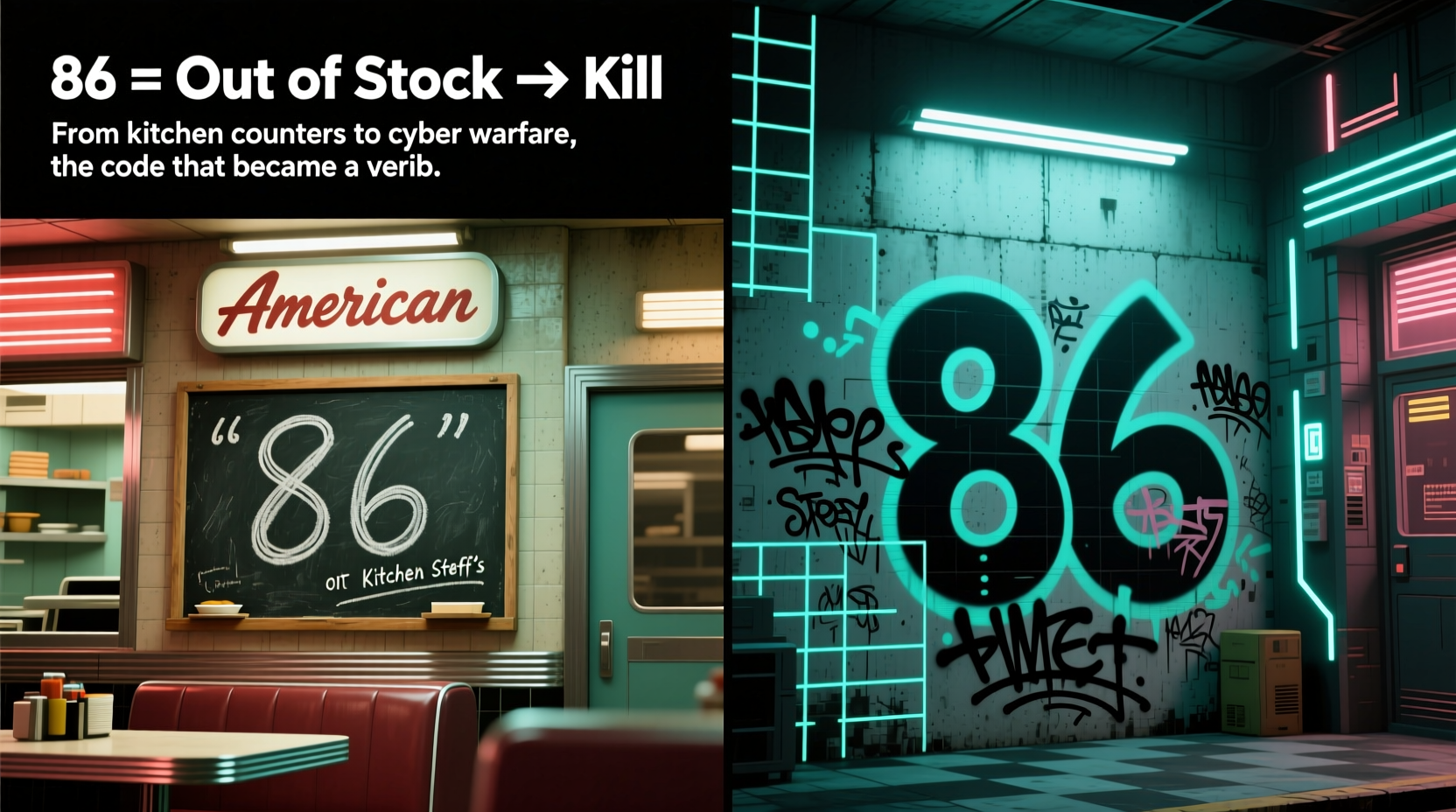
In modern usage, “86” functions as a verb meaning to refuse, eliminate, or get rid of something or someone. It appears across industries:
- Restaurants: “We’re 86’d on lobster rolls tonight.”
- Bartending: “86 that guy—he’s had too much.”
- Retail: “The product was 86’d due to poor sales.”
- Colloquial speech: “They 86’d the meeting last minute.”
While “kill” may be hyperbolic in some contexts, the underlying idea is finality: once something is 86’d, it’s gone. But the path from a number to a command of removal is far from obvious.
Historical Origins: Theories Behind the Term
No single source definitively explains the birth of “86,” but several compelling theories have emerged over decades of linguistic research and oral history. The most widely accepted explanations originate in early 20th-century American service industries, particularly speakeasies and diners during Prohibition and the post-war era.
1. Chumley’s Bar and the Speakeasy Code
One of the most famous origin stories traces “86” to Chumley’s, a legendary speakeasy in New York City’s Greenwich Village operating since 1922. According to staff lore, if police were approaching, employees would shout “86!” as a warning—the number referring to the alternate exit at 86 Bedford Street. Patrons and staff would flee through the back door before authorities arrived.
Over time, “86” evolved beyond escape. Bartenders began using it to signal that a patron was no longer welcome—either due to intoxication, belligerence, or suspicion. Saying “86 him” meant eject that person immediately.
2. Menu Item Number Theory
Another popular theory comes from diner culture. Many establishments in the 1930s and 1940s used numerical shorthand for menu items to speed up communication. “86” may have been the number assigned to steak—a high-demand item that frequently sold out.
When waitstaff informed the kitchen that an item was unavailable, they might say, “We’re 86 on the steak.” Over time, “86” detached from the specific dish and generalized into a term for any item that was “out” or “discontinued.” From there, it expanded to people: if a customer caused trouble, they could be “86’d” just like a sold-out entrée.
3. Slang for Being “Out” or “Beyond Reach”
Linguist Grant Barrett has suggested that “86” may derive from earlier slang where numbers represented conditions. For example, “100%” meant perfect, “45” referred to a record (since 45 rpm records were common), and “86” possibly meant “discarded” or “off-limits.”
This aligns with military and institutional jargon where numbers coded statuses. Being “86’d” could imply someone was no longer in the system—effectively erased or terminated.
“Language in closed environments like kitchens and bars evolves quickly. ‘86’ filled a need for a quick, unambiguous signal—and it stuck because it worked.” — Dr. Lydia Chen, Sociolinguist, Columbia University
From Diner Shorthand to Cultural Lexicon
By the 1950s, “86” had moved beyond niche use. It appeared in mainstream publications and television, often in crime dramas or workplace comedies set in restaurants. Its coded nature made it appealing: managers could issue sensitive instructions without alarming customers.
The term gained further traction in the 1970s and 1980s with the rise of cocktail culture and reality-based media. Bartenders on TV shows used “86” casually, reinforcing its association with authority and control.
Today, “86” transcends food service. It’s used in corporate settings (“We 86’d the old policy”), tech (“The feature was 86’d in the update”), and even politics (“The bill was 86’d by the committee”). Its core meaning—removal with finality—remains intact.
How \"86\" Evolved to Mean \"Kill\"
While “86” doesn’t literally mean “kill” in standard usage, the connotation exists in exaggerated or dramatic speech. Saying “I’m going to 86 this project” or “That idea needs to be 86’d” implies destruction or annihilation—not just pause or delay.
This metaphorical escalation mirrors other idioms like “nuked,” “torched,” or “wiped out.” In high-pressure environments—kitchens during dinner rush, emergency rooms, trading floors—language becomes terse and vivid. “86” fits perfectly: short, punchy, and absolute.
Moreover, in criminal or underworld slang, “86” has occasionally been interpreted more literally. Some urban legends claim hitmen used “86” as code for assassination. While no credible evidence supports this, the myth persists, feeding the term’s dark mystique.
Practical Usage Guide: When and How to Use \"86\"
Understanding “86” helps professionals communicate efficiently—especially in fast-paced environments. Here’s how to apply it correctly:
- Inventory Management: “We’re 86’d on avocado toast—update the digital menu.”
- Customer Service: “Don’t serve him another drink. He’s 86’d.”
- Project Management: “The logo redesign has been 86’d. Focus on the new copy.”
- Internal Communication: Use cautiously—some may find it overly harsh or cryptic.
| Situation | Appropriate Use of \"86\" | Alternative Phrasing |
|---|---|---|
| Item out of stock | “We’re 86’d on salmon.” | “Salmon is currently unavailable.” |
| Removing a disruptive guest | “86 the guy in the red shirt.” | “Ask that guest to leave, please.” |
| Cancelling a proposal | “The CEO 86’d the merger plan.” | “The merger plan was rejected.” |
| Informal team chat | “Let’s 86 this outdated process.” | “We should discontinue this process.” |
Mini Case Study: The Night the Margaritas Were 86’d
At “Luna Tapas,” a busy downtown restaurant, Friday nights are chaotic. During one peak service, the head bartender noticed the margarita mix had soured due to a refrigeration failure. Rather than risk customer complaints or health violations, she radioed the floor manager: “Margaritas are 86’d. No exceptions.”
Waitstaff quickly updated guests, offering complimentary sangria instead. Though some patrons were disappointed, the swift action prevented backlash. By using “86,” the team communicated urgency and finality without panic. The next day, the owner praised the decision: “You didn’t hesitate. You protected our reputation.”
This incident illustrates how “86” serves as both a practical tool and a cultural signal—one that commands immediate compliance in critical moments.
Frequently Asked Questions
Does “86” really mean “kill”?
Not literally. While “86” implies elimination or rejection, it does not mean physical harm. The association with “kill” comes from metaphorical use—e.g., “kill the idea”—and pop culture exaggeration.
Is “86” still used today?
Yes. It remains common in restaurants, bars, retail, and even tech startups. Its brevity makes it ideal for fast-paced environments where clarity and speed matter.
Are there similar coded terms in service industries?
Absolutely. Examples include “Code 3” (manager needed), “Table 42” (trouble at table), or “Adam” (police arrival). These codes help teams respond discreetly to sensitive situations.
Conclusion: The Enduring Power of a Number
The story of “86” is a testament to how language evolves in real-world pressure. Born in dimly lit bars and bustling kitchens, it filled a need for discretion, speed, and finality. From signaling a police raid to removing a problematic employee, “86” endures because it works.
It reminds us that words—even numbers—carry layers of history, context, and power. Whether you’re a server managing inventory or a leader cutting a failing initiative, understanding the weight behind “86” can sharpen your communication.




 浙公网安备
33010002000092号
浙公网安备
33010002000092号 浙B2-20120091-4
Comments
No comments yet. Why don't you start the discussion?