
Chemical equations are the language of chemistry, providing a concise way to represent what happens during a chemical reaction. But if you've ever looked at one, you may have noticed that the number of atoms on each side is always equal. This isn't by accident—it's because chemical equations must be balanced. Understanding why this is necessary is essential for anyone studying chemistry, from high school students to aspiring scientists.
At its core, balancing chemical equations is rooted in one of the most fundamental laws of nature: the law of conservation of mass. This principle dictates that matter cannot be created or destroyed in a chemical reaction. Therefore, the total mass of reactants must equal the total mass of products. Balancing equations ensures this law is upheld.
The Law of Conservation of Mass
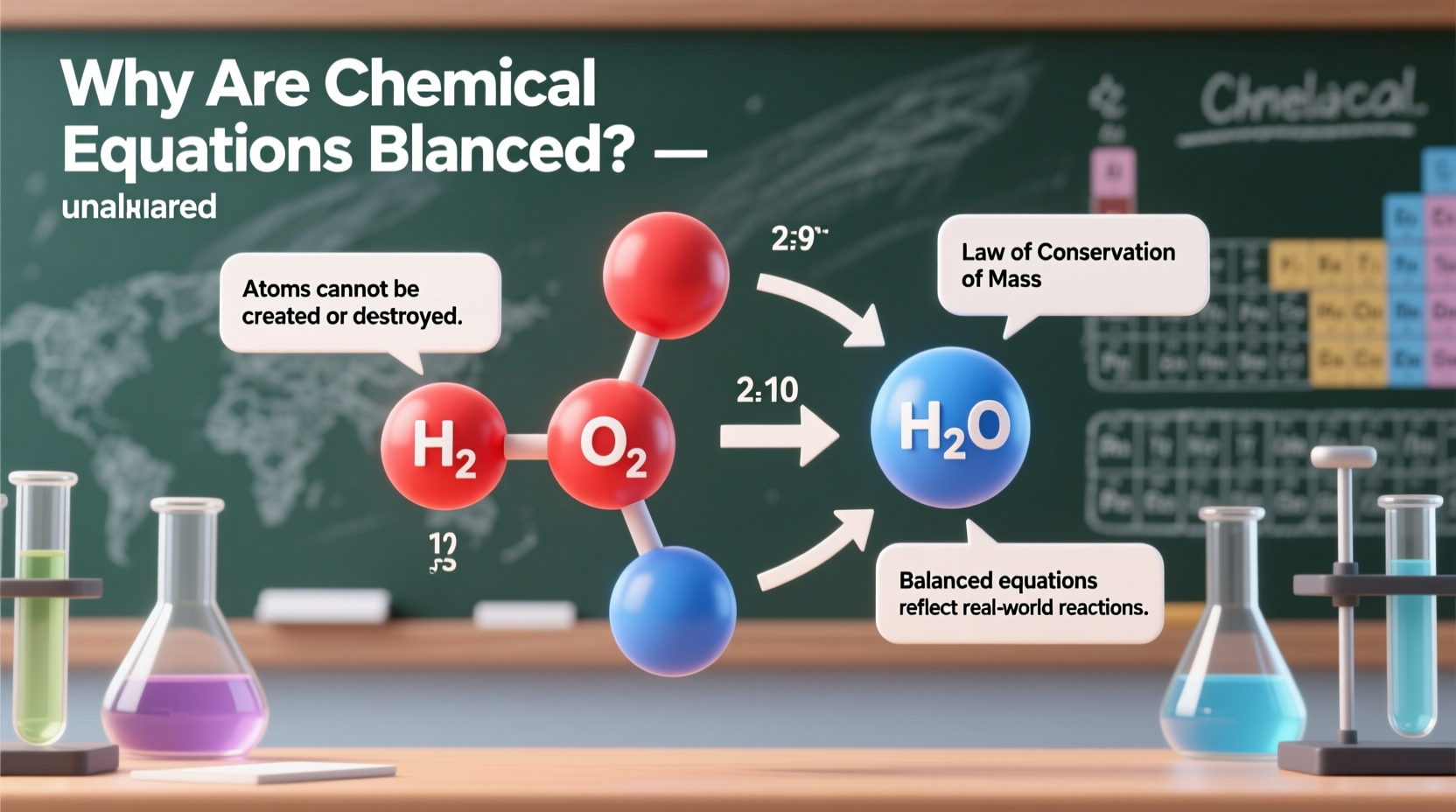
First formally articulated by Antoine Lavoisier in the late 18th century, the law of conservation of mass states that in a closed system, mass is neither gained nor lost during a chemical reaction. In practical terms, this means every atom present at the start of a reaction must still be present at the end—just rearranged into new substances.
Consider the combustion of methane:
CH₄ + O₂ → CO₂ + H₂O
At first glance, this equation appears correct. Methane burns in oxygen to produce carbon dioxide and water. However, counting the atoms reveals an imbalance:
| Molecule | Reactant Side Atoms | Product Side Atoms |
|---|---|---|
| Carbon (C) | 1 | 1 |
| Hydrogen (H) | 4 | 2 |
| Oxygen (O) | 2 | 3 |
Hydrogen and oxygen counts don’t match. The equation violates the conservation law. To fix it, we adjust coefficients—the numbers placed before molecules—to balance the atom count on both sides.
How Balancing Works: A Step-by-Step Guide
Balancing a chemical equation involves adjusting coefficients so that the number of each type of atom is identical on both sides. Here’s how to approach it systematically:
- Write the unbalanced equation. List all reactants and products using correct chemical formulas.
- Count atoms on each side. Tally the number of atoms for each element.
- Start with the most complex molecule. Begin balancing elements that appear in only one compound on each side.
- Use coefficients to balance. Never change subscripts—only modify coefficients.
- Check your work. Ensure all atoms balance and coefficients are in the lowest whole-number ratio.
Returning to the methane example:
Unbalanced: CH₄ + O₂ → CO₂ + H₂O
Balance hydrogen first. Since CH₄ has 4 H atoms and H₂O has only 2, place a coefficient of 2 in front of H₂O:
CH₄ + O₂ → CO₂ + 2H₂O
Now hydrogen balances (4 on each side), but oxygen does not. There are 2 O atoms on the left and 4 on the right (2 from CO₂ and 2 from two H₂O molecules). Place a 2 in front of O₂:
CH₄ + 2O₂ → CO₂ + 2H₂O
Now verify:
- Carbon: 1 = 1
- Hydrogen: 4 = 4
- Oxygen: 4 = 4
The equation is now balanced and obeys the law of conservation of mass.
Why Subscripts Can't Be Changed
A common mistake among beginners is altering subscripts to balance equations. For example, changing H₂O to H₄O to match hydrogen in CH₄ might seem helpful, but it creates a nonexistent compound. H₄O is not water—it’s chemically incorrect.
Subscripts define the identity of a molecule. Changing them alters the substance itself. Coefficients, on the other hand, only change the quantity, not the identity. This distinction is crucial for accurate chemical representation.
“Balancing equations isn’t just a classroom exercise—it reflects the unbreakable rules governing matter transformation.” — Dr. Alan Reyes, Physical Chemist
Real-World Example: Rust Formation
Consider the formation of rust, a common process involving iron and oxygen:
Fe + O₂ → Fe₂O₃
Left side: 1 Fe, 2 O
Right side: 2 Fe, 3 O
This is clearly unbalanced. To correct it:
- Balance iron: Place a 2 in front of Fe → 2Fe + O₂ → Fe₂O₃
- Now oxygen: Left has 2 O, right has 3 O. Find the least common multiple—6.
- Use 3 O₂ (giving 6 O) and 2 Fe₂O₃ (also 6 O): 2Fe + 3O₂ → 2Fe₂O₃? Wait—now iron is unbalanced again.
- Adjust iron: Need 4 Fe on left to match 4 Fe in 2Fe₂O₃.
Final balanced equation: 4Fe + 3O₂ → 2Fe₂O₃
All atoms balance: 4 Fe and 6 O on each side.
This real-world example shows how balancing applies beyond textbooks. Engineers monitoring corrosion, environmental scientists tracking oxidation, and metallurgists designing alloys all rely on correctly balanced equations to predict material behavior.
Common Pitfalls and How to Avoid Them
Even experienced students make errors when balancing equations. Here are frequent mistakes and how to prevent them:
| Pitfall | Why It’s Wrong | Correct Approach |
|---|---|---|
| Changing subscripts | Alters chemical identity (e.g., H₂O vs. H₂O₂) | Only use coefficients to adjust quantities |
| Forgetting diatomic elements | Elements like O₂, N₂, Cl₂ exist as pairs | Always write them as O₂, not O |
| Not simplifying coefficients | Using 4H₂ + 2O₂ → 4H₂O instead of 2H₂ + O₂ → 2H₂O | Reduce to smallest whole-number ratios |
| Ignoring polyatomic ions | Treating SO₄²⁻ as separate S and O atoms | Treat intact ions as single units when they remain unchanged |
Frequently Asked Questions
Can a chemical equation be balanced with fractions?
Yes, during intermediate steps, fractional coefficients may be used (e.g., ½O₂). However, final equations should use whole numbers. Multiply through by the denominator to eliminate fractions. For example, 2H₂ + O₂ → 2H₂O is preferred over H₂ + ½O₂ → H₂O.
Do physical states affect balancing?
No. The (s), (l), (g), or (aq) labels indicate state but do not influence atom counting. They provide context but aren’t part of the balancing process.
What if the equation seems impossible to balance?
Double-check the chemical formulas. An incorrectly written formula (e.g., writing AlO instead of Al₂O₃) will make balancing impossible. Ensure all compounds follow valence rules and naming conventions.
Conclusion: Mastering the Foundation of Chemical Literacy
Balancing chemical equations is more than a mechanical task—it’s a direct application of one of nature’s most fundamental laws. Every balanced equation confirms that atoms are merely rearranged, never lost or created. This principle underpins everything from industrial synthesis to environmental modeling.
By mastering this skill, you gain the ability to predict reaction outcomes, calculate yields, and understand energy changes. Whether you're preparing for an exam or exploring real-world chemical processes, a firm grasp of balancing ensures accuracy and deepens comprehension.




 浙公网安备
33010002000092号
浙公网安备
33010002000092号 浙B2-20120091-4
Comments
No comments yet. Why don't you start the discussion?