
Many people assume that a sit-up is a basic exercise anyone can perform. Yet, for a surprising number, even attempting one leads to strain, discomfort, or complete failure. The inability to perform a sit-up isn’t a personal shortcoming—it’s often a sign of underlying physical imbalances, lack of strength, or poor movement mechanics. Understanding the root causes is the first step toward improvement. With targeted strategies, most individuals can develop the necessary strength, stability, and coordination to execute a proper sit-up.
Why Sit-Ups Are Harder Than They Look
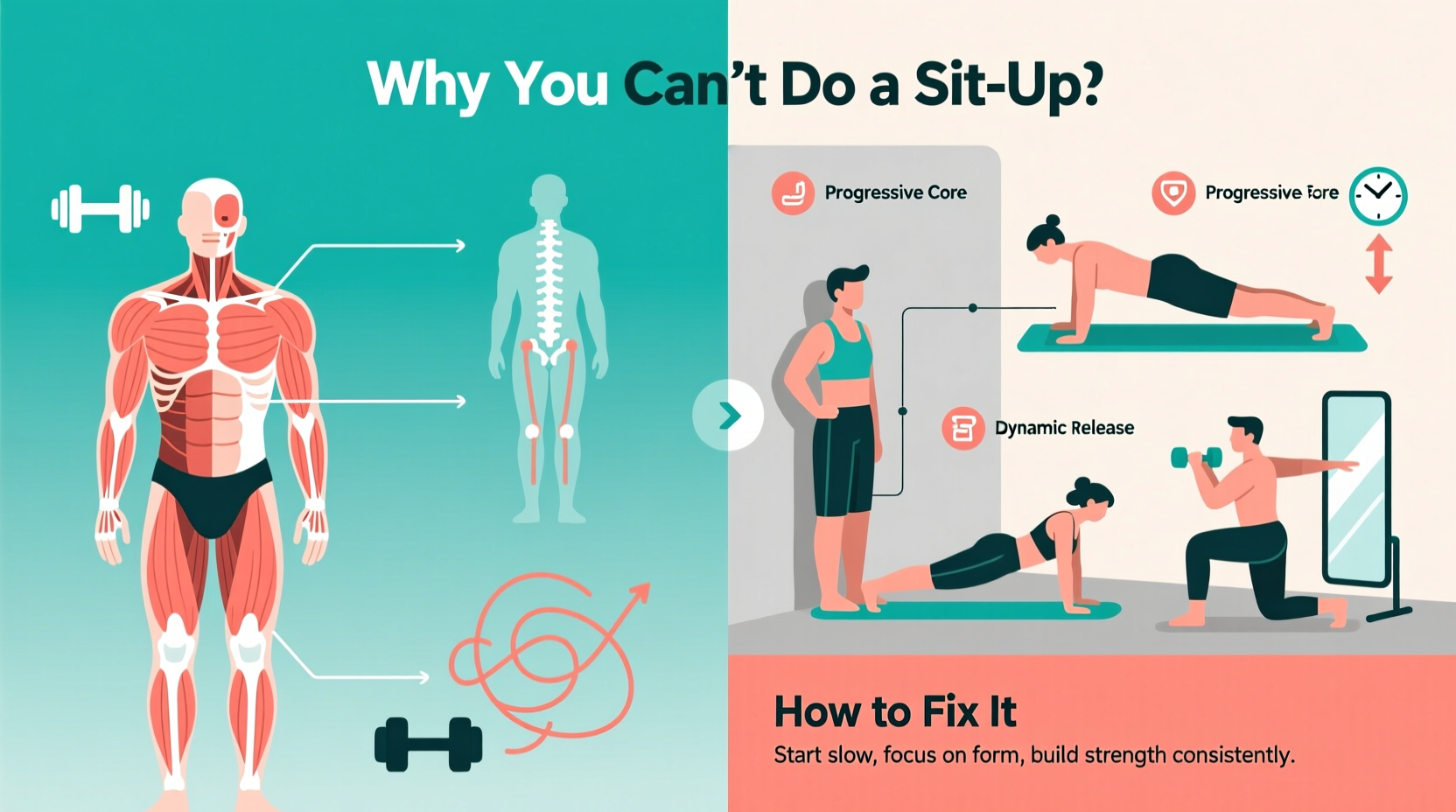
A sit-up appears simple: lie on your back, curl up, and return down. But this movement requires coordinated effort across multiple muscle groups. It demands strength in the rectus abdominis (the “six-pack” muscles), hip flexors, obliques, and deep core stabilizers like the transverse abdominis. It also relies on adequate spinal mobility, shoulder stability, and neuromuscular control.
When any of these components are underdeveloped or compromised, the body compensates—often by overusing the neck, shoulders, or hip flexors—leading to inefficient movement or injury risk. Recognizing that a sit-up is not just an abdominal exercise but a full-body movement helps explain why so many struggle with it.
Common Reasons You Can’t Do a Sit-Up
Several interrelated factors may prevent someone from completing a sit-up. These range from muscular weaknesses to structural limitations.
- Weak Core Muscles: If your abdominal muscles lack the strength to lift your torso against gravity, the movement fails before it begins.
- Tight Hip Flexors: Overactive or shortened hip flexors can pull the pelvis forward, limiting range of motion and increasing lower back strain.
- Poor Thoracic Mobility: Stiffness in the upper back restricts the ability to curl forward smoothly, forcing the neck and shoulders to compensate.
- Excess Body Weight: Carrying extra weight, especially around the midsection, increases the load the core must lift, making the movement significantly harder.
- Lack of Mind-Muscle Connection: Some individuals can’t properly engage their abs due to poor neuromuscular control, leading to ineffective contractions.
- Previous Injuries or Chronic Pain: Lower back issues, hernias, or post-surgical conditions may make traditional sit-ups painful or contraindicated.
“Sit-ups aren’t inherently bad, but they’re often performed incorrectly or attempted too early in a fitness journey. Building foundational core control should come first.” — Dr. Lena Torres, Physical Therapist and Movement Specialist
Step-by-Step Guide to Build Sit-Up Ability
Improving your ability to perform a sit-up is a progressive process. Rushing into full repetitions without preparation increases injury risk and reinforces poor habits. Follow this timeline to build strength safely.
- Week 1–2: Master the Hollow Hold
Lie on your back, press your lower back into the floor, and lift your shoulders and legs slightly off the ground. Hold for 15–20 seconds. This teaches core engagement without spinal flexion. - Week 3–4: Practice Curl-Ups (Partial Sit-Ups)
Place hands behind your head, keep feet flat, and lift only your shoulder blades off the floor. Perform 2 sets of 8–10 reps with slow tempo. - Week 5–6: Add Resistance with Band-Assisted Sit-Ups
Loop a resistance band over a stable object and hold the ends while performing sit-ups. The band reduces load and guides proper path of motion. - Week 7–8: Progress to Full Sit-Ups with Feet Unanchored
Once you can perform 3 sets of 12 assisted sit-ups with good form, try unanchoring your feet and perform full sit-ups slowly, focusing on using abs, not momentum.
Do’s and Don’ts When Training for Sit-Ups
| Do’s | Don’ts |
|---|---|
| Engage your core before initiating movement | Yank your neck forward with your hands |
| Breathe out as you rise, in as you lower | Hold your breath during the movement |
| Keep chin slightly tucked to protect the neck | Perform rapid, jerky motions to \"cheat\" reps |
| Start with modified versions like curl-ups | Attempt full sit-ups with poor form |
| Stretch hip flexors and thoracic spine daily | Ignore pain or discomfort in the lower back |
Mini Case Study: From Zero to First Sit-Up
Mark, a 38-year-old office worker, couldn’t perform a single sit-up despite trying for years. Each attempt resulted in neck strain and no visible progress. After consulting a trainer, he learned his hip flexors were extremely tight from prolonged sitting, and his core activation was minimal.
His program began with daily foam rolling of the hip flexors, twice-weekly hollow holds, and breathing drills to improve diaphragmatic control. By week six, he progressed to curl-ups and used a resistance band for assistance. At week ten, Mark completed his first full sit-up with proper form—no neck strain, no momentum. Within three months, he could perform 15 clean sit-ups in a row.
Mark’s success wasn’t about brute effort—it was about addressing the root causes and progressing intelligently.
Alternative Exercises to Build Core Strength
If traditional sit-ups remain inaccessible, several alternatives build the same foundational strength more safely.
- Dead Bugs: Enhances core stability while protecting the lower back.
- Plank Variations: Builds endurance in the entire anterior core.
- Leg Raises (Bent Knees): Targets lower abs without excessive hip flexor dominance.
- Seated Marches: Teaches pelvic control and core engagement in a supported position.
- Ab Rollouts (with Hands on Knees): A beginner-friendly version of a challenging movement.
Checklist: Can You Perform a Sit-Up?
Before attempting a full sit-up, ensure you meet these criteria:
- ✅ Can hold a 20-second hollow hold with proper form
- ✅ Can perform 10 controlled curl-ups without neck strain
- ✅ Have no pain in the lower back or abdomen during core work
- ✅ Can activate your abs independently (try drawing belly button toward spine)
- ✅ Have stretched hip flexors daily for at least two weeks
Frequently Asked Questions
Is it normal to not be able to do a sit-up?
Yes, it’s very common. Many healthy adults cannot perform a sit-up due to weak core muscles, tight hips, or poor technique. It doesn’t indicate poor fitness overall—just a specific gap in strength or mobility.
Are sit-ups bad for your back?
When done incorrectly, yes. Traditional sit-ups can place high compressive forces on the lumbar spine, especially if the hip flexors dominate. For those with back issues, safer alternatives like planks or dead bugs are recommended.
How long does it take to do your first sit-up?
With consistent training (3–4 times per week), most people achieve their first proper sit-up within 6–10 weeks. Progress depends on starting fitness level, body composition, and adherence to proper form.
Conclusion: Start Where You Are, Not Where You Think You Should Be
The inability to do a sit-up is not a failure—it’s feedback. Your body is signaling where strength, mobility, or control is lacking. With patience and intelligent progression, nearly anyone can develop the capacity to perform a safe, effective sit-up. Focus on building foundational core stability, correcting imbalances, and moving with intention rather than speed.




 浙公网安备
33010002000092号
浙公网安备
33010002000092号 浙B2-20120091-4
Comments
No comments yet. Why don't you start the discussion?