
In early 2025, the Associated Press (AP) filed a federal lawsuit against Karoline Leavitt, then serving as White House Press Secretary under President Donald Trump’s second administration. The suit centered on Leavitt’s decision to revoke AP’s standing press credentials without explanation, effectively barring its reporters from official briefings, events, and direct access to senior officials. This unprecedented move sparked a constitutional debate about press freedom, transparency, and the executive branch’s power to exclude media organizations. At stake was not just one outlet’s access—but the precedent it could set for how future administrations manage their relationship with the press.
The Background: A Sudden Revocation of Credentials
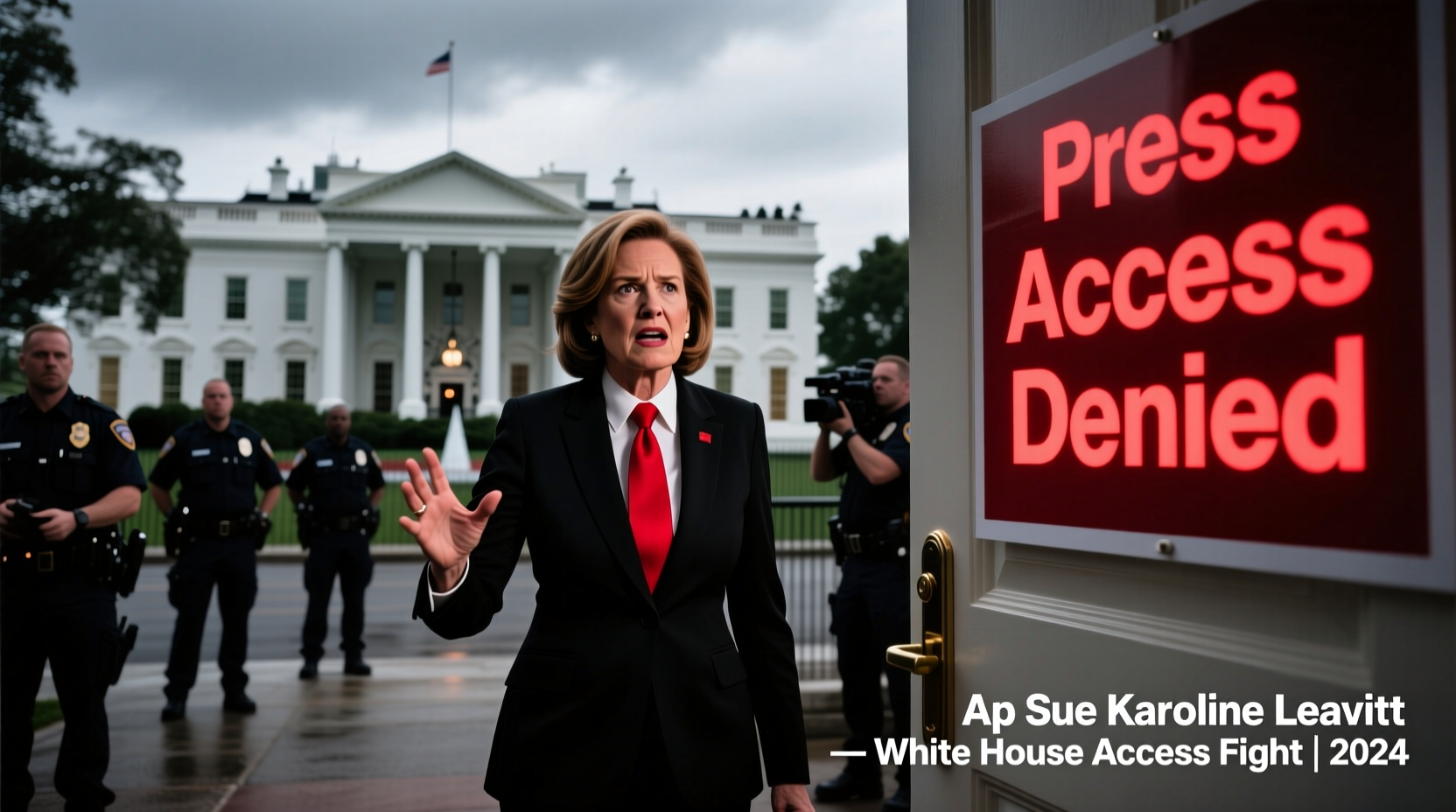
The conflict began in January 2025, shortly after Leavitt assumed her role as White House Press Secretary. Known for her combative style and loyalty to Trump’s communications strategy, Leavitt quickly restructured media operations, tightening access and favoring outlets perceived as favorable to the administration. On January 17, AP received formal notice that its hard pass—granting daily entry to the West Wing and briefing rooms—had been suspended indefinitely. No reason was given, and internal appeals through the White House Correspondents’ Association (WHCA) were ignored.
This action followed a pattern seen during Trump’s first term, where outlets like CNN and the New York Times faced verbal attacks and occasional access restrictions. But this marked the first time a major wire service had its credentials fully revoked—a move critics called “a direct assault on institutional journalism.”
“Denying a news organization access without cause undermines the public’s right to know. The White House is not a private residence—it’s a seat of government funded by taxpayers.” — Margaret Sullivan, Media Columnist, The Washington Post
Legal Grounds: Why the AP Took the Case to Court
The AP did not respond with opinion pieces or social media rebuttals. Instead, it filed a lawsuit in the U.S. District Court for the District of Columbia, arguing that the revocation violated both the First Amendment and the Due Process Clause of the Fifth Amendment. Their case rested on three core legal principles:
- First Amendment Right of Access: While there is no absolute constitutional right to White House press credentials, courts have consistently ruled that once a system of access is established, the government cannot exclude journalists arbitrarily or in retaliation for critical coverage.
- Due Process Violation: The AP was denied any opportunity to appeal, question the basis of exclusion, or present evidence in its defense—fundamental elements of procedural fairness.
- Precedent from Past Cases: The lawsuit cited *Sherrill v. Knight* (1977), in which the D.C. Circuit ruled that denying a journalist's credentials requires a “clear and compelling” justification, especially when done without process.
The AP argued that Leavitt’s actions were retaliatory, pointing to a series of investigative reports published in late 2024 that exposed financial discrepancies in Trump’s Mar-a-Lago operations and questioned the legitimacy of certain executive orders. These stories drew sharp criticism from Trump at rallies, with Leavitt echoing the sentiment in off-camera remarks captured by other journalists.
The Broader Implications: Press Freedom in a Polarized Era
The lawsuit transcended the fate of one news agency. It became a flashpoint in the ongoing struggle between an increasingly assertive executive branch and a press corps striving to maintain independence. Critics warned that allowing the White House to unilaterally block media organizations would open the door to censorship by omission.
A table summarizing recent White House-media conflicts illustrates the escalation:
| Administration | Incident | Outcome |
|---|---|---|
| Trump (2017–2021) | Revoked Jim Acosta’s (CNN) pass after heated exchange | Court ordered restoration; judge cited due process |
| Biden (2021–2024) | Limited pool reporting during pandemic | Restored access after WHCA negotiations |
| Trump (2025) | Revoked AP’s credentials without cause | Under litigation; potential landmark ruling expected |
The difference this time? Scale and strategy. Unlike the Acosta incident—which focused on an individual reporter—the AP case involved an entire institution responsible for supplying news to thousands of outlets globally. Removing AP from the White House press pool doesn’t just silence one voice; it distorts the information ecosystem.
Mini Case Study: How One Exclusion Affects National Coverage
In the week following the credential suspension, AP reporters were forced to rely on pooled video and secondhand summaries from other outlets during presidential announcements. During a critical infrastructure rollout event, AP missed a spontaneous Q&A session where Trump clarified a controversial policy change. Because no AP journalist was present to ask follow-ups, the clarification went unchallenged and was later misreported by regional affiliates.
Within days, fact-checkers identified inconsistencies in over 20 local news articles citing the AP feed. Editors traced the error back to the lack of real-time access. “We weren’t in the room,” said Maria Hernandez, AP’s national political editor. “And when we’re not in the room, misinformation spreads faster than facts.”
Expert Perspectives: What Legal and Media Scholars Say
Constitutional law experts agree that while the president has discretion over logistics, he does not have unchecked authority to punish critical press.
“The First Amendment doesn’t guarantee every reporter a front-row seat, but it does prohibit viewpoint-based discrimination. That’s what this case hinges on.” — David Lat, Constitutional Law Analyst and Editor-in-Chief, Lowering the Bar
Media scholars also point to international comparisons. In democracies like Germany and Canada, press access is governed by independent accreditation boards—not political appointees. The U.S., uniquely among developed nations, allows the executive branch to control access directly, creating inherent conflict.
Still, some defenders of the administration argue that the White House has a right to manage its messaging environment. “Not every outlet deserves equal access if they operate in bad faith,” wrote conservative commentator Ben Shapiro in a March 2025 column. But even Shapiro acknowledged that “due process must be followed”—a standard the AP lawsuit claims was ignored.
Step-by-Step: How News Organizations Can Protect Access Rights
For media institutions operating in an era of increasing governmental pushback, proactive measures are essential. Here’s a practical timeline for safeguarding press access:
- Document All Interactions: Keep records of credential applications, renewals, and communications with the WHCA and White House Communications Office.
- Establish Legal Partnerships: Work with media advocacy groups like the Reporters Committee for Freedom of the Press (RCFP) to pre-draft legal responses.
- Engage in Collective Action: Coordinate with other outlets through the WHCA to resist unilateral decisions.
- File Promptly: If access is denied without cause, initiate legal action within 72 hours to preserve urgency and public attention.
- Mobilize Public Support: Issue public statements explaining the stakes—not just for the outlet, but for democratic accountability.
Checklist: Ensuring Fair Press Access
- ✅ Verify that your organization’s credentials are up to date
- ✅ Maintain active membership in the White House Correspondents’ Association
- ✅ Train reporters on protest protocols if access is blocked
- ✅ Designate a legal liaison for media rights issues
- ✅ Monitor peer organizations for coordinated access challenges
FAQ
Can the White House legally deny a news outlet access?
The White House can regulate logistics and security, but cannot exclude journalists based on content, viewpoint, or retaliation for critical reporting. Courts have repeatedly struck down arbitrary denials as unconstitutional.
Has the AP won similar cases before?
Yes. In 2018, the AP successfully challenged the Department of Homeland Security over restricted access to immigration court proceedings, setting a precedent for transparency in government operations.
What happens if the AP loses the lawsuit?
A loss could embolden future administrations to selectively exclude media, weakening press independence. However, appellate courts may still intervene, and public backlash often influences policy reversals regardless of legal outcome.
Conclusion: Defending the Fourth Estate
The lawsuit against Karoline Leavitt is more than a dispute over a press badge. It is a test of whether the American press can operate free from political retribution. The Associated Press did not sue for publicity or prestige—it acted to uphold a principle: that a functioning democracy requires unimpeded access to truth.
As administrations come and go, the mechanisms of accountability must remain intact. Journalists, editors, and citizens alike must remain vigilant. The fight for access isn’t just about who gets to stand in the briefing room—it’s about who gets to hold power to account.




 浙公网安备
33010002000092号
浙公网安备
33010002000092号 浙B2-20120091-4
Comments
No comments yet. Why don't you start the discussion?