
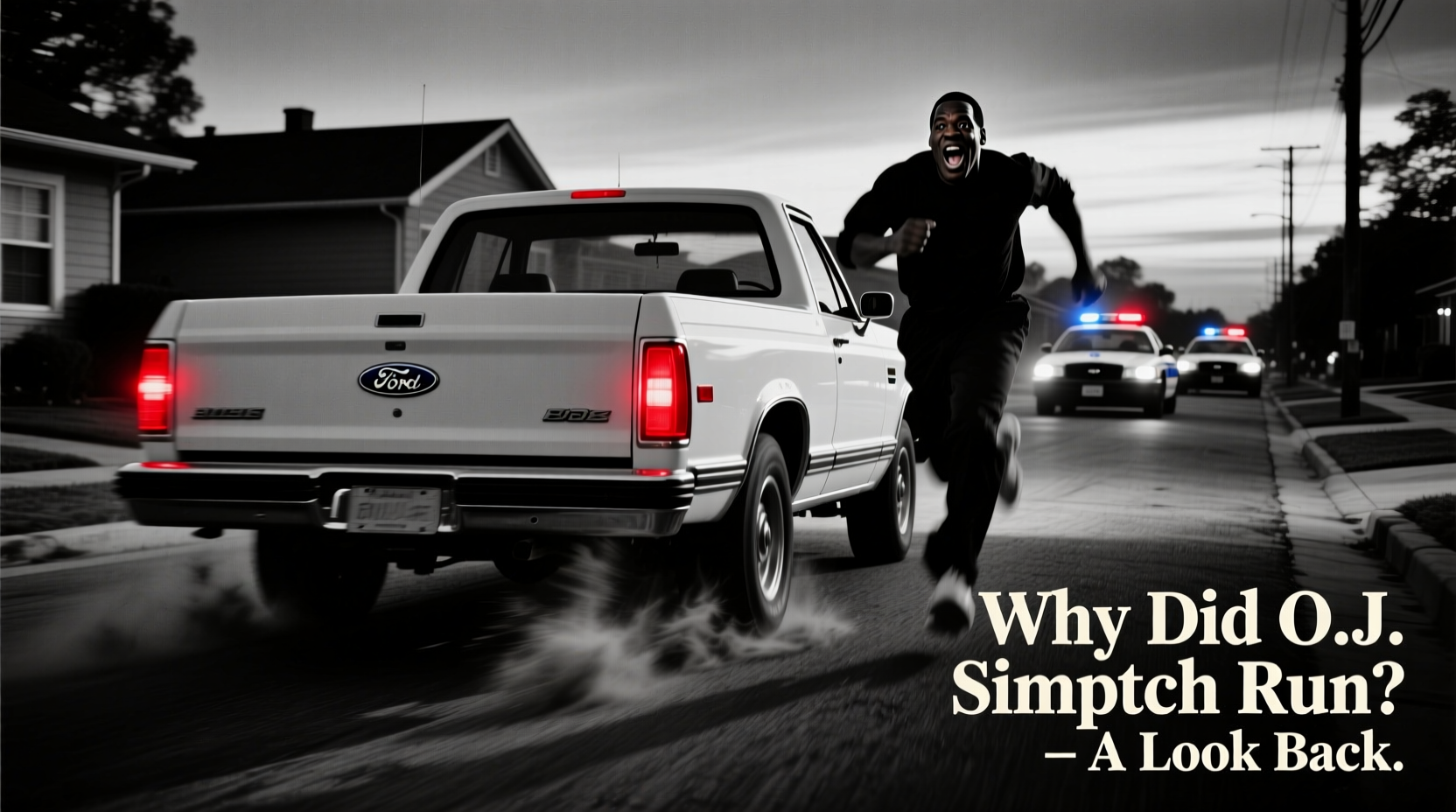
On June 17, 1994, one of the most surreal moments in American television history unfolded live across the nation. Millions watched as a white Ford Bronco, driven slowly down Los Angeles freeways by Al Cowlings with O.J. Simpson in the passenger seat, was followed by a fleet of police cars. There were no sirens. No aggressive maneuvers. Just a slow, tense procession broadcast to a stunned public. The question on everyone’s mind: Why did O.J. Simpson run?
This wasn’t just a man evading arrest—it was a spectacle that merged celebrity, race, justice, and media into a single, unforgettable event. To understand why Simpson fled, it’s essential to examine the circumstances leading up to the chase, the psychological state of the accused, and the broader social tensions of the era.
The Night Before: Murders and Immediate Aftermath
Just two days before the Bronco chase, Nicole Brown Simpson and Ronald Goldman were found brutally murdered outside Nicole’s home in Brentwood, Los Angeles. Both had been stabbed multiple times. The crime scene was gruesome, and evidence quickly pointed toward O.J. Simpson, Nicole’s ex-husband.
Simpson was scheduled to turn himself in on the morning of June 17. His legal team had negotiated a surrender plan with prosecutors. But when officers arrived at his Rockingham estate, Simpson was gone. Instead, they found a handwritten note—later referred to as a “suicide letter”—that expressed love for his children and friends, apologized for any pain he caused, and denied involvement in the murders.
The letter read, in part: “To whom this may concern… I’ve had a great life, great friends. Please remember me in peace and love, not as an accomplice to all this.” This ambiguous message sparked immediate fear that Simpson intended to take his own life.
Possible Motivations Behind the Flight
Several theories have emerged over the years about why Simpson chose to flee rather than surrender. While only Simpson knows the full truth, law enforcement experts, psychologists, and journalists have analyzed the likely factors.
- Fear of Conviction: Despite his fame, Simpson may have realized the strength of the prosecution’s case. Blood evidence, timeline inconsistencies, and prior domestic violence allegations created a compelling narrative.
- Desire to Avoid Public Humiliation: As a beloved sports icon and actor, Simpson had spent decades in the spotlight. Surrendering in handcuffs would mark a dramatic fall from grace.
- Mental State and Emotional Turmoil: Friends reported that Simpson was distraught after hearing of Nicole’s death. Grief, guilt, or panic could have impaired his judgment.
- Belief in a Flawed Justice System: Some analysts suggest Simpson doubted he’d receive a fair trial due to racial dynamics in policing and the judiciary—a sentiment echoed by many in the Black community at the time.
“O.J. didn’t run because he was guilty—he ran because he was afraid. And fear doesn’t always distinguish between innocence and guilt.” — Roger Friedman, former legal analyst for Fox News
A Nation Watches: The Bronco Chase Timeline
The pursuit lasted nearly two hours and became a national event. Here is a step-by-step breakdown of key moments:
- 1:30 PM: LAPD confirms O.J. Simpson is missing; suicide letter found.
- 2:00 PM: Al Cowlings informs police he is with Simpson and will not let him harm himself.
- 3:15 PM: The white Bronco is spotted on Interstate 405, heading north toward downtown LA.
- 3:20 PM: Live TV coverage begins. Networks interrupt regular programming.
- 3:45 PM: Police escort forms around the Bronco. No attempt is made to stop it, fearing a high-speed crash with Simpson inside.
- 5:00 PM: The Bronco exits the freeway and returns to Simpson’s estate.
- 5:17 PM: Simpson exits the vehicle and surrenders peacefully.
The calm nature of the chase puzzled many. Police later explained that using force risked turning the moment into a tragedy—especially if Simpson was already suicidal. Instead, they opted for containment and communication.
Race, Media, and Public Perception
The Bronco chase occurred during a period of intense scrutiny of the LAPD following the Rodney King beating and the 1992 Los Angeles riots. For many African Americans, Simpson was not just a celebrity—he was a symbol of Black success in a system historically biased against people of color.
As journalist Juan Williams noted, “For white America, O.J. was a murderer on the run. For much of Black America, he was a man being hunted by a racist police force.” This duality shaped how the event was interpreted across different communities.
Media coverage amplified the drama. An estimated 95 million people watched the chase live—more than the audience for the Super Bowl that year. The spectacle blurred the lines between news and entertainment, foreshadowing today’s 24-hour cable news culture.
| Aspect | Public Reaction (White Majority) | Public Reaction (Black Community) |
|---|---|---|
| O.J.’s Flight | Seen as guilt-driven evasion | Viewed as self-preservation amid systemic bias |
| Police Response | Criticized as too passive | Praised for avoiding escalation |
| Media Coverage | Treated as breaking news spectacle | Seen as exploitative and racially charged |
Mini Case Study: The Impact on Celebrity Justice
The Simpson saga changed how the public views celebrity trials. Before 1994, few criminal cases received continuous live coverage. Afterward, trials like those of Phil Spector, Casey Anthony, and Jodi Arias were treated as must-watch events.
Consider the 2013 trial of George Zimmerman. Like Simpson, Zimmerman became a polarizing figure, with media dissecting every detail. The difference? By then, the template had been set: high-profile defendant, racial tension, national debate, and non-stop coverage.
The Bronco chase wasn’t just about one man’s actions—it established a new norm where justice, fame, and television converged.
FAQ
Was O.J. Simpson armed during the chase?
Yes. He was reportedly holding a loaded handgun during the drive. Al Cowlings later confirmed he kept constant watch to prevent Simpson from harming himself.
Did the police try to stop the Bronco?
No. Authorities decided against aggressive tactics out of concern for public safety and Simpson’s mental state. They maintained visual contact and escorted the vehicle until it reached Rockingham.
What happened immediately after Simpson surrendered?
He was taken into custody, booked, and formally charged with the murders of Nicole Brown Simpson and Ronald Goldman. The criminal trial began months later and ended in acquittal in October 1995.
Conclusion: A Moment That Changed America
Why did O.J. Simpson run from the police? The answer lies at the intersection of personal fear, public identity, and societal fracture. Whether motivated by guilt, desperation, or distrust in the system, his decision to flee turned a private crisis into a national obsession.
The Bronco chase was more than a manhunt—it was a mirror held up to America, reflecting deep divides in race, justice, and media influence. Over 25 years later, it remains a pivotal moment in cultural history, reminding us how quickly a single act can unravel into a defining chapter of national consciousness.




 浙公网安备
33010002000092号
浙公网安备
33010002000092号 浙B2-20120091-4
Comments
No comments yet. Why don't you start the discussion?