
Cats have a reputation for being unpredictable—especially when they bat a water glass off the edge of a table with one swift paw. While this behavior can be frustrating, even alarming, it’s rarely malicious. Instead, it stems from deeply rooted instincts, natural curiosity, and sensory exploration. Understanding why cats engage in this seemingly destructive act provides insight into their complex psychology and helps owners respond with empathy rather than frustration.
In homes across the world, cat owners witness this behavior regularly: a careful scan of the surroundings, a focused stare, then—swipe. The object tumbles to the floor. Whether it's a pen, a phone charger, or a carefully placed decorative bowl, nothing seems safe. But far from random mischief, this action is a window into your cat’s evolutionary past and cognitive development.
The Evolutionary Roots of Object-Knocking Behavior
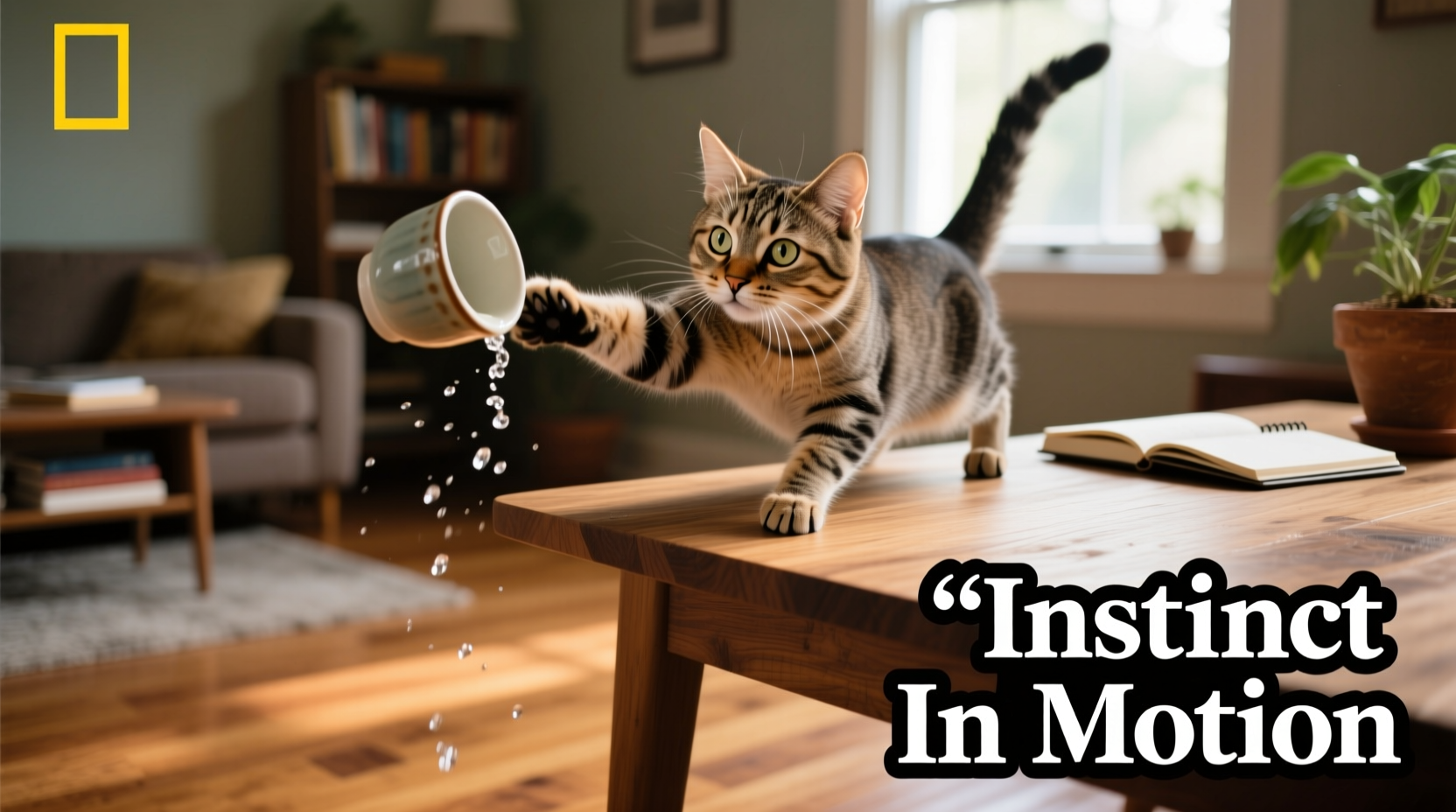
Cats are predators by nature. Even domesticated cats retain the instincts of their wild ancestors, who relied on stealth, precision, and environmental awareness to survive. In the wild, movement often signals prey. A rustling leaf, a shifting shadow, or an object that wobbles slightly triggers a predatory response. When a household item sits precariously on a table, its potential for motion makes it intriguing.
By tapping or swiping at an object, a cat tests whether it will move—simulating the way they might investigate a potential meal in the wild. If the object falls and makes noise, it further reinforces the behavior through cause-and-effect learning. The sound mimics the scurrying of small animals, satisfying the cat’s hunting drive even in a predator-free environment.
“Cats don’t knock things over to annoy people—they’re engaging in a form of problem-solving shaped by thousands of years of evolution.” — Dr. Sarah Thompson, Feline Behavioral Scientist
This instinctual testing mechanism isn’t limited to hunting. It also plays a role in spatial awareness. Cats use touch and motion to map their surroundings. By interacting with objects, they gain information about texture, weight, balance, and stability—all critical skills for navigating tight spaces and judging jumps in the wild.
Cognitive Development and Environmental Enrichment
Kittens begin exploring their world early, using their paws as primary tools for interaction. Unlike humans, who rely heavily on hands and vision, cats use tactile feedback from their sensitive paws to gather data. This “paw-first” approach means they often reach out to touch unfamiliar items before retreating or investigating further.
Knocking things over becomes part of their learning process. Each interaction teaches them about physics—gravity, momentum, friction. These experiences contribute to neural development and coordination. A kitten that repeatedly bats a bottle cap across the floor isn’t misbehaving; it’s practicing motor skills essential for survival.
However, adult cats continue this behavior not just out of habit but because many indoor environments lack sufficient mental stimulation. Without adequate enrichment—such as climbing structures, puzzle feeders, or interactive toys—cats may resort to self-created entertainment. Knocking objects off surfaces provides novelty, auditory feedback, and a sense of control over their environment.
Social Communication and Attention-Seeking
While instinct and curiosity are primary drivers, social factors also play a role. Cats are observant creatures. If a cat notices that knocking something over results in a reaction—someone rushing into the room, raising their voice, or picking up the object—it learns that the behavior has consequences.
In some cases, this becomes a deliberate strategy for gaining attention. Even negative reactions reinforce the action in the cat’s mind. From the feline perspective, “If I knock this mug down and my human responds, then doing it again will bring more interaction.”
This dynamic is especially common in households where owners are busy or spend long hours away. The cat may not distinguish between positive and negative attention—any response is better than none. Over time, object-knocking evolves into a communication tool, particularly if alternative forms of engagement are limited.
Recognizing the Signs of Attention-Driven Behavior
- Your cat watches you closely before swiping.
- The behavior occurs primarily when you're nearby or distracted (e.g., working on a laptop).
- It repeats the action shortly after being corrected.
- No interest is shown in playing with the fallen object afterward.
Environmental Triggers and Sensory Stimulation
Not all objects are equally tempting. Cats are drawn to certain characteristics that make items irresistible targets:
- Movement: Objects that dangle, sway, or reflect light (like wind chimes or shiny ornaments) mimic prey-like motion.
- Sound: Items that make noise when touched—bells, keys, ceramic bowls—provide auditory feedback that satisfies curiosity.
- Texture: Smooth, cold surfaces like glass or metal contrast with fur and skin, making them novel to touch.
- Elevation: High surfaces are both attractive and challenging, appealing to a cat’s love of vantage points.
A cluttered table offers multiple stimuli at once—a perfect playground for a curious cat. The combination of visual variety, accessible edges, and dangling cords creates an ideal scenario for swatting experiments.
| Object Type | Why Cats Are Drawn to It | How to Reduce Appeal |
|---|---|---|
| Glass or ceramic cups | Reflective surface, cold texture, produces loud crash | Use opaque mugs; store out of reach |
| Pens and pencils | Roll easily, mimic rodent movement | Keep in closed containers |
| Phone chargers/cords | Dangle and twitch like prey | Cord organizers or cord covers |
| Remote controls | Smooth buttons, occasional beeps | Store in drawers or designated bins |
| Decorative figurines | Unstable balance, interesting shapes | Display on secure shelves or behind barriers |
Mini Case Study: Luna and the Midnight Mug Incident
Luna, a 3-year-old Siamese mix, lived with her owner Maria in a small apartment. Every few nights, Maria would wake to the sound of breaking ceramic. A mug had been knocked off the nightstand—again. Initially, Maria assumed Luna was acting out of spite. She tried scolding, then covering the table with aluminum foil, which only made Luna avoid the area altogether.
After consulting a feline behaviorist, Maria realized Luna wasn’t being destructive—she was bored. Her nighttime activity peaked during Maria’s sleep hours, when stimulation was lowest. The mugs were tall, smooth, and close to the edge, making them easy targets. More importantly, the crash woke Maria, guaranteeing interaction.
The solution involved three steps: removing breakable items from elevated surfaces, installing a cat tree near the bed with dangling toys, and introducing a timed treat dispenser that activated at night. Within two weeks, the midnight crashes stopped. Luna redirected her energy toward the toy tree, and Maria regained peace—and intact mugs.
How to Manage and Redirect the Behavior
Eliminating object-knocking entirely may not be realistic or necessary. Instead, focus on managing risks and redirecting the instinct into appropriate outlets. Here’s a step-by-step guide:
- Assess Your Environment: Walk through each room from a cat’s eye level. Identify tempting objects on edges, shelves, or desks.
- Secure Valuables: Move fragile or dangerous items (electronics, medications, sharp objects) out of reach or behind closed doors.
- Create Alternative Outlets: Set up a dedicated “knock zone” with safe, noisy toys—lightweight plastic balls, rattan balls, or empty boxes on a low table.
- Incorporate Puzzle Play: Use treat-dispensing toys that require batting or paw manipulation, satisfying the same motor patterns without collateral damage.
- Engage Daily: Spend 10–15 minutes twice a day in interactive play using wand toys to simulate hunting sequences.
- Avoid Reinforcement: Do not react strongly when objects are knocked over. Calmly clean up without eye contact or verbal response to avoid rewarding attention-seeking behavior.
- Use Deterrents Strategically: Double-sided tape, plastic mats with nubs, or motion-activated air sprays can discourage access to specific zones without harming the cat.
Checklist: Cat-Friendly Surface Management
- ✅ Remove breakables from ledges and tables
- ✅ Anchor loose cords with clips or tubing
- ✅ Provide stable climbing structures nearby
- ✅ Introduce rotating toys every 7–10 days
- ✅ Designate a \"safe knock\" area with durable, noise-making items
- ✅ Increase daily play sessions to satisfy predatory needs
- ✅ Use shelf risers or barriers to protect display areas
Frequently Asked Questions
Is it normal for cats to knock things over?
Yes, it’s extremely common and considered normal behavior, especially among curious or high-energy cats. As long as no harm comes to the cat or household members, it’s typically not a cause for concern.
Should I punish my cat for knocking things down?
No. Punishment can damage trust and increase anxiety. Cats don’t connect delayed punishment with their actions. Instead, focus on environmental management and positive reinforcement for desired behaviors.
Could this behavior indicate a health issue?
Rarely. However, sudden changes in behavior—such as increased compulsive swatting or disorientation while walking—should be evaluated by a veterinarian. Neurological conditions or vision loss could contribute to accidental knocks.
Conclusion: Embracing Feline Instincts with Practical Solutions
Cats knock things off tables not out of defiance, but because they are intelligent, instinct-driven animals navigating a world not designed for their natural behaviors. Their actions reflect curiosity, predatory heritage, and a desire to interact with their surroundings. Rather than viewing this behavior as a flaw, it’s more productive to see it as an opportunity—to enrich their environment, deepen understanding, and build a more harmonious home.
With thoughtful adjustments, owners can preserve their belongings while honoring their cat’s need for exploration and stimulation. The goal isn’t to suppress feline nature, but to guide it toward safer, more constructive expressions. When we meet our cats where they are—instincts and all—we foster relationships built on respect, patience, and mutual well-being.




 浙公网安备
33010002000092号
浙公网安备
33010002000092号 浙B2-20120091-4
Comments
No comments yet. Why don't you start the discussion?