
It’s a familiar holiday scene: a shimmering strand of tinsel catches the light, and before you can blink, your cat is pouncing, batting, chewing—and possibly swallowing—what looks like harmless festive decoration. Their reactions range from intense fixation and playful stalking to sudden, almost frantic chasing or even vocalizing at the dangling strands. While endearing in the moment, these behaviors signal something deeper—and far more perilous—than simple curiosity. Tinsel isn’t just “cat toy–adjacent.” It’s a leading cause of feline gastrointestinal emergencies during December. Understanding *why* cats react so strongly—and what that reaction reveals about their biology, perception, and vulnerability—is the first step toward meaningful prevention.
The Science Behind the Sparkle: Why Tinsel Triggers Instinct
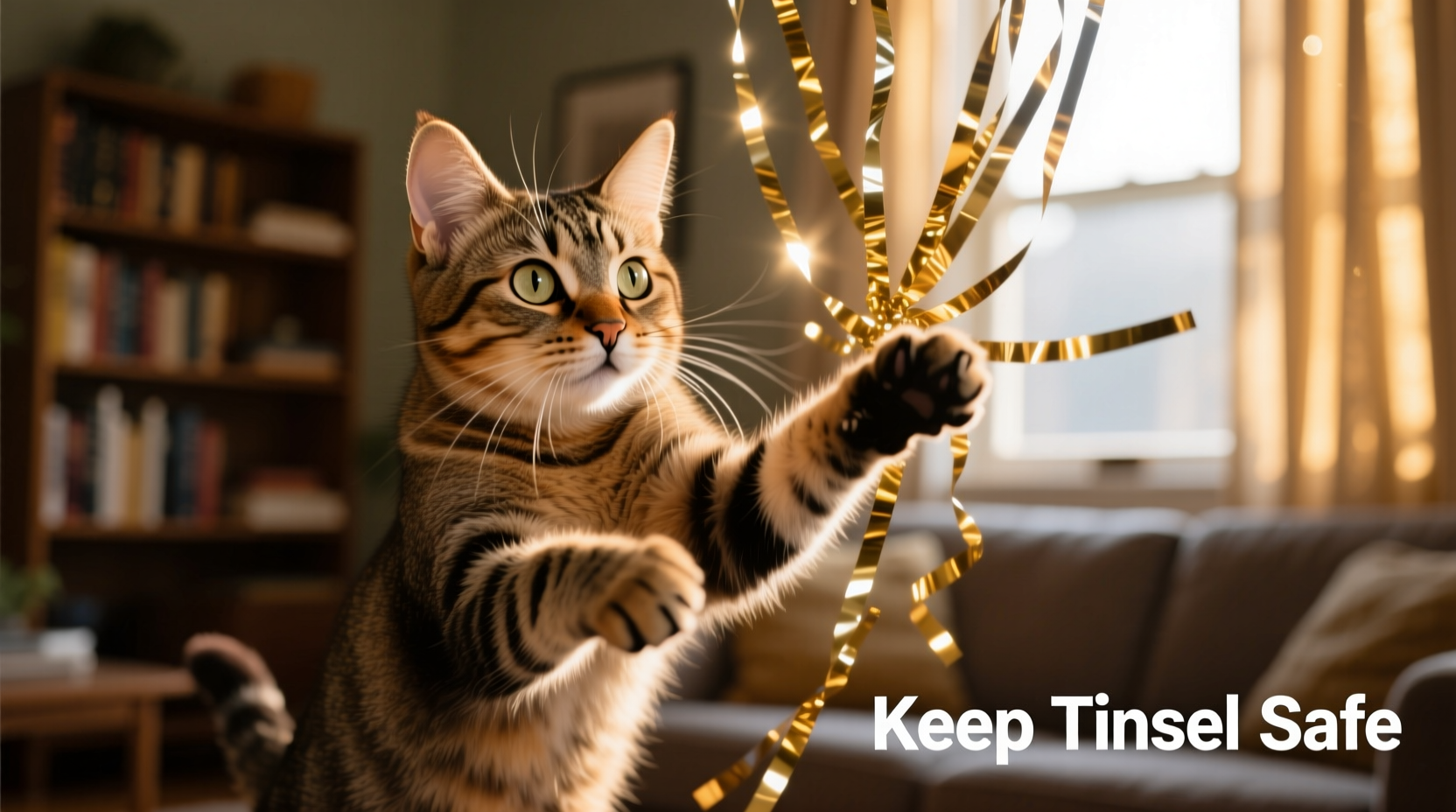
Cats don’t see tinsel as decorative foil. They perceive it through a sensory lens fine-tuned by evolution. Their visual system prioritizes movement, contrast, and flicker over static detail. Tinsel reflects ambient light in rapid, unpredictable bursts—mimicking the erratic motion of insects or small prey. A single draft causes it to sway and glint; a stray paw sends it skittering across the floor. To a cat’s retina—packed with motion-sensitive rod cells and wired to a highly reactive superior colliculus—tinsel doesn’t look like plastic or polyester. It looks like *prey in distress*.
This isn’t imagination. Neurological studies confirm that cats’ visual processing centers fire most intensely in response to stimuli moving at speeds between 0.5 and 2 meters per second—the exact range of tinsel swaying from a tree branch or sliding off a shelf. Add high-contrast reflectivity (especially silver or gold against darker backgrounds), and you’ve activated a near-perfect predatory trigger. The behavior isn’t “playful” in the human sense; it’s a full sensorimotor loop: detection → orientation → pursuit → capture → oral investigation. And that final stage—chewing or ingesting—is where instinct becomes life-threatening.
Why “Just a Little Bit” Is Never Safe: The Anatomy of a Tinsel Emergency
Tinsel is uniquely dangerous because it combines three hazardous properties: non-biodegradability, linear tensile strength, and barbed microstructure. Unlike yarn or ribbon, most modern tinsel is made from metallized polyester film—thin, flexible, and nearly impossible for stomach acids to break down. Once swallowed, it rarely passes cleanly through the digestive tract. Instead, it tends to anchor itself—often at the base of the tongue or in the upper intestine—and then acts like a saw blade as peristalsis continues pushing gut contents forward.
This creates a condition known as “linear foreign body obstruction,” which accounts for approximately 12% of all feline GI obstructions admitted to emergency clinics between Thanksgiving and New Year’s. In affected cats, tinsel doesn’t just block passage—it lacerates intestinal walls, causing perforations, sepsis, and sometimes fatal peritonitis within 24–48 hours of ingestion.
“Tinsel is one of the most preventable yet frequently overlooked hazards in veterinary ERs each December. We see kittens as young as 10 weeks presenting with vomiting, lethargy, and abdominal pain—only to discover 30 centimeters of tinsel wrapped around the jejunum like a garrote.” — Dr. Lena Torres, DVM, Board-Certified Small Animal Surgeon, Midwest Veterinary Emergency Consortium
A Real-World Scenario: How One Evening Turned Critical
Marisol adopted two-year-old tabby Leo in March. He’d never shown interest in strings or ribbons—until her mother gifted a vintage-style tree topper with cascading silver tinsel. On Christmas Eve, Marisol noticed Leo intently watching a loose strand dangle from the lowest branch. She assumed he’d lose interest. By midnight, he’d batted it down, chewed one end, and swallowed a 15-centimeter piece. At 4 a.m., he vomited twice, refused food, and began hiding under the sofa—classic early signs of GI distress. Marisol rushed him to the clinic. X-rays confirmed a linear foreign body; surgery revealed tinsel tightly knotted around two loops of small intestine, with visible abrasions and early inflammation. Recovery took five days, $2,800, and a strict post-op diet. Leo survived—but only because Marisol recognized the subtle behavioral shifts and acted fast.
This case underscores two critical realities: First, cats rarely show overt distress until damage is already underway. Second, the risk isn’t limited to “unsupervised” moments. Even brief lapses—a turned back while wrapping gifts, a distracted phone call—can be enough.
Practical, Proven Safety Strategies (Backed by Veterinary Behaviorists)
Eliminating tinsel entirely is the gold standard—but many families want festive charm without compromise. The solution lies not in restriction alone, but in layered, evidence-based mitigation. Veterinary behaviorists and toxicology specialists recommend combining environmental design, behavioral redirection, and proactive monitoring.
Step-by-Step Tinsel-Safe Holiday Setup
- Assess your cat’s baseline behavior: Does your cat stalk dangling objects? Chase reflections? Chew non-food items? If yes, treat tinsel as high-risk—regardless of past history.
- Choose alternatives wisely: Opt for wide, matte ornaments (wood, ceramic, felt) or LED string lights (cool-to-touch, no sharp edges). Avoid anything with loose ends, metallic sheen, or movement potential.
- Install physical barriers: Use a freestanding pet gate around the tree base—or, better yet, place the tree in a closed room with a baby gate that allows airflow but blocks entry.
- Provide counter-stimulation: Introduce new interactive toys *before* decorating begins—especially those mimicking prey movement (e.g., wand toys with feather tips on flexible rods) to redirect hunting drive.
- Conduct daily safety sweeps: Every morning and evening, inspect the tree and floor for fallen strands, loose ornaments, or displaced decorations. Use a lint roller to pick up microscopic fragments.
What to Do (and Not Do) If Ingestion Occurs
Immediate action saves lives—but common misconceptions delay care. Below is a vet-validated decision guide.
| Action | Do | Don’t |
|---|---|---|
| Observed ingestion | Call your veterinarian or local emergency clinic immediately—even if your cat seems fine. Note time, estimated length swallowed, and behavior. | Wait to see if they “pass it naturally.” Do not induce vomiting (tinsel can cause esophageal trauma on the way up). |
| Mild symptoms (vomiting once, mild lethargy) | Withhold food for 12 hours (offer water), then feed a bland, low-residue meal (boiled chicken + rice). Monitor closely for 24 hours. | Give laxatives, butter, or olive oil—these worsen motility issues and increase perforation risk. |
| Severe symptoms (repeated vomiting, refusal to eat, hunched posture, crying) | Transport to a clinic immediately. Bring packaging or photos of the tinsel if available. | Administer human pain relievers (ibuprofen, acetaminophen)—all are highly toxic to cats. |
Long-Term Prevention: Building a Cat-Safe Home Beyond the Holidays
Protecting cats from tinsel isn’t seasonal housekeeping—it’s part of a broader philosophy of environmental stewardship. Cats live in a world built for humans, where everyday objects pose hidden threats. Tinsel is merely the most visible example. Veterinarians report rising cases of ingestion involving holiday-themed items: pine needle clusters (toxic and sharp), potpourri oils (dermal and GI irritants), and battery-powered light strings (electrocution and burn risks).
A truly safe home anticipates feline behavior—not just during December, but year-round. That means auditing your space through a cat’s senses: What moves when air flows? What reflects light unexpectedly? What dangles within paw’s reach? It also means recognizing that “curiosity” is often misread as “naughtiness.” Cats explore orally—not out of defiance, but because their whiskers, paws, and mouths are primary sensory organs. When a cat chews tinsel, they’re not being destructive. They’re gathering data: texture, flexibility, resistance, taste.
- Replace tinsel with safer alternatives: Hand-cut paper chains (non-toxic, biodegradable), dried citrus slices strung on cotton twine, or reusable fabric garlands made from organic cotton.
- Use scent deterrents strategically: Citrus sprays (diluted orange or lemon essential oil in water) applied to tree trunks or stands deter many cats—but test on a small area first and avoid direct contact with skin or eyes.
- Enrich, don’t restrict: Provide daily 15-minute play sessions using wand toys that mimic bird or insect flight patterns. This satisfies predatory drive *before* it fixates on inappropriate targets.
- Educate guests proactively: Place a small sign near the tree: “Leo’s safe zone—please keep tinsel, ribbons, and small ornaments out of reach.” Most people appreciate guidance over guessing.
Frequently Asked Questions
Can I use “pet-safe” tinsel sold online?
No product marketed as “pet-safe tinsel” eliminates the core hazard: linear foreign body risk. Some brands substitute softer materials (like cellulose-based film), but these still resist digestion, retain tensile strength, and can cause obstruction. The American College of Veterinary Surgeons advises against *any* linear, ingestible decorative material for households with cats.
My cat has never shown interest in strings—am I safe?
Not necessarily. Interest can emerge suddenly due to hormonal shifts (especially in unneutered males), environmental changes (new pets, construction noise), or developmental stages (kittens aged 3–6 months exhibit peak exploratory behavior). A lack of prior incidents does not equate to immunity—it reflects absence of exposure, not safety.
What if my cat only bats at tinsel but never puts it in their mouth?
Batting is the highest-risk phase. Each swipe increases the chance of snagging, fraying, or breaking off a strand. Micro-tears in the tinsel create jagged edges that catch on teeth or gums—making subsequent ingestion more likely. Even “just batting” warrants immediate removal of the item from accessible zones.
Conclusion: Celebrate Thoughtfully, Not Just Festively
Holiday traditions carry deep emotional weight—light, sparkle, shared ritual. But tradition shouldn’t require compromise on compassion. When we choose not to hang tinsel, we’re not sacrificing joy; we’re expanding it to include the quiet dignity of a cat who can move through their home without encountering manufactured danger. We’re honoring the intelligence behind their pounce, the sensitivity behind their gaze, and the vulnerability behind their trust. Safety isn’t about control—it’s about cohabitation with intention. It’s choosing handmade paper stars over synthetic glitter. It’s placing the tree where light dances safely across the floor instead of where it tempts a predator’s eye. It’s pausing, mid-decorating, to watch how your cat watches the world—and adjusting accordingly.
Your vigilance today prevents an ER visit tomorrow. Your redesign of the holiday landscape protects not just against tinsel—but against the broader pattern of overlooking feline needs in human-centered spaces. Start now. Swap one decoration. Block one zone. Observe one behavior more closely. These small, deliberate choices accumulate into profound care.




 浙公网安备
33010002000092号
浙公网安备
33010002000092号 浙B2-20120091-4
Comments
No comments yet. Why don't you start the discussion?