
Every year, as the holiday season winds down, millions of people across the world carefully unplug their Christmas lights, coil them as neatly as possible, and tuck them into boxes—only to pull them out months later hopelessly knotted. It’s a frustrating ritual that feels almost inevitable. But why do these simple strings of bulbs resist order so stubbornly? Is it bad luck, poor dexterity, or something deeper at play?
The answer lies not in holiday magic but in the laws of physics, probability, and the nature of flexible strings. From knot theory to thermodynamics, scientists have studied why cords tangle—and why Christmas lights are especially prone to chaos. Understanding the science behind this annual annoyance isn’t just fascinating—it can also help you prevent tangles for good.
The Physics of Tangles: Entropy and Random Motion
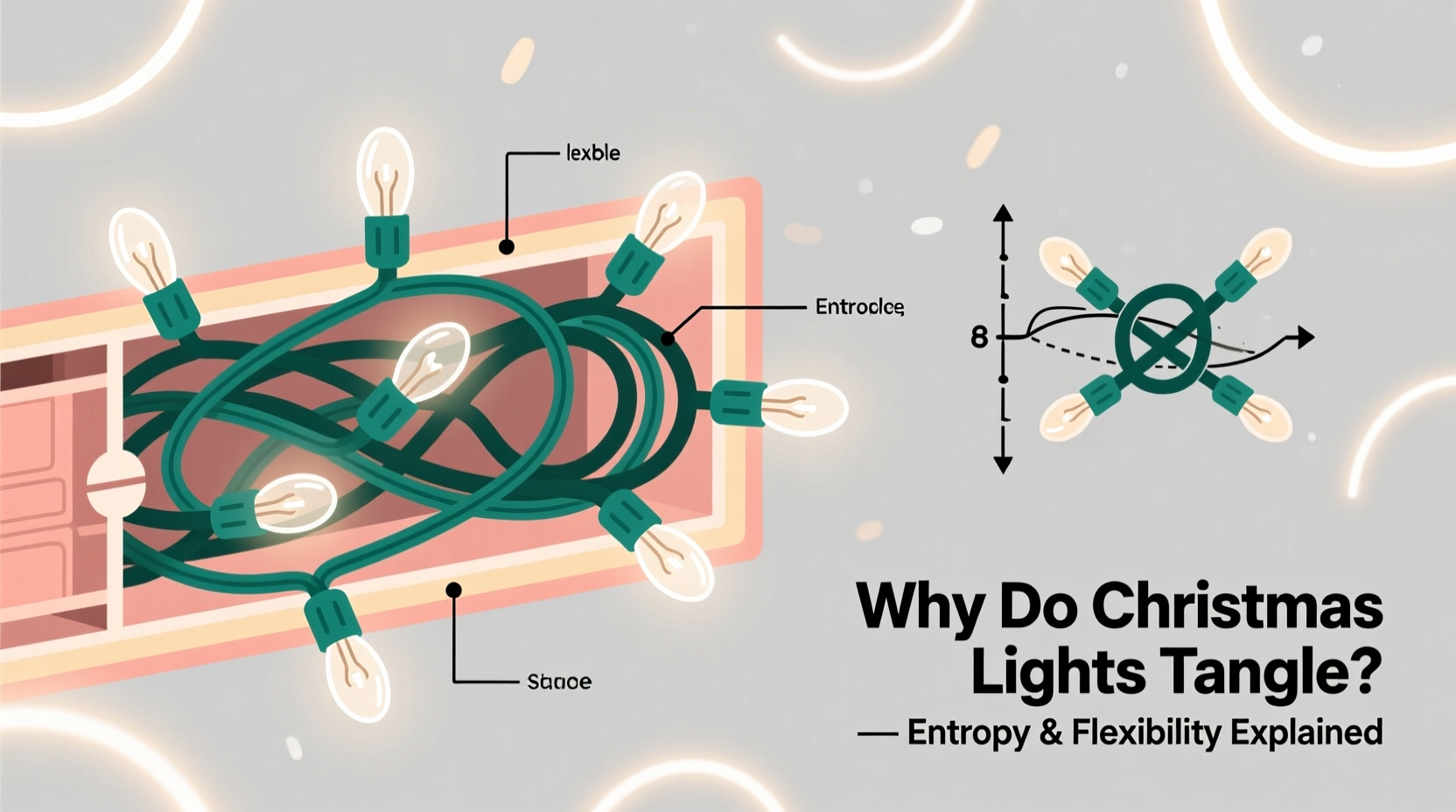
At the heart of the tangled-lights problem is a fundamental principle of physics: entropy. In thermodynamics, entropy measures disorder within a system. Left unchecked, systems naturally evolve toward greater disorder over time. A tidy strand of Christmas lights represents low entropy; a jumbled mess is high entropy. And given even slight movement, the path from order to disorder is both rapid and predictable.
In 2007, physicists Dorian M. Raymer and Douglas E. Smith conducted a now-famous experiment at the University of California, San Diego. They placed a piece of rope inside a rotating box and observed how often knots formed after tumbling. Their findings were startling: knots appeared in seconds, and complex ones at that. Even more surprising, nearly every trial resulted in some form of knotting—regardless of how neatly the rope was placed inside.
Christmas lights behave exactly like those ropes. When stored in a box, drawer, or bin, any small shift—during transport, seasonal shifting in the garage, or even temperature-related expansion—creates enough motion for the cord to twist, loop, and snag. Over weeks or months, random movements accumulate, making tangling statistically almost guaranteed.
“Knots will form whenever a long, flexible object is agitated in confinement. It’s not a matter of if, but when.” — Dr. Douglas E. Smith, Physicist, UC San Diego
Knot Theory and Why Strings Love Complexity
Mathematicians have long studied what’s known as “knot theory,” a branch of topology that classifies different types of knots based on their structure. What they’ve found is that even simple motions can generate surprisingly complex knots—especially in long, thin objects like Christmas light strands.
A strand of Christmas lights typically ranges from 15 to 100 feet in length. At that scale, the number of possible configurations skyrockets. For example, a 3-foot cord has relatively few ways to tangle. But a 50-foot cord? The number of potential crossing points, loops, and interweavings becomes astronomical. Each bulb acts as a node—a point where friction increases and snags are more likely to occur.
Moreover, Christmas lights aren’t smooth ropes. They’re studded with bulbs, wires, plugs, and connectors. These irregularities create \"pinch points\" where the cord can catch on itself. Once one loop forms, it becomes a trap for other sections of the wire, accelerating the tangle process.
Interestingly, research shows that the longer the strand, the higher the probability of knot formation—but only up to a point. Beyond about 200 centimeters (6.5 feet), the likelihood of knotting levels off because the cord reaches a saturation point of entanglement. Most Christmas light sets exceed this threshold by several times, placing them deep in the “high-tangle-risk” zone.
Real-World Factors That Worsen Tangling
While physics sets the stage, everyday habits make the problem worse. How we store, handle, and pack Christmas lights dramatically influences how tangled they become by next season.
- Loose coiling: Throwing lights into a box without securing the coil allows free ends to drift and weave through loops.
- Mixed storage: Storing lights with other decorations—ribbons, hooks, or ornaments—introduces foreign objects that act as snagging hazards.
- Poor containers: Flimsy boxes or open bins allow shifting during storage. Rigid, compartmentalized containers reduce motion.
- Temperature and humidity changes: Materials expand and contract, subtly moving the cord over time—even without human handling.
- Multiple plug types: Larger transformers or dual-ended plugs add bulk and asymmetry, increasing the chance of catching.
A mini case study illustrates this well: Sarah, a homeowner in Vermont, had struggled for years with her porch lights becoming a “rat’s nest” each January. She’d wrap them around a piece of cardboard, secure them with a rubber band, and place them in a plastic tote with her wreaths and garlands. By November, the lights were fused with ribbon scraps and tangled around ornament hooks. After switching to individual sealed containers and using the “over-under” coiling method (explained below), she retrieved perfectly neat lights two Decembers in a row—no cutting required.
Proven Methods to Prevent Tangles
Knowing the science is half the battle. The other half is applying practical strategies that counteract natural disorder. Here’s a step-by-step guide to storing Christmas lights so they stay tangle-free year after year.
Step-by-Step: The Over-Under Coiling Method
- Unplug and inspect: Before storage, check for broken bulbs or frayed wires. Repair or replace as needed.
- Start at the plug end: Hold the plug in one hand—this prevents the active end from whipping around.
- Use your arm as a guide: Extend your non-dominant arm and wrap the cord in alternating directions: over the top, then under the bottom, repeating.
- Maintain consistent loops: Aim for 6–8 inch diameter coils. Avoid twisting the cord as you go.
- Secure the bundle: Use fabric ties, velcro straps, or reusable zip ties—never metal or tight elastics that can damage insulation.
- Store in a dedicated container: Place the coil in a rigid box or wrap it in tissue paper before placing it in a larger bin.
This technique minimizes twist accumulation and keeps the cord balanced. Unlike simple circular wrapping, which introduces rotational stress, the over-under method cancels out twists with each pair of loops.
Alternative Storage Tools
For those who want extra insurance, specialized tools can make a big difference:
- Light reels: Spool-style devices designed specifically for lights. Wind evenly and lock in place.
- Notched cardboard sheets: Cut a rectangle and make opposing U-shaped notches on each short end. Wrap lights between the tabs to keep loops separate.
- Plastic gutter guards: Repurposed foam pipe insulation or split foam tubes can hold coiled lights and cushion bulbs.
- Wine glass boxes: Their internal dividers are perfect for separating multiple light strands.
Do’s and Don’ts of Christmas Light Storage
| Do | Don’t |
|---|---|
| Use the over-under coiling method | Wrap tightly in a single direction |
| Secure with soft fabric ties or velcro | Use rubber bands or metal twist ties |
| Store in rigid, labeled containers | Toss into open bins with other decor |
| Inspect and test lights before storing | Pack away broken or flickering strands |
| Keep in a cool, dry place away from rodents | Leave in damp basements or attics with pests |
FAQ: Common Questions About Tangled Christmas Lights
Can I use zip ties to secure my coiled lights?
You can, but only if they’re reusable (velcro) zip ties. Standard plastic zip ties can be too tight and may compress or cut into the insulation over time, especially in cold environments where materials become brittle. If you must use them, leave slack and cut them off carefully each year.
Why do LED lights tangle just as much as incandescent ones?
Even though LED strands are often thinner and lighter, they still follow the same physical principles. Their reduced weight might seem helpful, but it actually makes them more susceptible to air currents and minor shifts in storage. Plus, many LED sets include controllers or battery packs that create bulky endpoints—prime snagging zones.
Is there a way to untangle lights quickly if they’re already knotted?
Yes. Start by laying the entire strand flat on a large surface like a driveway or floor. Locate the two ends and gently trace them inward, loosening loops rather than pulling. Use the “two-handed method”: one hand holds a section steady while the other works out nearby knots. Patience beats force—rushing leads to broken bulbs or severed wires.
Final Checklist: Tangle-Free Storage in 6 Steps
- Test all lights and replace faulty bulbs before packing.
- Begin coiling from the plug end to control the active tip.
- Use the over-under method to eliminate built-up twist.
- Secure the coil with soft, non-abrasive fasteners.
- Store in a dedicated, rigid container away from other items.
- Label the container with location and light type.
Conclusion: Defy Entropy, One Strand at a Time
Tangled Christmas lights aren’t a curse—they’re a consequence of physics. Entropy ensures that disorder wins unless we intervene with intention and technique. But armed with the right knowledge, you can outsmart randomness and reclaim the joy of hassle-free holiday decorating.
The effort you put into proper storage pays off every November when you open a box and find lights ready to hang—not wrestle. Small changes in routine lead to big gains in convenience and longevity. This year, don’t just pack away your lights. Pack them away with purpose.




 浙公网安备
33010002000092号
浙公网安备
33010002000092号 浙B2-20120091-4
Comments
No comments yet. Why don't you start the discussion?