
It’s a familiar holiday scene: you’ve spent hours arranging your Christmas tree just right—perfectly shaped, rich green needles, strands of warm white lights draped evenly. Then you plug in the tree water pump, and suddenly, the lights flicker and dim. The festive glow dulls as if the spirit of the season itself is being drained. What’s going on? And more importantly, how can you fix it without rewiring your entire house?
This phenomenon isn’t magic—or malfunction. It’s physics. And with a bit of understanding about household electrical systems, you can diagnose the issue, prevent potential hazards, and keep your display bright and safe all season long.
Understanding Voltage Drop and Circuit Overload
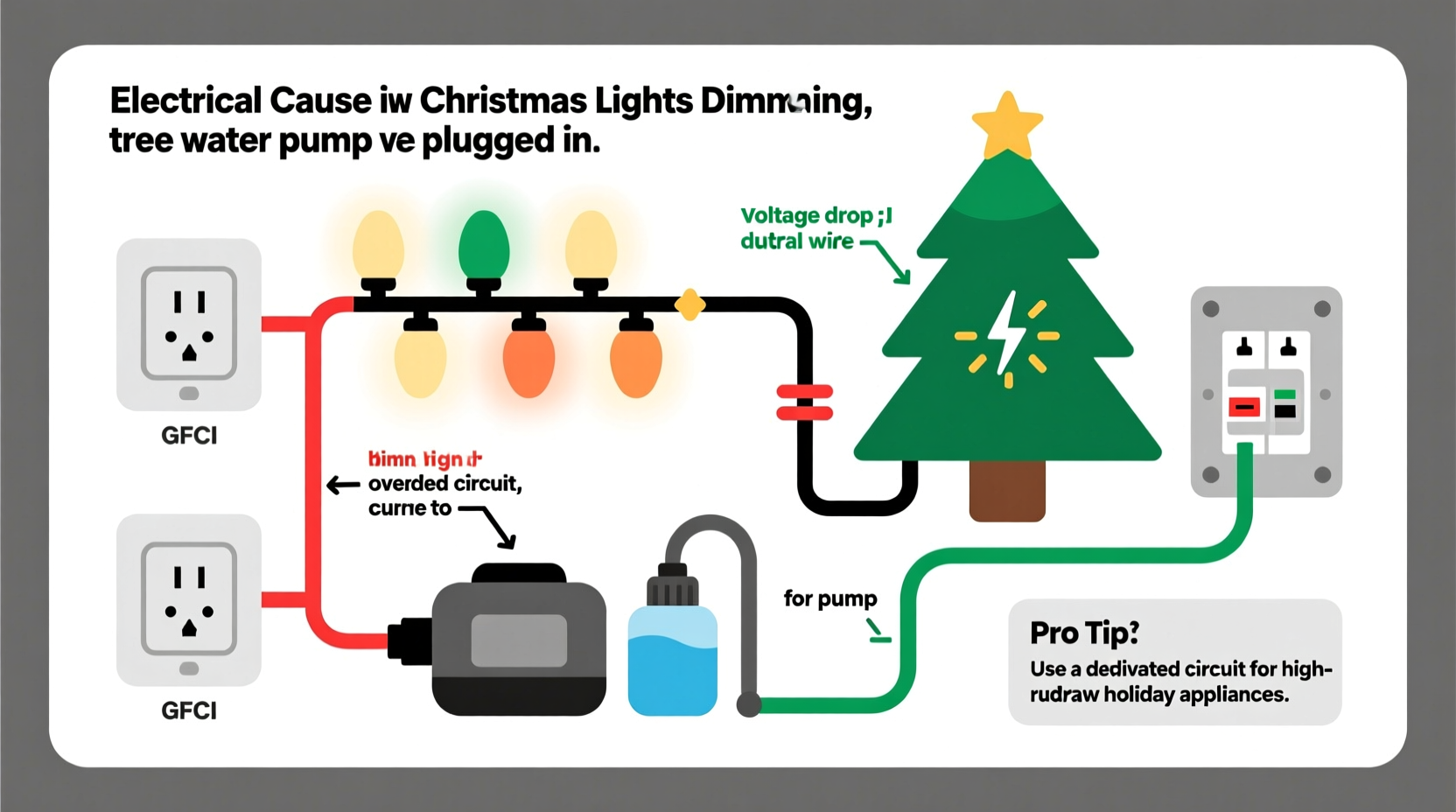
When your Christmas lights dim upon activating the tree water pump, the root cause is typically voltage drop due to circuit overload. Every electrical circuit in your home has a finite capacity—usually 15 or 20 amps at 120 volts in North American residential wiring. When multiple devices draw power from the same circuit, especially those with motors like water pumps, they create a sudden demand spike.
The tree water pump, though small, contains an electric motor. Motors require a higher initial current (inrush current) when starting—often two to three times their rated running current. This surge momentarily reduces available voltage across the circuit. Since incandescent and even some LED lights are sensitive to voltage fluctuations, they respond by dimming until the motor reaches steady operation.
Voltage drop is calculated using Ohm’s Law: V = I × R, where voltage (V) lost equals current (I) multiplied by resistance (R) in the wiring. Longer extension cords, older wiring, or undersized circuits increase resistance, worsening the effect.
How Shared Circuits Cause Dimming Lights
In many homes, outlets in the same room—or even adjacent rooms—are wired to a single circuit. If both your Christmas tree lights and the tree water pump are plugged into outlets on the same breaker, they share the available amperage. Once total demand approaches or exceeds 80% of the circuit’s capacity (the safe operating limit), performance issues arise.
For example: A standard 15-amp circuit provides 1,800 watts (15A × 120V). The 80% rule limits continuous load to 1,440 watts. Suppose your light strings consume 300 watts collectively. The water pump may draw 250 watts during startup. That’s 550 watts—well under the limit. So why the dimming?
The answer lies in timing. Lights operate continuously, but the pump cycles on intermittently. At the moment the pump starts, inrush current can briefly pull over 500 watts. Even if average usage stays low, this transient spike causes a momentary dip in voltage, visible as dimming.
Additionally, daisy-chained outlets, worn receptacles, or corroded connections increase impedance, amplifying the voltage drop. Older homes with aluminum wiring or outdated panels are especially prone to these issues.
Signs Your Circuit Is Overloaded
- Lights dim when appliances turn on
- Outlets feel warm to the touch
- Breaker trips frequently
- Frequent bulb burnout near high-draw devices
- Humming or buzzing from outlets
“Voltage fluctuations from motor loads are common in holiday setups. The real danger isn’t the dimming—it’s the cumulative stress on wiring and insulation.” — Rafael Nguyen, Licensed Electrician & Home Safety Inspector
Step-by-Step Guide to Isolate Electrical Circuits
Isolating circuits means ensuring that high-draw devices like pumps, heaters, or motors don’t share a circuit with sensitive loads such as lights or electronics. Here’s how to do it safely and effectively:
- Identify the circuit(s) powering your tree area. Plug a lamp into each outlet near the tree and turn off breakers one at a time until the lamp goes out. Label each outlet with its corresponding breaker number.
- Check your breaker panel layout. Open the panel (only if comfortable and safe) and note which outlets are grouped under each breaker. Many panels have labels; if not, create a map.
- Unplug the tree water pump and test lights alone. Ensure lights shine at full brightness with no other seasonal devices running.
- Plug the pump into a different circuit. Choose an outlet in another room—ideally on a dedicated circuit like a kitchen counter or bathroom GFCI. Avoid sharing with refrigerators or microwaves.
- Use a power meter (optional). A plug-in watt meter can show real-time draw and voltage levels, helping confirm whether isolation solved the issue.
- Verify results. Turn on the pump while observing the lights. No dimming means successful isolation.
If no alternative circuit is accessible, consider installing a new outlet on a separate breaker—an upgrade best left to a licensed electrician.
Do’s and Don’ts of Holiday Electrical Setup
| Do | Don’t |
|---|---|
| Use outlets on separate circuits for lights and motor-driven devices | Daisy-chain multiple high-wattage items on one outlet strip |
| Choose LED lights—they draw less power and generate less heat | Use damaged or frayed extension cords |
| Install a GFCI outlet for the water pump to prevent shock hazards | Run cords under rugs or furniture where they can overheat |
| Label outlets and breakers for quick troubleshooting | Ignore warm outlets or buzzing sounds |
| Test GFCI outlets monthly with the test button | Leave holiday displays unattended for long periods |
Real Example: A Living Room Lighting Crisis Resolved
Sarah from Portland decorated her living room with over 1,200 mini incandescent lights, a rotating tree skirt motor, and a self-watering tree stand with a submersible pump. Each year, she noticed the lights dimmed dramatically every time the pump cycled on. One evening, the breaker tripped mid-party, plunging the room into darkness.
After consulting an electrician, she discovered all devices were running off a single 15-amp circuit originally designed for general lighting. The combined startup load exceeded 1,600 watts momentarily—overloading the circuit.
The solution? She relocated the pump to a kitchen GFCI outlet on a dedicated 20-amp circuit. She also replaced half her incandescent strands with energy-efficient LEDs, cutting baseline load by 60%. The result: no more dimming, no tripped breakers, and a safer setup.
FAQ: Common Questions About Tree Pumps and Light Dimming
Can LED Christmas lights still dim with a water pump?
Yes, although less noticeably than incandescent bulbs. While LEDs draw far less power, cheaply made or non-regulated LED strings can still react to voltage drops. High-quality LEDs with built-in drivers are more stable.
Is it dangerous if my lights dim when the pump starts?
Momentary dimming isn’t immediately hazardous, but it indicates strain on the circuit. Repeated voltage fluctuations can degrade wire insulation over time, increasing fire risk. Consistent dimming should be addressed promptly.
Can I use a UPS or surge protector to stop the dimming?
No. Surge protectors won’t prevent voltage drop caused by motor load. A UPS (uninterruptible power supply) might stabilize voltage for lights, but most aren’t designed to handle motor startups and could fail. Circuit separation is the only reliable fix.
Checklist: Prevent Holiday Electrical Issues
- ✅ Map all outlets used for holiday decor to their respective breakers
- ✅ Confirm total wattage of lights and motor devices stays under 80% of circuit capacity
- ✅ Move tree water pump to a different circuit, preferably GFCI-protected
- ✅ Replace old or thin extension cords with heavy-duty, short ones (14 AWG or thicker)
- ✅ Upgrade incandescent lights to LEDs to reduce overall load
- ✅ Test GFCI outlets before plugging in any water-connected device
- ✅ Install a smart plug to monitor pump runtime and energy use
- ✅ Schedule an annual check of home electrical system, especially in homes over 20 years old
When to Call a Professional Electrician
While basic circuit isolation can be done safely by homeowners, certain situations require expert help:
- You’re unsure which breaker controls which outlet
- Breakers trip repeatedly even after reducing load
- Outlets show signs of scorching, melting, or loose plugs
- Your home has aluminum wiring or knob-and-tube systems
- You want to install a new dedicated circuit for holiday use
A licensed electrician can perform a load analysis, inspect wiring integrity, and recommend upgrades such as arc-fault circuit interrupters (AFCIs), which are now required in living areas by modern electrical codes and offer superior fire protection.
Conclusion: Keep Your Holidays Bright and Safe
The dimming of your Christmas lights when the tree water pump activates is more than a nuisance—it’s a signal from your home’s electrical system. By understanding circuit load, voltage dynamics, and proper isolation techniques, you can preserve the brilliance of your display and protect your household from avoidable risks.
Take action now: unplug the pump, trace your circuits, and reconfigure your setup. Small changes today can prevent emergencies tomorrow. Whether you’re managing a modest tabletop tree or a towering centerpiece, smart electrical practices ensure your holidays stay joyful, radiant, and safe.




 浙公网安备
33010002000092号
浙公网安备
33010002000092号 浙B2-20120091-4
Comments
No comments yet. Why don't you start the discussion?