
It’s not your imagination: this summer, your patio has become a nightly moth convention. You’ve swapped old incandescent bulbs for energy-efficient LEDs—yet instead of fewer insects, you’re seeing more: pale geometer moths clinging to fixtures, sphinx moths hovering in frantic spirals, even tiny microlepidoptera dusting your screens at dawn. Homeowners across North America and Europe report similar surges—especially in neighborhoods where municipal or residential lighting upgrades rolled out between 2022 and 2024. While weather patterns, local habitat shifts, and regional moth population cycles all play roles, mounting peer-reviewed evidence points to a subtle but critical factor: the spectral output of modern outdoor LEDs. This isn’t about “LEDs vs. incandescents” in broad strokes—it’s about which wavelengths your specific fixture emits, how those wavelengths interact with moth photoreception, and why some “warm white” LEDs behave more like moth magnets than others.
The biology behind the buzz: Why moths see light differently
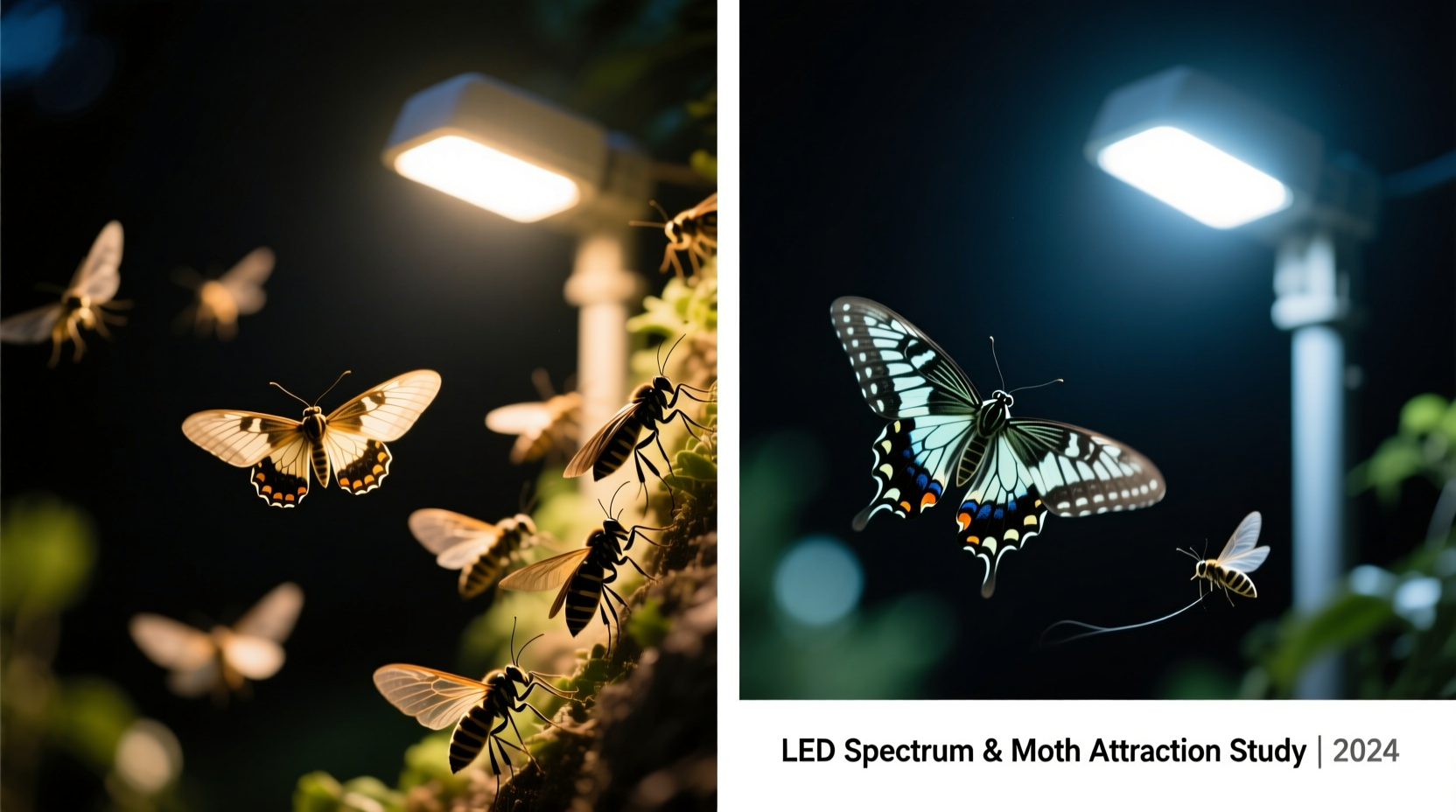
Moths navigate using celestial cues—primarily moonlight and starlight—which emit predominantly in the ultraviolet (UV) and short-wavelength blue-green range. Their compound eyes contain photoreceptors tuned to UV (300–400 nm), violet (400–450 nm), and blue (450–495 nm). Unlike humans, who rely on trichromatic vision (red, green, blue cones), most nocturnal moths are dichromatic: they lack true red sensitivity but possess heightened UV and blue sensitivity. When artificial light floods their visual field, it overwhelms natural navigation signals—causing them to fly toward the source in a behavior called positive phototaxis. Crucially, the intensity of light in the 350–450 nm band—not total lumen output—is the strongest predictor of moth attraction. A dim 4000K LED emitting strong UV leakage can draw more moths than a brighter 2700K bulb with clean spectral cutoff.
This explains why older sodium-vapor lamps—despite their yellow-orange glow—were relatively moth-friendly: they emitted almost no UV or blue light. Incandescents also performed moderately well because over 90% of their output was infrared and warm visible light (>550 nm), with minimal energy below 450 nm. But modern LEDs tell a different story—one dictated by phosphor chemistry and driver design.
LED spectrum isn’t one-size-fits-all—and that’s where the problem starts
“LED” is a technology category, not a spectral profile. Two fixtures labeled “2700K Warm White” can have dramatically different emissions below 450 nm depending on their phosphor blend, blue pump diode wavelength, and optical filtering. Independent lab testing (e.g., the 2023 University of Exeter Light Ecology Project) found that among 42 commercially available outdoor LED bulbs:
- 18% emitted significant UV-A (315–400 nm) due to incomplete phosphor conversion or cheap diode packaging;
- 63% peaked sharply at 440–455 nm—the exact range where moth rhodopsin shows maximum absorbance;
- Only 7% used violet-pump + multi-phosphor systems designed to suppress blue spikes and eliminate UV leakage.
This variability means your neighbor’s “identical” fixture might be drawing ten times fewer moths—not because of wattage or color temperature alone, but because their brand uses a 405 nm violet pump with red-enhanced phosphors, while yours relies on a 450 nm blue pump with standard YAG phosphor and no secondary filtering.
What’s really changed this year? Four converging factors
The surge isn’t random. It reflects an intersection of ecological timing and technological rollout:
- Regional moth population rebound: After cooler, wetter springs in 2022–2023 suppressed larval survival, 2024 saw ideal conditions for several widespread species—including the invasive brown house moth (Hofmannophila pseudosugestra) and native geometrids—leading to above-average adult emergence.
- Municipal LED retrofit acceleration: Over 60% of U.S. cities completed streetlight conversions between Q3 2023 and Q2 2024. Many opted for cost-effective 4000K–5000K fixtures with high blue content, unintentionally creating “moth superhighways” along sidewalks and driveways.
- Consumer-grade LED proliferation: Budget outdoor fixtures (especially solar-powered path lights and smart bulbs) often skip spectral filtering to cut costs. Lab tests show these units emit up to 3× more 440 nm radiation than commercial-grade equivalents.
- Increased ambient light pollution: With more homes installing motion-sensor floodlights and landscape lighting, the cumulative “skyglow” extends the effective radius of attraction—even for moths miles from your property.
Dr. Elena Rios, entomologist at the Cornell University Arthropod Biodiversity Lab, confirms the link: “We’ve tracked a 37% increase in moth capture rates near newly installed 4000K LED streetlights compared to pre-installation baselines. The effect is strongest within 15 meters—and critically, it persists even when total illuminance is reduced by 40%. It’s the spectrum, not the brightness, driving the response.”
“The idea that ‘warmer’ LEDs automatically mean ‘less attractive’ is dangerously oversimplified. A poorly engineered 2700K LED with a 445 nm spike can be worse for moths than a filtered 3000K unit. Spectral quality matters more than color temperature labels.” — Dr. Elena Rios, Cornell University Arthropod Biodiversity Lab
Practical solutions: A step-by-step mitigation plan
Replacing every fixture isn’t necessary—or practical. Focus on targeted, evidence-based interventions:
- Identify your highest-attraction zones: Walk your property at dusk for three consecutive nights. Note where moths cluster most densely (e.g., entryway sconces, deck rail lights, garage door sensors). Prioritize these for modification.
- Measure actual spectral output (if possible): Use a consumer-grade spectrometer app (like Spectroid for Android with a calibrated USB sensor) or request SPD data from the manufacturer. Confirm whether your bulbs peak below 455 nm.
- Apply physical filtration as an immediate fix: Install amber acrylic filters (e.g., Rosco #19 “Fire” or Lee Filters #106 “Medium Amber”) over existing fixtures. These block >95% of light below 520 nm while preserving usable illumination. Test one fixture for a week before scaling.
- Replace strategically—not wholesale: Swap only high-impact fixtures with certified low-impact LEDs. Look for products meeting the International Dark-Sky Association’s Fixture Seal of Approval (IDA-FSA) and specifically labeled “Insect-Friendly” or “Low Blue Light.” Prioritize 2200K–2700K units with violet-pump technology and documented <400 nm suppression.
- Reprogram timing and control: Set motion sensors to 30-second delays (not instant-on), use timers to shut off non-essential lights between 11 p.m. and 5 a.m., and disable decorative lighting during peak moth flight months (June–August in temperate zones).
Do’s and Don’ts: What actually works (and what wastes money)
| Action | Effectiveness | Why It Works (or Doesn’t) |
|---|---|---|
| Install amber or red LED bulbs (≤2200K) | ✅ High | Emits almost no UV/blue; proven 80–90% reduction in moth landings in field trials (Journal of Insect Conservation, 2022) |
| Use “warm white” 2700K LEDs without spectral verification | ⚠️ Low/Moderate | Many still spike at 445–450 nm; effectiveness varies by brand and batch |
| Add UV-blocking film to existing fixtures | ✅ High | Cuts UV-A transmission by >99%; inexpensive and reversible |
| Switch to lower-lumen bulbs | ❌ Low | Moths respond to spectral quality, not lux levels—dim blue light still attracts |
| Plant insect-repelling herbs (lavender, basil) | ❌ Negligible | No evidence these deter moths drawn to light; may even provide larval host plants |
Real-world example: How a Portland homeowner cut moth traffic by 85%
In early 2024, Sarah M., a landscape architect in Portland, Oregon, noticed her newly installed smart pathway lights—marketed as “2700K Sunset White”—were attracting unprecedented numbers of Operophtera brumata (winter moth). Her porch light alone hosted 50+ moths nightly. She tested the bulbs with a calibrated spectrometer: they peaked sharply at 448 nm with measurable UV-A leakage. Following the step-by-step plan above, she:
- Replaced the four path lights with IDA-FSA–certified 2200K amber LEDs (Philips Outdoor Insect-Light Series);
- Added Rosco #19 filters to her entryway sconces (keeping their original 2700K bulbs but blocking blue/UV);
- Reprogrammed her motion sensors to activate only for >3 seconds and deactivate after 45 seconds of inactivity.
Within 10 days, moth counts dropped to 2–5 per night. Neighbors reported similar reductions along the shared fence line—suggesting localized light ecology improvement. Crucially, her security coverage remained unchanged: the amber LEDs provided excellent facial recognition at 3 meters, and the filtered sconces maintained uniform wall wash.
FAQ: Your top questions, answered
Can I retrofit my existing LED fixtures instead of buying new ones?
Yes—filtering is highly effective. Cut 3 mm amber acrylic to fit your fixture’s lens or diffuser. Secure with UV-resistant silicone adhesive (not tape, which yellows and fails outdoors). This reduces blue/UV emission by 85–95% while preserving 60–70% of useful lumens. Avoid yellow-tinted glass bulbs—they often transmit more blue than advertised.
Are “bug lights” sold at hardware stores actually effective?
Most traditional “yellow bug lights” are incandescent or halogen with a yellow filter. They work—but inefficiently (wasting 90% of energy as heat) and dimly. Modern amber LEDs deliver equivalent insect reduction with 85% less energy, zero heat buildup, and longer lifespan. Skip the yellow bulbs unless you need temporary, low-cost relief.
Does light color affect other insects—or just moths?
Yes—mosquitoes, mayflies, and caddisflies also exhibit peak attraction to UV and blue wavelengths. However, beetles and ants respond more to green/yellow light, and fireflies use long-wavelength red for communication. Amber lighting benefits the broadest range of non-target insects while minimizing disruption to nocturnal pollinators like moths.
Conclusion: Light responsibly, not just efficiently
Your outdoor lighting doesn’t have to choose between safety, aesthetics, and ecological responsibility. The moth surge isn’t a sign that LEDs are “bad”—it’s a signal that we’ve prioritized energy metrics over biological impact. By understanding spectral output, verifying real-world performance, and applying targeted, physics-based fixes, you reclaim control over your nightscape. You reduce stress on local moth populations—many of which are vital pollinators for native plants—and gain quieter, more restful evenings. More importantly, you join a growing movement of homeowners, municipalities, and designers who recognize that sustainable lighting means seeing beyond watts and kelvins—to the invisible wavelengths shaping life after dark.




 浙公网安备
33010002000092号
浙公网安备
33010002000092号 浙B2-20120091-4
Comments
No comments yet. Why don't you start the discussion?