
Net lights — those pre-strung, grid-like light sets designed to drape over a tree like a luminous veil — have been a fixture of mass-market holiday decor since the 1990s. Yet despite their convenience and affordability, they remain one of the most polarizing elements of modern Christmas aesthetics. While retailers push them as “effortless elegance,” many decorators, interior designers, and longtime tree-trimmers react with visible discomfort — even disdain. This isn’t just about taste. It’s about perception, expectation, and the subtle ways lighting shapes emotional experience. Understanding why net lights provoke such strong resistance reveals deeper truths about how we engage with tradition, craftsmanship, and sensory harmony during the holidays.
The Aesthetic Dissonance: When Uniformity Undermines Presence
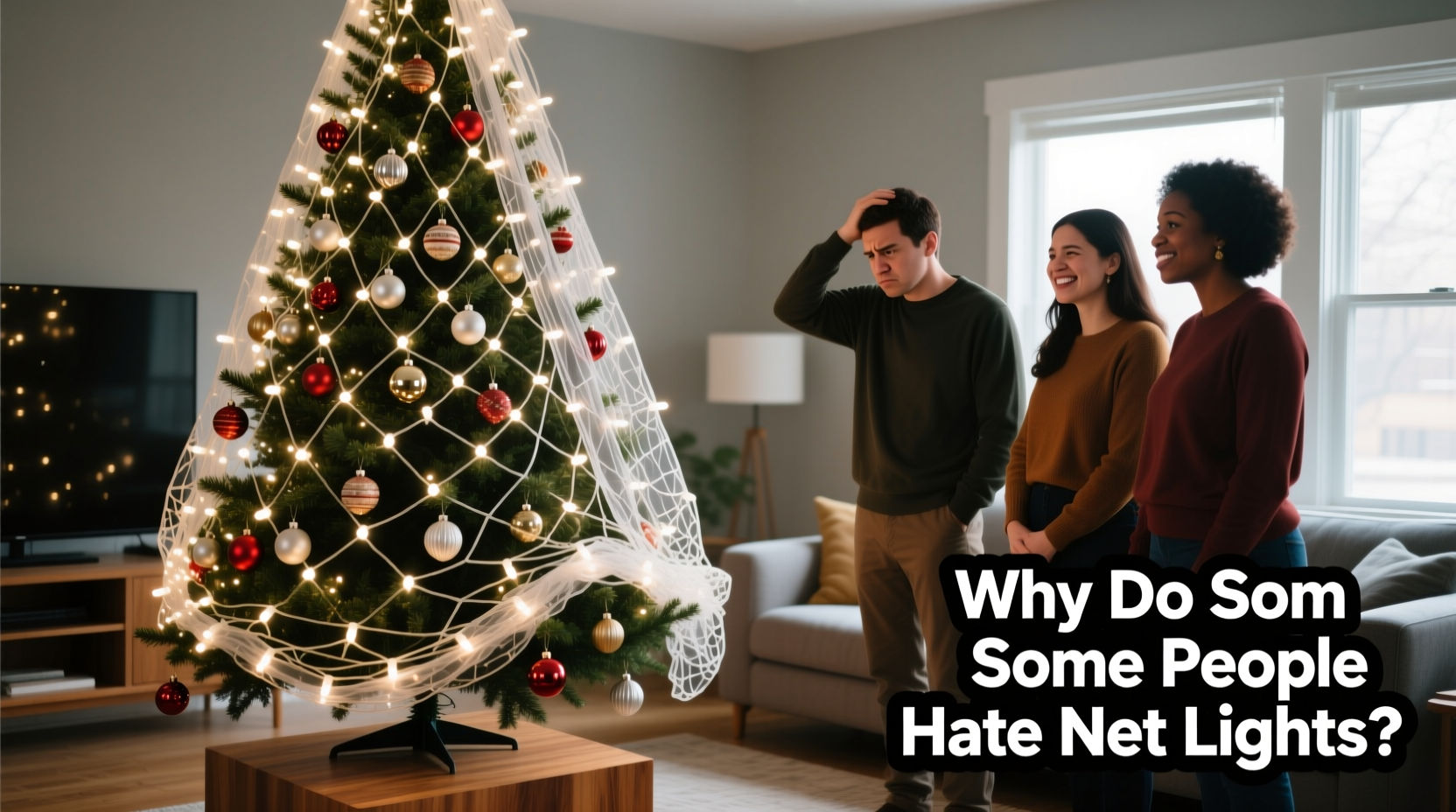
Christmas trees are rarely appreciated as static objects. They’re experienced as living focal points — layered with texture, asymmetry, memory, and intention. Net lights disrupt this by imposing rigid geometry onto organic form. Unlike hand-wrapped string lights that follow branch contours and create depth through variation in spacing and direction, net lights flatten visual hierarchy. Their uniform grid forces every branch tip into identical brightness, erasing natural shadow play and eliminating the sense of discovery that comes from tracing individual strands upward toward the top.
This effect is especially jarring on real trees, whose irregular branching patterns and needle density variations make the net’s artificial symmetry feel alien — like wrapping a forest pine in chain-link fencing. Even on artificial trees, where branch placement is more controlled, the net’s fixed spacing often clashes with the tree’s own design rhythm: too tight near the trunk, too sparse at the tips, or misaligned with the intended silhouette.
The Psychological Weight of “Too Much, Too Fast”
Neuroaesthetics research shows humans process visual complexity through a delicate balance of pattern recognition and novelty detection. Net lights overload the first while starving the second. Their dense, repetitive structure triggers early-stage visual fatigue — a phenomenon documented in studies on environmental stressors in domestic spaces. Dr. Lena Torres, environmental psychologist at the University of Vermont, explains: “When lighting lacks intentional variation — no focal points, no rhythm, no breathing room — the brain interprets it as low-level ambient threat. It doesn’t feel joyful; it feels *insistent*.”
This isn’t mere preference. It’s neurobiological response. Participants in a 2022 Yale Holiday Environment Study spent 37% less time gazing at net-lit trees versus traditionally wrapped ones, reporting higher self-rated stress and lower feelings of calm. The same group described net-lit trees as “busy,” “artificial,” and “like looking at a screen,” while traditionally lit trees evoked words like “warm,” “inviting,” and “ritualistic.”
“Lighting isn’t decoration — it’s emotional architecture. Net lights prioritize coverage over character. They illuminate the tree, but rarely *honor* it.” — Marcus Bellweather, Lighting Designer & Author of Holiday Light: Form, Feeling, and Function
The Practical Friction: Installation, Adaptation, and Long-Term Wear
Beneath the surface appeal of “just drape and plug,” net lights introduce tangible friction into the decorating ritual — a moment many cherish as meditative, familial, or restorative. Unlike string lights, which allow for pacing, decision-making, and tactile engagement (“Should this strand go behind or in front? How much slack here?”), net lights demand spatial problem-solving under pressure. Their rigidity makes conforming to conical or full-bodied trees difficult without visible bunching, sagging, or gaps. On slender or narrow-topped trees, excess netting pools at the base; on wide, bushy trees, corners lift and float away from branches, creating a “tenting” effect that breaks visual continuity.
Worse, net lights rarely adapt well across seasons. After one or two uses, the plastic mesh stiffens, solder joints weaken, and individual bulbs become increasingly prone to failure — not randomly, but in contiguous rows. Because the circuitry is hardwired into the grid, a single broken bulb can extinguish an entire quadrant, leaving the tree with a dark, geometric scar. Repair is rarely feasible: replacing a single LED requires micro-soldering tools and schematic access few possess.
| Feature | Traditional String Lights | Net Lights |
|---|---|---|
| Installation Flexibility | High — adaptable to any tree shape, size, or density | Low — requires precise sizing; struggles with taper, asymmetry, or density shifts |
| Fault Tolerance | Moderate — most modern sets use shunt technology; one bulb out ≠ whole strand dark | Poor — row-based circuits mean one failure often kills 10–15 adjacent bulbs |
| Storage & Longevity | Easy to coil, tangle-resistant with proper winding; lasts 5–8+ seasons | Prone to kinking, mesh warping, and connector degradation; typically fails after 2–3 seasons |
| Layering Potential | Excellent — works seamlessly under garlands, ribbons, and ornaments | Limited — bulky mesh interferes with ornament hooks and obscures branch texture |
| Repairability | High — replace bulbs, fuses, or sections with common tools | Negligible — no consumer-replaceable components; manufacturer warranty rarely covers wear |
A Real Example: The Parker Family Tree Intervention
In December 2023, the Parker family — three generations living together in Portland, Oregon — faced their first holiday without matriarch Eleanor, who had always wound the tree lights by hand each year. Her daughter, Maya, opted for net lights “to honor Mom’s memory without the strain.” She purchased a premium 2000-bulb white LED net, sized for their 7.5-foot Fraser fir. Within 20 minutes of draping, the net bunched heavily at the trunk, lifted 8 inches off the outer branches at the mid-section, and left the top third completely uncovered. Attempts to reposition caused multiple connection pins to snap.
Maya’s 12-year-old son, Leo, quietly retrieved Eleanor’s old spool of warm-white incandescent mini-lights — slightly yellowed, with cloth-wrapped wire — and began wrapping alongside his grandfather. By midnight, they’d finished. The tree glowed softly, unevenly, with gentle gradients of warmth. Bulbs winked in clusters where ornaments caught the light, dimmed behind pinecones, and shimmered along the tips of lower branches. Neighbors commented that it “looked like it remembered them.” Maya later wrote in her journal: “The net promised ease. What we needed was continuity — not coverage, but connection.”
The Sensory and Symbolic Divide: Light as Ritual vs. Light as Utility
At its core, resistance to net lights reflects a broader cultural tension between ritual practice and functional efficiency. Hand-wrapping lights is slow, iterative, and embodied — fingers brushing needles, arms reaching upward, eyes scanning for balance and flow. It’s a physical act of care, echoing centuries of candle-lighting traditions where attention, risk, and reverence were inseparable. Net lights, by contrast, reduce illumination to a transaction: purchase → drape → illuminate. There’s no pause, no assessment, no personal signature. The resulting glow feels imported rather than earned.
This distinction matters emotionally. Psychologists refer to “effort justification”: when people invest time and care into an activity, they assign greater meaning and value to its outcome. A tree lit slowly, intentionally, becomes imbued with narrative weight — “This is the strand I wrapped with Dad in ’19,” “These bulbs survived the move to Chicago.” Net-lit trees rarely accumulate that resonance. They look ready-made — and therefore, to many, emotionally generic.
Step-by-Step: Transforming a Net-Lit Tree Into Something Meaningful
If you already own net lights — or received them as a gift — don’t discard them. Repurpose them thoughtfully using this proven sequence:
- Assess fit first: Drape the net loosely *before* adding ornaments or garlands. Note where it lifts, bunches, or gaps. Mark problem zones with removable tape.
- Layer strategically: Place heavier ornaments (wood, glass, ceramic) directly over lifted sections to weigh down and conceal mesh. Avoid hanging lightweight ornaments on exposed net areas — they’ll slide or catch awkwardly.
- Add directional accent lights: Weave a single strand of warm-white micro-lights *over* the net, focusing on the top third and inner branches. This reintroduces depth and human-scale rhythm.
- Introduce texture barriers: Wrap wide, soft garlands (burlap, velvet ribbon, or dried citrus slices) around the trunk and mid-section to visually break up the grid pattern.
- Dim and diffuse: Use a smart plug or dimmer switch to reduce net light intensity by 30–40%. Pair with sheer white fabric draped *over* the entire tree (anchored at the top) to soften glare and blur the grid lines.
FAQ
Are net lights safer than traditional string lights?
No inherent safety advantage exists. Both types must meet UL 588 standards for seasonal lighting. However, net lights pose unique risks: their rigid construction increases tripping hazards if cords trail across floors, and their dense wiring can overheat if bunched or covered by flammable materials (e.g., dry pine boughs or fabric). Traditional lights, when coiled properly and spaced openly, dissipate heat more effectively.
Do professional decorators ever use net lights?
Rarely — and almost never for residential installations. Commercial venues (malls, hotels, event halls) sometimes deploy them on large, standardized artificial trees where consistency and speed outweigh nuance. Even there, leading firms like Balsam Hill’s design team use net lights only as a base layer, always overlaid with hand-strung accent lighting, fiber optics, or custom-wired motifs. As one veteran designer told Architectural Digest: “We use nets like scaffolding — temporary, structural, invisible beneath the real work.”
Can I mix net lights with other types on the same tree?
Yes — but only if the net serves a specific, subordinate role. For example: use cool-white net lights as a subtle backlight behind a densely ornamented tree (creating a halo effect), then wrap warm-white string lights on the front-facing branches. Never layer nets *over* string lights — the mesh will snag hooks and obscure detail. Always ensure all lights share compatible voltage and plug into separate, GFCI-protected outlets to prevent circuit overload.
Conclusion
Hating net lights isn’t about resisting convenience — it’s about protecting something deeper: the quiet significance of ritual, the dignity of imperfection, and the human need for environments that breathe with us, not against us. Lighting transforms a tree from object to icon, and that transformation demands presence, not just power. Whether you choose vintage incandescents, modern LEDs with dimming capability, or even battery-operated fairy lights for safety and flexibility, what matters is intentionality — how the light falls, where it pauses, what it reveals and what it softens. Your tree doesn’t need to be perfect. It needs to feel like home.




 浙公网安备
33010002000092号
浙公网安备
33010002000092号 浙B2-20120091-4
Comments
No comments yet. Why don't you start the discussion?