
Fragrance is more than a scent—it's an extension of identity, a mood enhancer, and often the final touch in a polished appearance. Yet, nothing is more frustrating than applying your favorite perfume in the morning only to realize by midday that it’s completely vanished. Why does this happen? And more importantly, what can you do about it?
The truth is, not all perfumes behave the same way on every person or under every condition. Some seem to linger for hours, while others disappear within minutes. The reasons are rooted in chemistry, biology, and application technique. Understanding these factors isn’t just useful—it’s essential if you want your scent to stay with you from morning meetings to evening plans.
The Science Behind Fragrance Longevity
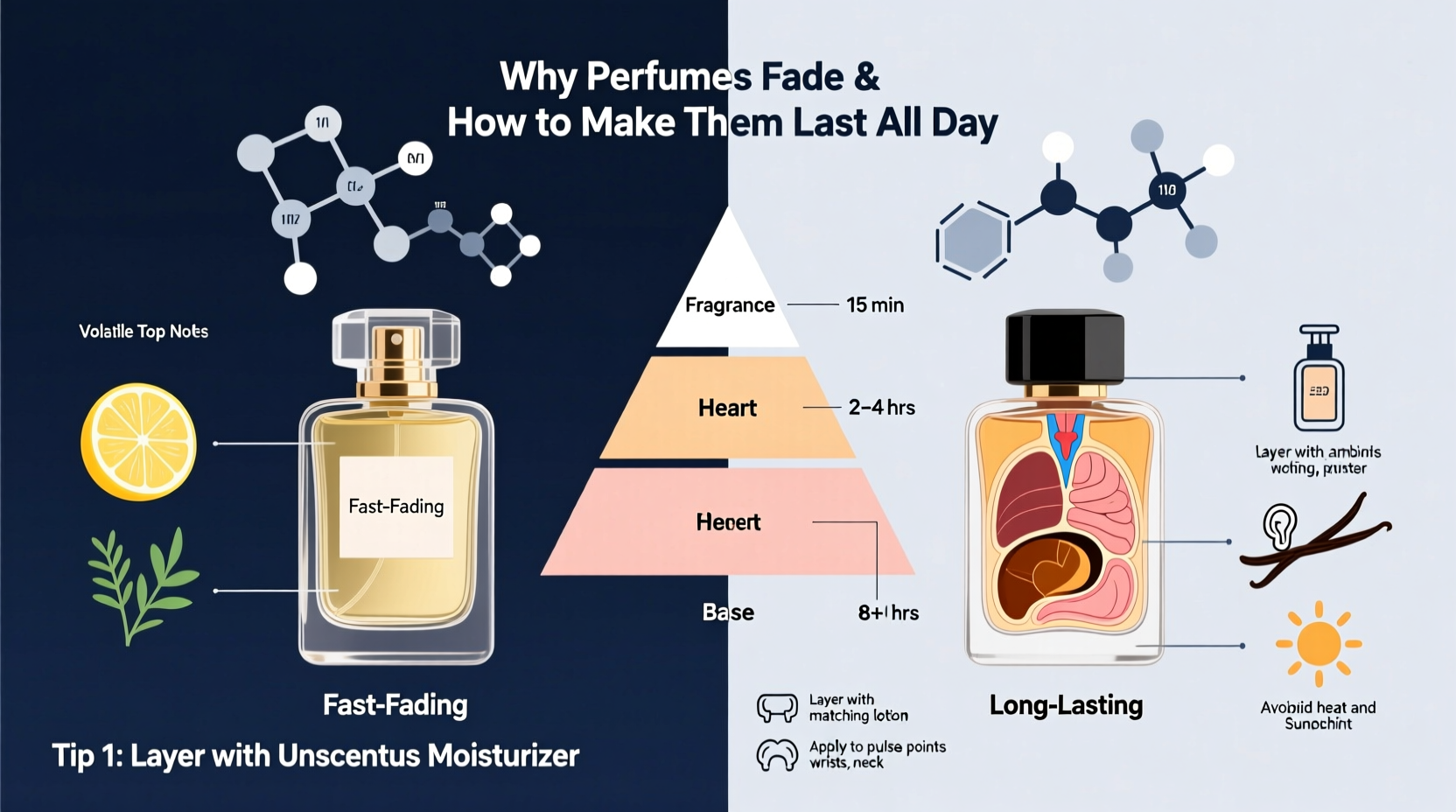
Perfume longevity depends on several interconnected factors: concentration, ingredient composition, skin chemistry, and environmental conditions. At its core, perfume is made up of volatile aromatic compounds suspended in alcohol. As the alcohol evaporates, the scent molecules disperse into the air. How long this process takes—and how strongly the scent projects—depends on multiple variables.
One of the most critical factors is the **fragrance concentration**. Perfumes come in different forms, each with varying levels of aromatic oils:
| Type | Aromatic Oil Concentration | Average Longevity |
|---|---|---|
| Eau de Cologne (EDC) | 2–4% | 1–2 hours |
| Eau de Toilette (EDT) | 5–10% | 2–4 hours |
| Eau de Parfum (EDP) | 10–15% | 4–8 hours |
| Parfum/Extrait | 15–30% | 6–12+ hours |
As you move up the concentration ladder, the amount of pure fragrance oil increases, meaning less alcohol and more scent molecules that evaporate slowly. This directly impacts staying power. A parfum will naturally outlast an eau de cologne because it contains significantly more base notes and fixatives that anchor the scent.
Skin Chemistry: Why Perfume Smells Different on Everyone
No two people experience the same fragrance identically. Skin pH, sebum production, hydration levels, and even diet influence how a perfume develops and fades. Oily skin tends to hold onto fragrance longer because natural oils help trap scent molecules. Dry skin, on the other hand, lacks this retention ability, causing perfumes to evaporate more quickly.
pH levels also play a role. A more acidic skin environment can alter the balance of top, middle, and base notes, sometimes muting certain accords or accelerating their breakdown. For example, citrus top notes may vanish almost instantly on highly acidic skin, while warm vanilla or musk base notes might bloom unexpectedly.
“Fragrance is a dialogue between chemistry and biology. Two people wearing the same perfume can smell entirely different—one radiant and lasting, the other faint and fleeting.” — Dr. Lena Moreau, Cosmetic Chemist & Scent Formulation Specialist
This variability explains why a friend might swear by a fragrance that disappears on you. It’s not defective—it’s simply interacting differently with your unique biochemistry.
Environmental and Lifestyle Factors That Affect Scent Duration
Beyond skin type and formulation, external forces significantly impact how long your perfume lasts. Temperature, humidity, clothing fabric, and daily activity all contribute.
- Heat and Humidity: High temperatures increase molecular volatility, causing faster evaporation. In hot climates, even long-lasting perfumes may fade quicker. Conversely, cold weather can suppress scent projection, though it may prolong longevity by slowing evaporation.
- Physical Activity: Sweating opens pores and mixes with fragrance, altering its character and often diluting its presence. Exercise or walking in humid environments accelerates scent loss.
- Clothing Material: Natural fibers like cotton and wool absorb fragrance better than synthetic materials like polyester. Spraying on clothes (especially pulse points near the body) can extend wear time, though caution is needed with delicate fabrics or dark dyes.
Urban environments with pollution and airborne particles can also degrade fragrance molecules over time, dulling the scent profile before it fully develops.
Step-by-Step Guide: How to Make Your Perfume Last All Day
You don’t need expensive tools or rare products to improve your fragrance’s staying power. With a few strategic habits, you can dramatically extend its life. Follow this timeline-based routine:
- Morning: Prep Your Skin
Start with a neutral, unscented moisturizer or unscented body lotion. Hydrated skin creates a better base for fragrance adherence. Avoid heavily fragranced lotions that could clash with your perfume. - Application: Target Pulse Points
Apply perfume to warm areas where blood flow heats the skin, enhancing diffusion:- Wrists
- Neck (sides and back)
- Behind ears
- Inner elbows
- Back of knees
- Midday: Refresh Strategically
Carry a travel-sized version or perfume vial. Reapply lightly to one pulse point (e.g., neck) around noon. Don’t over-spray—layering too much can overwhelm and distort the scent. - Evening: Layer for Depth
If you’re heading out again, consider layering with a matching scented body oil or unscented oil (like jojoba) on pulse points before reapplying. Oils bind well with fragrance and slow evaporation. - Night: Store Properly
Keep your perfume in a cool, dark place away from sunlight and temperature fluctuations. Bathroom cabinets are poor choices due to humidity and heat from showers.
Checklist: Maximize Your Perfume’s Longevity
Use this practical checklist every time you apply fragrance:
- ✅ Moisturize skin before applying perfume
- ✅ Choose EDP or Parfum for longer wear
- ✅ Spray—not dab—on pulse points
- ✅ Avoid rubbing wrists together
- ✅ Store perfume in a cool, dark cabinet
- ✅ Reapply once midday if needed
- ✅ Use matching scented body products (if available)
- ✅ Avoid direct sunlight exposure after application
- ✅ Consider layering with a light oil for dry skin
- ✅ Rotate perfumes based on season and climate
Real Example: Sarah’s Scent Struggles—and Solution
Sarah, a marketing executive in Miami, loved her floral-citrus EDT but found it gone by 10:30 a.m., despite reapplying. She assumed it was a low-quality product. After consulting a fragrance specialist, she learned three things: her skin was dry, she was using a low-concentration EDT, and she stored her perfume in the bathroom.
She adjusted her routine: switched to an EDP version of a similar scent, began using an unscented body butter daily, applied to pulse points without rubbing, and moved her perfume to a bedroom drawer. Within days, her fragrance lasted until dinner. “I didn’t need a new scent,” she said. “I just needed to use it smarter.”
Do’s and Don’ts of Perfume Application
| Do’s | Don’ts |
|---|---|
| Apply to moisturized skin | Apply to dry, flaky skin |
| Store in a cool, dark place | Leave in car or bathroom |
| Spray from 6–8 inches away | Drench yourself in spray |
| Layer with matching body products | Mix multiple strong perfumes |
| Reapply lightly during the day | Rub wrists together aggressively |
Frequently Asked Questions
Why does my perfume last longer on clothes than on my skin?
Fabric fibers absorb and trap fragrance molecules more effectively than skin, especially natural materials like cotton or wool. However, perfumes can stain delicate fabrics or interact with dyes, so test first. Also, alcohol in perfume can weaken certain fibers over time.
Does drinking water really help my perfume last longer?
Indirectly, yes. Well-hydrated skin retains moisture better, creating a smoother surface for fragrance adherence. Dehydrated skin loses scent faster due to increased flakiness and reduced oil retention. Drinking enough water supports overall skin health, which benefits fragrance performance.
Can I mix different perfumes to make them last longer?
Mixing perfumes (also known as scent layering) can enhance complexity and longevity—if done carefully. Combine complementary scents (e.g., a woody base with a floral top). Avoid clashing accords like heavy orientals with sharp citruses. Test combinations on a tissue first to avoid olfactory chaos.
Final Thoughts: Make Your Scent Work for You
Perfume fading isn’t always about quality—it’s often about compatibility and care. By understanding the interplay between formulation, skin, and environment, you gain control over how your fragrance performs. The goal isn’t just to smell good in the morning, but to carry that impression confidently throughout the day.
Small changes—like switching to a higher concentration, prepping your skin, or storing your bottle properly—can yield dramatic results. Fragrance should be a silent companion, not a fleeting whisper. With the right approach, your signature scent can leave a lasting impression, just as intended.




 浙公网安备
33010002000092号
浙公网安备
33010002000092号 浙B2-20120091-4
Comments
No comments yet. Why don't you start the discussion?