
We’ve all experienced it: you’re sitting across from a friend who suddenly yawns, and within seconds, your jaw begins to stretch involuntarily. It’s not because you’re tired—it’s because their yawn triggered yours. This phenomenon, known as contagious yawning, occurs in humans and some animals, but its roots go far beyond mere mimicry. Scientists have spent decades studying why we “catch” yawns, and the answers point to complex psychological and neurological mechanisms tied to empathy, social bonding, and even brain development.
While yawning itself serves biological functions like regulating brain temperature or increasing alertness, contagious yawning is uniquely social. Unlike spontaneous yawning, which happens when we're sleepy or bored, contagious yawning appears linked to our ability to connect with others on an emotional level. Understanding this behavior offers insight into human cognition, emotional intelligence, and even developmental disorders like autism.
The Science Behind Contagious Yawning
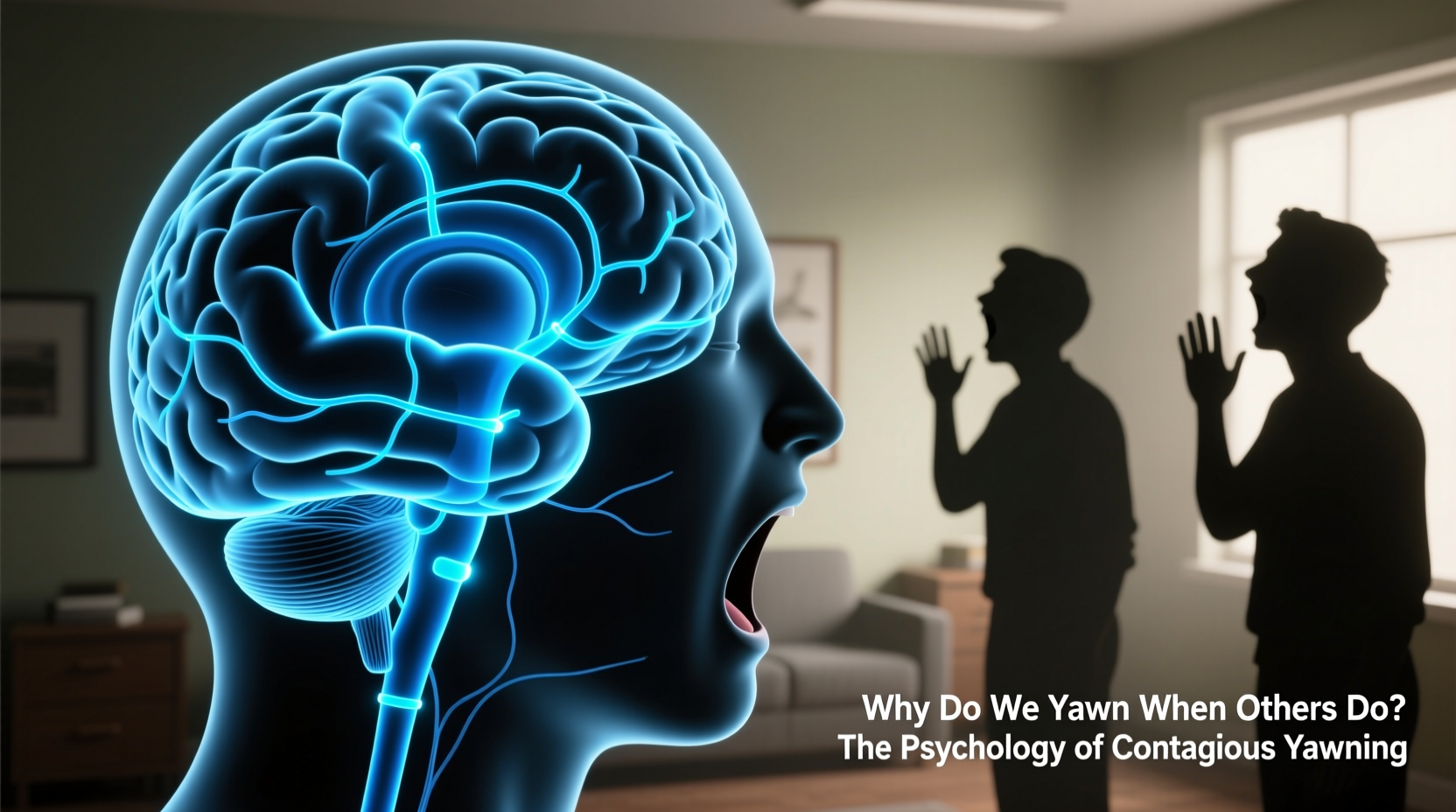
Contagious yawning isn’t just a quirky habit—it’s a measurable response observed in controlled studies. Researchers typically show participants videos of people yawning and record how many subsequently yawn themselves. On average, about 40% to 60% of adults exhibit contagious yawning under such conditions. Interestingly, children under the age of four rarely catch yawns, suggesting that the ability develops alongside social cognition.
Neurologically, contagious yawning is believed to involve the mirror neuron system—a network of brain cells that fire both when we perform an action and when we observe someone else doing it. These neurons are thought to play a crucial role in imitation, learning, and empathy. When you see someone yawn, your mirror neurons may activate the same motor pathways used to initiate a yawn, effectively \"mirroring\" the behavior.
Studies using functional MRI (fMRI) have shown increased activity in brain regions associated with social awareness, such as the precuneus and posterior cingulate cortex, during contagious yawning. Notably, individuals with higher levels of empathy are more likely to experience contagious yawning, reinforcing the idea that it's tied to emotional attunement rather than mere reflex.
Empathy and Social Connection
One of the most compelling theories about contagious yawning is its link to empathy—the ability to understand and share another person’s feelings. Research has consistently found that people who score higher on empathy scales are more susceptible to contagious yawning. This correlation suggests that yawning together may be a primitive form of emotional synchronization, much like laughing at the same joke or feeling tension in a group during a stressful moment.
A landmark study conducted by researchers at the University of Pisa demonstrated that participants were significantly more likely to yawn contagiously when watching close friends or family members yawn compared to strangers. This \"in-group bias\" supports the idea that yawning strengthens bonds within trusted social circles. In evolutionary terms, such synchrony could have helped early humans stay alert and coordinated during rest periods, enhancing group survival.
“Contagious yawning may be a window into our social brain. It reflects our unconscious drive to align with others emotionally.” — Dr. Steven Platek, Cognitive Neuroscientist, University of Liverpool
This empathetic component also explains why certain populations show reduced contagious yawning. For example, individuals on the autism spectrum, who often struggle with theory of mind (the ability to attribute mental states to others), are less likely to yawn in response to others. Similarly, people with psychopathy, characterized by low empathy, show diminished contagious yawning responses despite normal spontaneous yawning patterns.
Developmental and Evolutionary Perspectives
Contagious yawning doesn’t appear immediately in life. Infants and toddlers rarely respond to others’ yawns, and the tendency typically emerges around age four or five—coinciding with key milestones in emotional and cognitive development. At this stage, children begin to recognize emotions in others, develop perspective-taking skills, and engage in pretend play, all of which rely on empathetic understanding.
This developmental timeline underscores that contagious yawning is not simply a reflex but a learned social behavior rooted in maturing neural circuitry. As children grow better at reading facial expressions and interpreting social cues, they become more prone to mirroring actions like yawning.
From an evolutionary standpoint, contagious yawning may have served several adaptive purposes:
- Group vigilance: Synchronized yawning could signal drowsiness across a group, prompting collective action to stay alert.
- Social cohesion: Shared behaviors reinforce group identity and strengthen interpersonal bonds.
- Nonverbal communication: Before language evolved, subtle cues like yawning might have conveyed internal states across individuals.
Interestingly, contagious yawning has been observed in other socially intelligent species, including chimpanzees, bonobos, dogs, and even wolves. Dogs, for instance, are more likely to yawn in response to their owner’s yawn than to a stranger’s, further supporting the empathy-based model.
Factors That Influence Contagious Yawning
Not everyone experiences contagious yawning equally. A variety of biological, psychological, and environmental factors can influence susceptibility:
| Factor | Effect on Contagious Yawning |
|---|---|
| Age | Increases from childhood to adulthood, then declines slightly in older age. |
| Empathy Level | Higher empathy correlates with greater susceptibility. |
| Familiarity | More likely with close relationships than strangers. |
| Mental Health | Reduced in autism, schizophrenia, and psychopathy. |
| Time of Day | More frequent during low-alertness periods (e.g., late evening). |
| Stress & Fatigue | Can increase baseline yawning, potentially amplifying contagion. |
Additionally, individual differences in attention and self-awareness play a role. People who are highly focused on internal thoughts (a state called “mind-wandering”) are less likely to catch yawns, possibly because they’re less attuned to external social stimuli.
Mini Case Study: The Office Meeting Effect
Consider a mid-afternoon team meeting in a quiet conference room. One employee stifles a long yawn. Within minutes, two others subtly cover their mouths as they yawn too. Soon, half the room has yawned at least once. No one was particularly tired beforehand, yet the act spread like ripple through water.
In this scenario, the initial yawn acted as a social cue. The shared environment—dim lighting, sedentary posture, and monotonous discussion—created ideal conditions for both fatigue and suggestibility. But more importantly, the team’s established rapport made them more vulnerable to emotional contagion. Their brains, wired for social alignment, subconsciously synchronized through yawning, reflecting an underlying desire for cohesion—even if none of them were aware of it.
Debunking Common Myths About Contagious Yawning
Despite growing scientific understanding, several myths persist about why we yawn when others do:
- Myth: It’s caused by low oxygen levels. While yawning increases oxygen intake, studies show that altering CO₂ levels in the air doesn’t affect contagious yawning rates.
- Myth: Everyone experiences it equally. In reality, only about half the population is susceptible, and some people never experience it at all.
- Myth: Animals don’t catch yawns. As mentioned, multiple species—including dogs and primates—show contagious yawning, especially toward familiar individuals.
- Myth: It’s a sign of boredom or rudeness. Contagious yawning is involuntary and unrelated to disrespect; it’s a subconscious social reflex.
Understanding these misconceptions helps normalize the behavior and reduces social anxiety around yawning in public settings.
Checklist: Are You Prone to Contagious Yawning?
To assess your likelihood of experiencing contagious yawning, consider the following traits:
- You often feel emotionally affected by others’ moods (e.g., crying during sad movies).
- You’re more likely to yawn when a loved one does versus a stranger.
- You notice yourself mimicking gestures or speech patterns unconsciously.
- You’re sensitive to nonverbal cues like facial expressions or tone of voice.
- You report strong feelings of connection in close relationships.
If you answered “yes” to most of these, you’re likely among the empathetic majority who experience contagious yawning regularly.
FAQ
Why don’t babies yawn contagiously?
Babies lack the developed social cognition required for contagious yawning. The mirror neuron system and empathy-related brain regions are still maturing in early childhood, which is why the behavior typically emerges around age four or five.
Can you train yourself to stop catching yawns?
You can reduce the likelihood by avoiding eye contact after someone yawns or redirecting your attention quickly. However, since the response is largely automatic and subconscious, complete suppression is difficult. Accepting it as a natural social reflex is often more effective than resisting it.
Is lack of contagious yawning a cause for concern?
Not necessarily. While reduced susceptibility can correlate with lower empathy or certain neurodevelopmental conditions, many mentally healthy individuals simply don’t experience it. It’s one of many behavioral indicators—not a diagnostic tool.
Conclusion: Embracing the Ripple of Connection
Contagious yawning is far more than a funny quirk of human behavior. It’s a subtle yet powerful reflection of our deep-seated need for connection, empathy, and social harmony. Every time you catch a yawn, you’re participating in an ancient, unconscious ritual that binds us together—one silent, gaping breath at a time.
Recognizing the psychological depth behind this simple act invites us to appreciate the invisible threads linking us to others. Whether you’re in a classroom, a boardroom, or cuddling with your dog, remember: a yawn might just be the quietest way of saying, “I’m with you.”




 浙公网安备
33010002000092号
浙公网安备
33010002000092号 浙B2-20120091-4
Comments
No comments yet. Why don't you start the discussion?