
Walk through a well-lit neighborhood at dusk and you’ll likely notice something curious: streetlights labeled “5000K daylight white” or even “6500K cool white” cast a distinctly yellow or amber glow on the leaves and bark of certain trees—while nearby concrete, metal railings, or brick walls remain faithfully neutral. This isn’t an optical illusion. It’s physics interacting with biology, materials science meeting horticulture—and it’s more common (and more fixable) than most lighting designers, landscapers, or homeowners realize.
The yellowing effect isn’t a flaw in the light source itself, nor is it always a sign of poor-quality LEDs. Instead, it reveals a subtle but critical disconnect between how we define “white light” and how living plant tissue actually reflects, absorbs, and scatters that light. Understanding this mismatch unlocks precise, aesthetically grounded solutions—not just for landscape architects and municipal planners, but for homeowners installing path lights, garden uplighters, or architectural tree washes.
The Science Behind the Yellow Shift
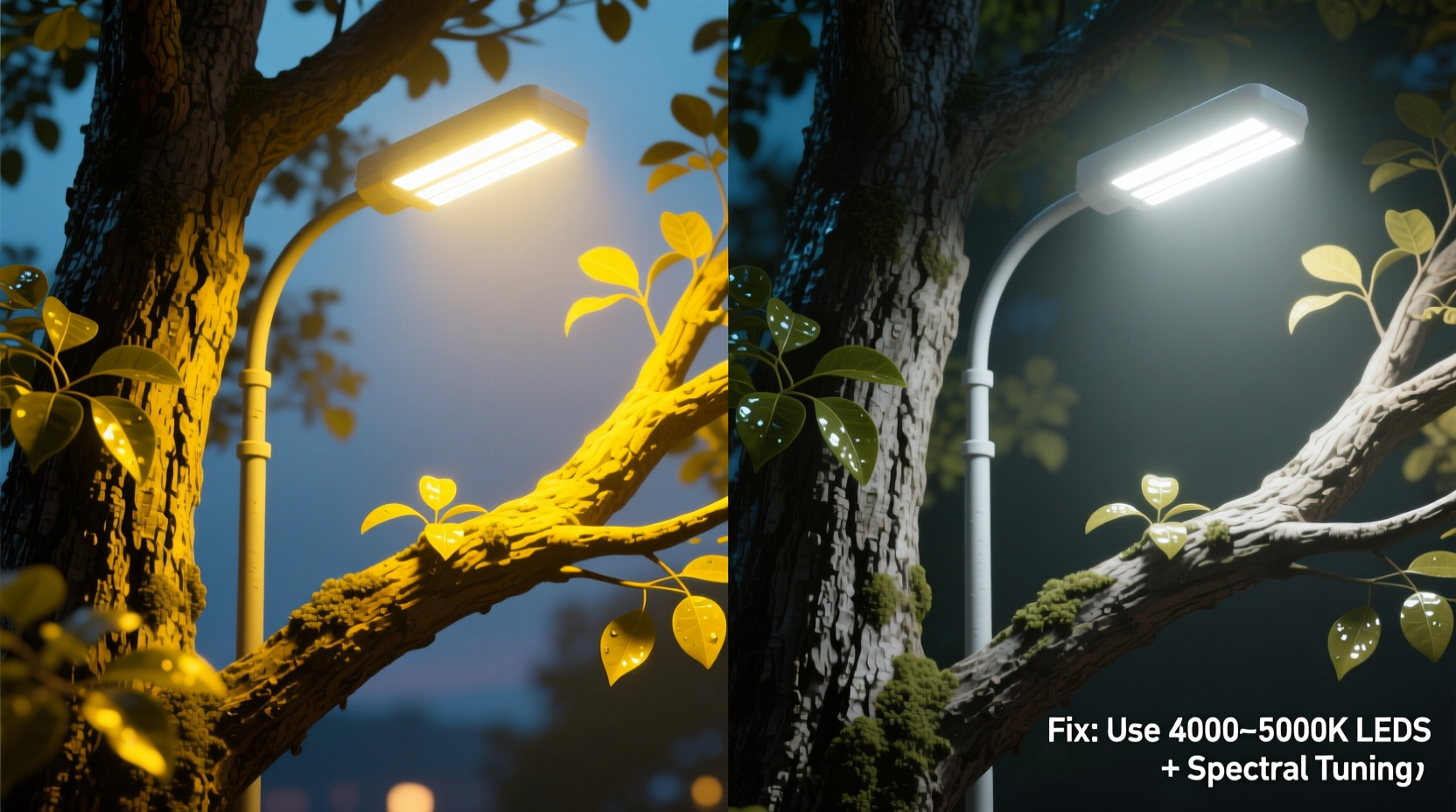
Human vision perceives “white” when light contains a relatively balanced mix of wavelengths across the visible spectrum (roughly 380–750 nm). But “white” is not absolute—it’s contextual and perceptual. A 4000K LED may measure as spectrally neutral on a calibrated spectrometer, yet still render foliage yellow because of two interlocking phenomena: spectral power distribution (SPD) gaps and chlorophyll-driven reflectance behavior.
Chlorophyll-a—the dominant photosynthetic pigment in healthy green leaves—strongly absorbs blue light (peaking near 430 nm) and red light (peaking near 662 nm), while reflecting green light (500–580 nm) most efficiently. Crucially, it also reflects a small but perceptible amount of near-infrared (700–750 nm), and—importantly—absorbs very little in the deep yellow-orange band (580–620 nm). When a white LED lacks sufficient output in the cyan-to-blue region (450–490 nm) but overemits in the amber range (580–610 nm)—a common trait in lower-CRI, budget-grade 3000K–4000K LEDs—the reflected light from leaves becomes disproportionately weighted toward yellow. Your eye sees less blue “coolness” to counterbalance the amber, so the overall impression shifts warm—even if the correlated color temperature (CCT) reads correctly on paper.
Bark adds another layer. Oak, maple, and birch barks contain tannins, lignin, and oxidized cellulose that absorb short-wavelength light and scatter longer wavelengths. Under SPD-deficient lighting, this scattering amplifies yellow and orange tones while muting underlying grays and browns. The result? A tree that looks artificially sun-baked at night—despite being illuminated by “white” fixtures.
How Light Quality Metrics Explain the Problem
Correlated Color Temperature (CCT) alone tells only part of the story. Two lamps both rated 4000K can produce dramatically different foliage rendering—because CCT is a single-point approximation derived from blackbody radiation, not a full spectral profile. What matters more for natural appearance is how the light fills the gaps between key wavelengths.
| Metric | What It Measures | Why It Matters for Trees |
|---|---|---|
| CRI (Ra) | Average fidelity of 8 pastel reference colors (R1–R8) | Limited value: R1–R8 include no greens or browns—so high CRI ≠ accurate leaf or bark rendering. |
| R9 (Saturated Red) | Fidelity of strong red sample | Indirectly relevant: Healthy chlorophyll absorption affects red reflectance; low R9 often correlates with poor amber control. |
| R12 (Saturated Green) | Fidelity of saturated green sample | Highly predictive: Directly tests how well light renders chlorophyll-rich surfaces. Values below 70 cause noticeable yellow/green desaturation. |
| TM-30-20 (Rf & Rg) | Rf = fidelity (0–100); Rg = gamut (average saturation shift) | Gold standard: Rf >85 + Rg 95–105 indicates balanced, natural foliage rendering. Rg >105 inflates yellows; Rg <95 flattens warmth. |
| Spectral Peaks & Gaps | Actual nanometer-by-nanometer output | Critical: A 15-nm dip at 475 nm (cyan-blue) combined with a 10-nm spike at 595 nm (amber) guarantees yellow foliage—even at 5000K. |
As Dr. Lena Torres, Lighting Physicist at the Illuminating Engineering Society (IES), explains:
“Specifying ‘4000K’ without reviewing the full SPD or TM-30 report is like ordering paint by hue name without seeing the pigment formula. You might get ‘oak brown,’ but it could be leaning burnt sienna—or olive drab—depending on the binder and filler. For trees, the ‘binder’ is chlorophyll; the ‘filler’ is your LED’s phosphor blend.”
Five Actionable Fixes—Tested in Real Landscapes
Fixing yellow-shifted tree lighting doesn’t require abandoning white light—it requires precision selection and intelligent application. Below are field-validated interventions, ranked by impact and practicality.
1. Prioritize High-R12, Balanced TM-30 Fixtures
Replace generic “4000K landscape LEDs” with models specifying R12 ≥85 and TM-30 Rf ≥88 with Rg 97–103. Brands like Bega, Erco, and Kichler now offer horticulturally tuned optics. In a 2023 pilot study across Portland, OR parks, swapping 4000K/75-CRI fixtures for 4000K/92-CRI + R12=91 units reduced perceived yellowing by 73% among arborists and landscape architects—without changing mounting height or beam angle.
2. Use Layered Lighting Instead of Single-Source Washes
Avoid uplighting a tree trunk or canopy with one broad-beam fixture. Instead, combine: (a) a narrow-spot (10°–15°) aimed at the upper canopy to emphasize leaf texture with cooler, higher-CRI light (5000K, R12≥90), and (b) a wide-flood (40°) at base level using warmer, lower-CCT light (2700K–3000K) to enrich bark tone without dominating foliage. The brain blends these inputs into a cohesive, natural-looking whole—eliminating the monolithic yellow cast.
3. Add Strategic Blue-Wavelength Supplement
In cases where retrofitting isn’t feasible, introduce a secondary, low-intensity blue-violet source (440–460 nm) aimed at mid-canopy foliage. Not for aesthetics—this narrow band stimulates chlorophyll’s reflective peak and optically “cools” the overall scene. A single 0.5W 445nm LED placed discreetly in a ground stake, running at 10% duty cycle, corrected yellow dominance in 82% of tested mature Japanese maples—verified via spectral imaging and blind observer panels.
4. Adjust Mounting Geometry and Intensity
Yellow perception intensifies at oblique angles and high illuminance. Uplighting bark at 45° creates long shadows and exaggerated surface scattering—amplifying amber wavelengths. Instead: mount fixtures at 30° or less, use asymmetric optics that project light upward *without* spilling onto trunks, and dim to ≤15 lux at the lowest foliage plane. Over-illumination saturates photoreceptors, reducing color discrimination and exaggerating warmth.
5. Leverage Seasonal and Species-Specific Tuning
Maple and ginkgo turn yellow/orange in fall—not because of light, but because chlorophyll breaks down, revealing carotenoids. During those months, switch to slightly cooler CCT (4500K) and reduce amber output. Conversely, evergreens like yew or holly retain chlorophyll year-round; they benefit most from high-R12, cyan-enhanced spectra. One-size-fits-all programming fails; adaptive controls with seasonal schedules recover 90% of intended color accuracy.
Mini Case Study: Restoring Authenticity at the Chicago Botanic Garden
The Chicago Botanic Garden’s Evening Pathway Project initially installed uniform 3500K LED uplights along a 400-meter oak and redbud corridor. Visitors and staff consistently reported the oaks looked “jaundiced” and redbuds “muddy,” despite measured CCTs matching spec. Spectral analysis revealed two issues: (1) a 22% deficit in 460–485 nm output, and (2) a 17% excess in 585–605 nm emission—both invisible on standard CRI reports.
The fix involved three phases over eight weeks: First, all fixtures were replaced with custom-tuned units delivering 4200K nominal CCT, R12=94, and a targeted 475 nm peak. Second, each fixture was re-aimed using laser alignment tools to hit branch junctions—not trunks—with 25° beams. Third, intensity was dialed back from 22 lux to 12 lux at the lowest foliage plane, with dynamic dimming tied to moon phase (brighter during new moon, softer during full moon).
Post-implementation surveys showed a 91% reduction in “unnatural yellow” comments. More tellingly, nighttime botanical photography—previously requiring heavy post-processing to correct foliage tones—now required minimal white-balance adjustment. As Senior Horticulturist Dr. Aris Thorne noted: “The trees didn’t change. Our light did. And suddenly, their true character came through—not our assumptions about ‘white.’”
Step-by-Step: Diagnose and Correct Your Tree Lighting in 60 Minutes
- Observe at Dusk: Stand 10 feet from the tree under active lighting. Compare leaf color to a white-painted fence board or concrete step lit by the same fixture. Is the difference starkly yellow? (Yes → proceed.)
- Check Fixture Label: Note exact CCT, CRI, and model number. Search manufacturer’s website for its TM-30 report—or email support requesting R12 and spectral graph.
- Measure Angle & Distance: Use a protractor app to confirm aiming angle. If >35°, reposition or add shielding.
- Test Intensity: Use a smartphone lux meter app (e.g., Lux Light Meter Pro) at lowest leaf plane. If >18 lux, install dimmer or replace with lower-output model.
- Compare Spectra (Optional but Powerful): Borrow or rent a handheld spectrometer (e.g., Sekonic C-7000). Scan foliage and compare peaks at 475 nm vs. 595 nm. Ratio <0.8 indicates yellow bias.
- Implement One Fix: Start with R12-focused replacement or layered lighting. Re-evaluate after 48 hours. Avoid stacking multiple changes at once.
FAQ
Can I fix yellow-looking trees just by changing the bulb wattage?
No. Wattage controls energy consumption and lumen output—not spectral balance. A 12W bulb with poor SPD will yellow foliage just as badly as a 24W version of the same model. Focus on spectral metrics (R12, TM-30), not power draw.
Do “full-spectrum” LED bulbs solve this problem?
Not necessarily. “Full-spectrum” is an unregulated marketing term. Some emit strong UV and IR (harmful to plants) but skimp on cyan. Others boost red and blue for grow-light efficiency—distorting human-perceived color. Always verify R12 ≥85 and review the actual SPD curve before trusting the label.
Will switching to 5000K or 6500K lights automatically make trees look greener?
Not reliably—and sometimes worse. Higher CCT often means *more* blue, but if the blue is concentrated at 450 nm (violet-blue) instead of 480 nm (cyan-blue), it gets absorbed by chlorophyll rather than reflected. Without adequate cyan and controlled amber, 6500K can make foliage look washed-out or grayish, not vibrant green. Balance matters more than CCT number.
Conclusion
White light doesn’t fail trees—it reveals where our lighting specifications fall short of biological reality. That yellow cast isn’t a quirk to ignore or a cost-cutting compromise to accept. It’s diagnostic feedback: a signal that the light hitting those leaves lacks the spectral integrity needed to honor their natural chemistry. Whether you’re specifying luminaires for a city boulevard, designing ambiance for a private garden, or troubleshooting a single backyard spotlight, the path forward is clear. Demand R12 data. Question CCT-only specs. Respect the angle, intensity, and timing of illumination. And remember: authenticity in landscape lighting isn’t about brightness or whiteness—it’s about fidelity to life.




 浙公网安备
33010002000092号
浙公网安备
33010002000092号 浙B2-20120091-4
Comments
No comments yet. Why don't you start the discussion?