
If you’ve ever woken up in the middle of the night to find a crumpled sock delicately placed beside your pillow—or worse, dropped directly onto your face—you’re not alone. This peculiar yet endearing habit is more common than many realize. While it might seem random or even slightly bizarre, your cat’s nighttime sock deliveries are deeply rooted in instinct, communication, and emotional connection. Understanding the psychology behind this behavior can transform confusion into appreciation and strengthen the bond between you and your feline companion.
Cats don’t operate on human logic. Their actions are guided by evolutionary programming, social dynamics, and sensory perception. The act of bringing you socks—especially at night—is rarely about the sock itself. Instead, it’s a symbolic gesture layered with meaning, from hunting pride to affectionate offerings. By decoding these behaviors, we gain insight into how cats perceive their environment and their role within your household.
The Evolutionary Roots of Feline Gift-Giving
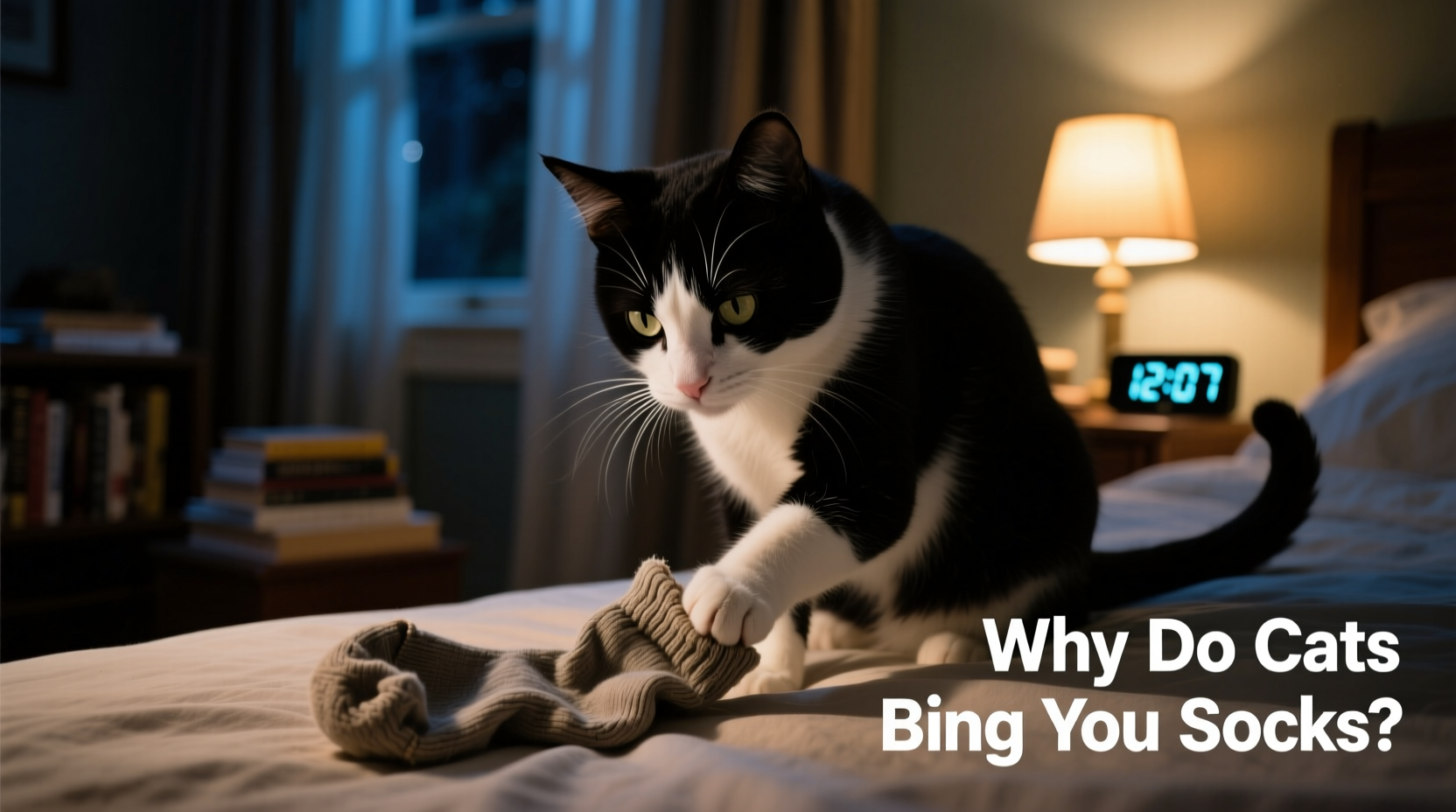
To understand why your cat brings you socks, it helps to look back at their wild ancestors. Domestic cats evolved from solitary hunters who relied on stealth, precision, and resourcefulness. In the wild, successful predators often bring prey back to safe zones—either to consume in peace or share with trusted members of their social group. Though modern housecats don’t need to hunt for survival, those instincts remain hardwired.
When your cat “catches” a sock and presents it to you, they’re engaging in a simulated hunting sequence: stalk, pounce, capture, and present. Socks, especially those worn and carrying your scent, mimic small prey in size, texture, and movement. The fact that this happens at night isn’t coincidental—cats are crepuscular, meaning they’re most active during twilight hours, including early morning and late evening. That’s when their predatory instincts peak.
“Cats don’t distinguish between a mouse and a sock in terms of ‘prey value’ if the object triggers their hunting sequence.” — Dr. Sarah Langston, DVM, Feline Behavior Specialist
This doesn’t mean your cat thinks the sock is alive. Rather, the act of capturing and presenting it fulfills an innate behavioral loop. What makes this gesture meaningful is the choice to bring it to *you*, not hide it or play with it alone. In feline society, sharing captured items is a sign of trust and social inclusion.
Why Socks? And Why at Night?
Not all cats deliver gifts, and among those that do, socks are a surprisingly frequent choice. There are several reasons why socks stand out as preferred “prey”:
- Familiar scent: Socks carry your personal odor, making them comforting and significant to your cat.
- Texture and size: Soft, flexible, and roughly rodent-sized, socks are easy to carry and manipulate.
- Movement potential: A loose sock bunched up or dragged across the floor mimics the erratic motion of small animals.
- Accessibility: Socks are often left on the floor, under beds, or in laundry baskets—prime hunting grounds.
As for timing, nocturnal activity aligns with natural feline rhythms. Your cat may have spent the evening napping, then awakened with pent-up energy. If they aren’t getting enough mental stimulation or physical exercise during the day, they’ll redirect that drive toward indoor “hunting.” The quiet of night also means fewer distractions—no loud TVs, no people moving around—making it the perfect time for focused play and ritualistic behavior.
Is It a Gift, a Cry for Attention, or Something Else?
The interpretation of sock delivery depends on context. While some cats do it purely out of instinct, others use it as a form of communication. Consider the following motivations:
1. Affection and Social Bonding
In multi-cat households or mother-kitten relationships, cats often bring prey to individuals they trust. By offering you a sock, your cat may be treating you as part of their social unit—essentially saying, “I caught this for you.” It’s a compliment, albeit an odd one.
2. Seeking Engagement
If your cat drops a sock at your feet and stares at you expectantly, they may want interaction. They’ve completed their “hunt” and now expect a response—whether it’s praise, play, or simply acknowledgment. Ignoring the offering might lead to repeated attempts, sometimes with louder meows or pawing.
3. Boredom or Understimulation
Cats confined indoors without adequate enrichment can develop repetitive behaviors. Fetching socks becomes a self-reinforcing loop: stalk, catch, present, get reaction (even if it’s just you picking it up). Over time, this turns into a learned routine.
4. Territorial Marking
By placing your scented sock in your sleeping area, your cat may be reinforcing communal scent bonds. It’s a subtle way of maintaining olfactory harmony within their territory—your bed, your scent, their contribution.
| Motivation | Clues to Identify It | How to Respond |
|---|---|---|
| Affection/Bonding | Gentle placement, purring, slow blinks | Soft praise, gentle petting |
| Attention-Seeking | Persistent meowing, pacing, staring | Engage briefly, then redirect to toy |
| Boredom | Repetitive behavior, multiple items brought | Increase daytime play and enrichment |
| Hunting Instinct | Middle-of-the-night timing, chewing/shaking | Provide alternative prey-like toys |
How to Respond Without Encouraging the Habit (If Desired)
While many owners find sock deliveries charming, others may prefer to minimize the behavior—especially if it disrupts sleep or involves inappropriate items (like dirty laundry or expensive clothing). The key is not punishment, which damages trust, but redirection and environmental management.
Step-by-Step Guide to Managing Nocturnal Sock Delivery
- Secure loose items before bedtime: Pick up socks, gloves, scarves, and other small textiles. Store them in closed drawers or hampers.
- Introduce substitute prey: Provide plush toys filled with catnip or silvervine that mimic small animals. Rotate them weekly to maintain novelty.
- Schedule interactive play sessions: Use wand toys to simulate hunting 15–20 minutes before bedtime. This satisfies predatory urges and promotes sleep afterward.
- Use food puzzles or treat-dispensing toys: These engage problem-solving skills and extend mental activity beyond physical play.
- Acknowledge—but don’t over-reward—the gesture: If your cat brings a sock, calmly say “thank you” and remove it without dramatic reactions. Avoid yelling or chasing, which can reinforce attention-seeking.
- Consider a dawn simulator or nightlight: Gentle lighting changes can help regulate your cat’s internal clock, slightly shifting peak activity earlier in the evening.
Real-Life Example: Bella and the Midnight Sock Ritual
Sarah, a graphic designer from Portland, noticed her cat Bella began bringing her socks every night around 2 a.m. At first, she found it amusing. But after weeks of disrupted sleep and missing gym socks, she consulted a feline behaviorist. Upon observation, it became clear that Bella was highly intelligent and under-stimulated during the day while Sarah worked remotely with headphones on, limiting interaction.
The behaviorist recommended structured play sessions using a feather wand twice daily, along with a timed treat dispenser set for midnight. Within two weeks, Bella’s sock deliveries decreased by 70%. She still occasionally brings a toy to the bedroom, but now drops a stuffed mouse instead of a sock—and usually during waking hours.
“It wasn’t about the sock,” Sarah said. “It was about connection. Once I started playing with her intentionally, she didn’t need to wake me up to get my attention.”
Expert Insight: What Veterinarians and Ethologists Say
Feline ethologists emphasize that gift-giving behaviors are normal and should be viewed through the lens of species-specific needs rather than human expectations.
“Bringing objects to owners is not a disorder—it’s a window into the cat’s mind. When we pathologize natural behaviors, we risk misunderstanding our pets. The goal isn’t to stop the behavior entirely, but to ensure it’s expressed in ways that work for both species.” — Dr. Monica Ellis, PhD, Animal Behavior Researcher, Cornell Feline Health Center
Veterinarians also caution against assuming the behavior indicates anxiety or illness unless accompanied by other symptoms like excessive vocalization, aggression, or litter box avoidance. In most cases, sock delivery is benign and even heartwarming once decoded.
Frequently Asked Questions
Is it normal for cats to bring gifts only at night?
Yes. Due to their crepuscular nature, cats are biologically programmed to be most active during low-light periods. Nighttime gift delivery aligns with peak alertness and hunting readiness. However, cats can adapt to human schedules, especially with consistent daytime engagement.
My cat brings me dead mice—how is that different from socks?
Dead prey is the literal fulfillment of hunting instinct; socks are symbolic. Both stem from the same motivation: sharing success with a trusted companion. If your cat is an outdoor hunter, consider supervised outdoor enclosures (catios) or increased indoor enrichment to reduce killing without restricting exploration.
Should I discourage the behavior completely?
Only if it causes distress, sleep disruption, or involves unsafe items. Complete suppression isn’t necessary or advisable. Instead, guide the behavior toward acceptable outlets—like designated toys—and reward calm, non-disruptive presentations during the day.
Final Thoughts: Embracing the Quirks of Feline Love
Your cat doesn’t bring you socks because they think you’re cold or unprepared for laundry day. They do it because, in their world, you’re family. Whether driven by instinct, affection, or a desire for interaction, this behavior reflects a deep-seated need to connect on their own terms. Rather than seeing it as a nuisance, consider it a unique expression of trust—a silent declaration that you are part of their inner circle.
With thoughtful environmental adjustments and a little patience, you can honor your cat’s instincts while preserving your sleep and sock drawer. The goal isn’t to eliminate quirks, but to understand them. After all, it’s these mysterious, tender gestures that make life with cats so profoundly rewarding.




 浙公网安备
33010002000092号
浙公网安备
33010002000092号 浙B2-20120091-4
Comments
No comments yet. Why don't you start the discussion?