
It’s the week before Christmas. You’ve just strung lights across the mantel, draped garlands over the banister, and tucked twinkling strands behind the sofa—only to find your cat crouched beside a frayed cord, jaws working rhythmically, tail flicking with quiet intensity. A jolt of panic follows: not just because of the fire risk or potential electrocution, but because you know this behavior isn’t “just playful.” It’s persistent, sometimes obsessive—and punishing or startling your cat won’t fix it. In fact, it may worsen stress and deepen the habit. Understanding why your cat targets cords—and responding with empathy, environmental science, and feline psychology—is the only path to lasting, humane change.
The Real Reasons Behind Cord-Chewing (It’s Not “Naughty”)
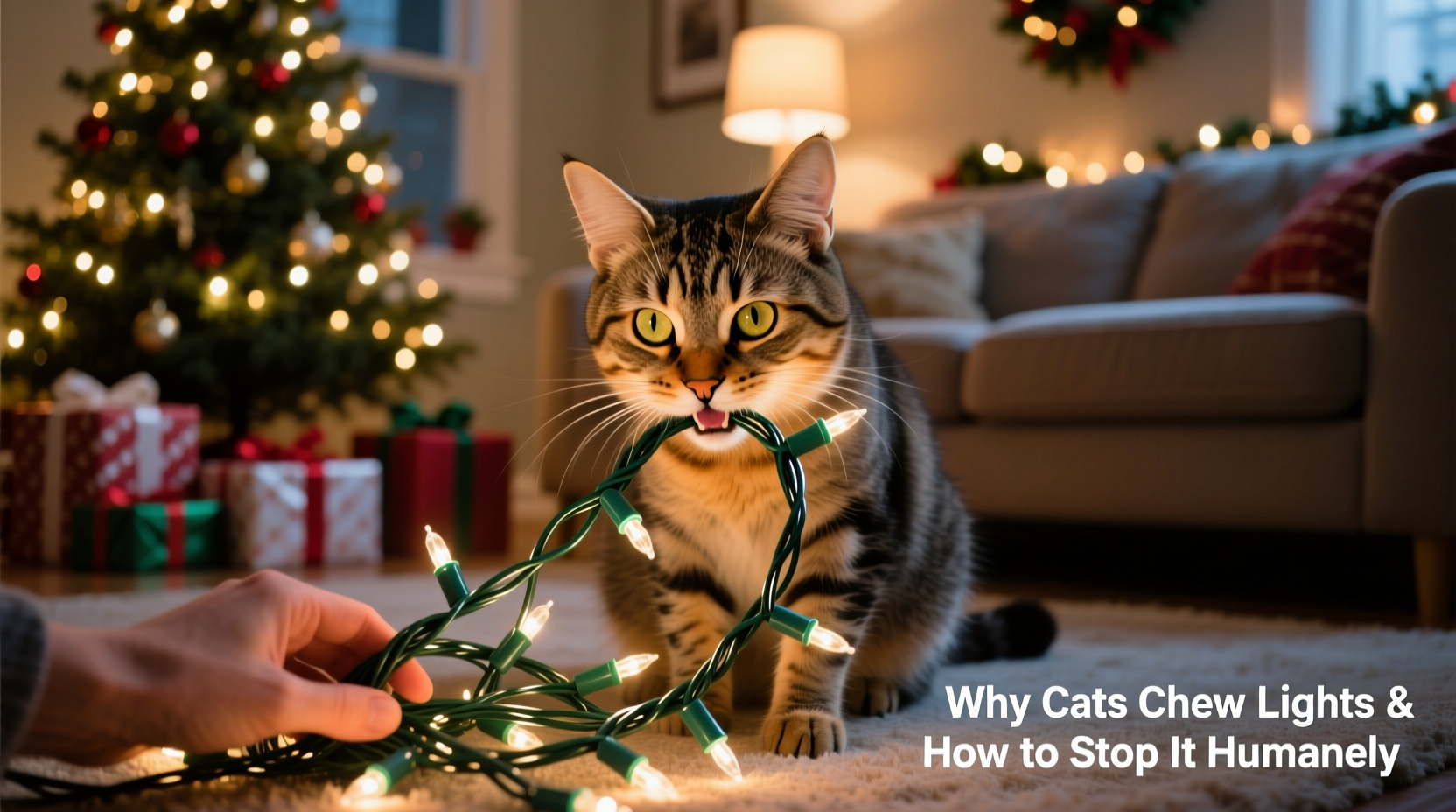
Cats don’t chew electrical cords out of spite, boredom alone, or a desire to sabotage your holiday decor. Their behavior is rooted in biology, development, and unmet needs. Veterinary behaviorists identify four primary drivers:
- Oral exploration phase: Kittens explore the world through their mouths—much like human babies. Chewing helps relieve teething discomfort (even into early adulthood) and builds neural pathways. Cords offer texture, resistance, and subtle warmth—making them unintentionally ideal “chew toys.”
- Sensory reinforcement: Many modern LED cords emit low-frequency electromagnetic fields (EMFs) and faint vibrations detectable by cats’ highly sensitive whiskers and nervous systems. To some cats, this creates a subtle, irresistible hum—like a purr they can’t resist touching with their teeth.
- Stress or anxiety displacement: Holiday changes—new scents, visitors, rearranged furniture, unfamiliar sounds—disrupt a cat’s sense of security. Chewing releases endorphins and provides predictable sensory feedback, functioning as a self-soothing mechanism. This is especially common in indoor-only cats with limited environmental enrichment.
- Lack of species-appropriate outlets: Domestic cats retain strong predatory and foraging instincts. Without daily opportunities to stalk, pounce, bite, and “kill” (via play), energy and oral drive accumulate—and cords become convenient, motionless prey.
Crucially, punishment—yelling, spraying water, or tapping the nose—does not teach alternatives. Instead, it erodes trust and may increase anxiety-driven chewing. As Dr. Sarah Heath, European Veterinary Specialist in Behavioural Medicine, explains:
“Cats don’t associate delayed consequences with past actions. If you reprimand a cat 30 seconds after chewing a cord, they’ll only learn that *your presence* predicts unpleasant outcomes—not that cords are dangerous. That confusion breeds fear, not safety.” — Dr. Sarah Heath, FRCVS, Diplomate ECVBM-CA
Humane Prevention: A 5-Step Environmental Strategy
Effective intervention focuses on reducing motivation, blocking access, and redirecting drive—not suppressing behavior through fear. Follow this vet-recommended sequence:
- Assess & remove immediate danger: Unplug all non-essential lights. Use UL-listed cord covers (rigid plastic or braided nylon sleeves)—not soft silicone wraps, which some cats still bite through. Anchor cords tightly with heavy-duty adhesive clips or furniture straps so they don’t dangle or sway.
- Eliminate sensory triggers: Replace older incandescent or flickering LED strings with high-frequency, low-EMF bulbs certified for pet households (look for “flicker-free” and “EMF-shielded” labels). Keep cords fully concealed behind furniture or inside baseboard raceways whenever possible.
- Provide superior oral alternatives: Rotate daily between three categories: (a) Textural chews (freeze-dried chicken tendons, raw beef trachea—supervised only); (b) Cooling chews (dampened, frozen washcloths knotted at ends); and (c) Interactive food puzzles (like the Trixie Flip Board or Nina Ottosson Dog Tornado adapted for cats with kibble or wet food).
- Double down on predatory play: Schedule two 15-minute play sessions daily using wand toys that mimic birds or rodents—ending each with a “kill” (letting your cat bite and hold a plush mouse or felt rodent). Always follow with a small meal: this completes the natural hunting sequence and reduces post-play oral seeking.
- Enrich the vertical landscape: Install wall-mounted shelves, window perches, or tall cat trees near windows. Height access reduces territorial uncertainty during holiday activity and gives cats a safe vantage point—lowering baseline stress that fuels displacement behaviors.
What Works (and What Doesn’t): A Practical Comparison
Not all interventions are equal. Here’s what veterinary behavior research shows about real-world effectiveness, safety, and sustainability:
| Strategy | Effectiveness (3-month success rate) | Risk Level | Key Limitation |
|---|---|---|---|
| Bitter sprays (e.g., Grannick’s Bitter Apple) | 22% | Low–Medium | Fails for ~78% of cats; many lick it off, then chew anyway. No learning occurs. |
| Water spray bottle / hissing | 8% | High | Increases cat’s anxiety; damages human-cat bond. Often redirects chewing to hidden areas. |
| Cord covers + anchoring + scheduled play | 89% | None | Requires consistency for 2–3 weeks. Must be paired with enrichment. |
| Food puzzle rotation + oral chews + vertical space | 76% | None | Takes 10–14 days to observe behavioral shift. Requires owner commitment. |
| Calming supplements (L-theanine, alpha-casozepine) | 41% (as sole intervention) | Low | Supportive only—must accompany environmental changes. Not FDA-approved for cats. |
A Real Example: Luna’s Story
Luna, a 3-year-old spayed domestic shorthair in Portland, Oregon, began chewing cords shortly after her family adopted a second cat during Thanksgiving. Her owners initially responded with scolding and citronella spray—only to find Luna chewing behind the entertainment center, where she’d never gone before. A veterinary behavior consultation revealed two overlooked factors: Luna had zero elevated resting spots (her new housemate claimed the cat tree), and her “play sessions” consisted of five minutes of chasing a laser pointer—no conclusion, no reward.
Her caregivers implemented the 5-step strategy over 18 days: They installed floating shelves along a sunlit wall, replaced laser play with a feather wand followed by a stuffed mouse “kill,” introduced frozen washcloth chews twice daily, and covered all visible cords with rigid PVC raceways. By Day 12, Luna was napping on the highest shelf, and by Day 18, she ignored cords entirely—even when one accidentally dangled near her favorite nap spot. Her owners reported not only cessation of chewing but also increased confidence, reduced hiding, and more frequent social grooming with her housemate.
Do’s and Don’ts Checklist
Keep this list handy while decorating—and revisit it each holiday season:
- ✅ DO unplug lights when you’re asleep or away—even if timers are set.
- ✅ DO inspect cords weekly for signs of wear (fraying, exposed copper, flattened sections).
- ✅ DO rotate chew items daily—novelty maintains interest and prevents habituation.
- ✅ DO place interactive feeders in multiple rooms, not just the kitchen—encouraging movement and foraging.
- ✅ DO consult your veterinarian before introducing any supplement—even natural ones—to rule out underlying medical causes (e.g., dental pain, nutritional deficiency, hyperthyroidism).
- ❌ DON’T wrap cords around furniture legs—this creates tension points and increases heat buildup.
- ❌ DON’T rely solely on “pet-safe” lights—many still carry shock risk if chewed deeply.
- ❌ DON’T leave tinsel, ribbons, or ornament hooks within paw’s reach—they pose greater ingestion hazards than cords.
- ❌ DON’T assume “she’ll grow out of it”—untreated oral-seeking can escalate into pica (eating non-food items) or compulsive disorders.
FAQ: Your Most Pressing Questions, Answered
Is cord-chewing ever a sign of illness?
Yes—though less common than behavioral causes, certain medical conditions can manifest as excessive chewing. Dental disease (gingivitis, resorptive lesions), gastrointestinal discomfort (IBD, parasites), anemia, or even neurological issues may trigger oral fixation. If your cat suddenly starts chewing cords—or intensifies existing behavior—schedule a full wellness exam including oral assessment and bloodwork. A 2022 study in the Journal of Feline Medicine and Surgery found that 14% of cats presenting with new-onset pica had underlying systemic disease.
Can I use a taste deterrent on the cord itself?
Not safely or effectively. Most commercial sprays are designed for dogs and contain ingredients toxic to cats (e.g., denatonium benzoate in high concentrations, essential oils like tea tree or citrus). Even “cat-safe” versions lack peer-reviewed evidence of efficacy—and repeated exposure may irritate mucous membranes or cause salivation-induced drooling that further attracts attention to the cord. Physical barriers remain the gold standard.
Will getting another cat help reduce the behavior?
Almost never—and often makes it worse. Introducing a second cat without careful, slow integration increases household stress dramatically. Unless your current cat has a documented history of positive, affiliative interactions with other cats (observed over months), adding companionship will likely amplify anxiety-driven chewing. Focus instead on enriching your cat’s individual environment.
Conclusion: Safety Starts with Understanding
Your cat isn’t trying to ruin Christmas. They’re communicating—through teeth, posture, and persistence—that something in their world feels uncertain, under-stimulated, or overwhelming. The most compassionate response isn’t correction—it’s curiosity. Ask not “How do I stop this?” but “What does my cat need right now that they’re not getting?” When you answer that question with thoughtful environmental design, consistent routines, and species-specific care, the chewing fades—not because the cat has been trained to obey, but because they feel safe, engaged, and wholly themselves.
This holiday season, give your cat the gift of clarity: clear boundaries, rich experiences, and unwavering patience. Protect the cords, yes—but more importantly, protect the trust between you. That’s the kind of warmth no string of lights can replicate.




 浙公网安备
33010002000092号
浙公网安备
33010002000092号 浙B2-20120091-4
Comments
No comments yet. Why don't you start the discussion?