
Every December, a familiar scene unfolds in homes across the country: ornaments scatter like fallen stars, tinsel hangs from startled ears, and a wide-eyed cat perches triumphantly—then precariously—on the top branch of the Christmas tree. It’s equal parts adorable and alarming. But this isn’t mischief for mischief’s sake. Your cat isn’t “being bad.” They’re responding to deeply rooted instincts, environmental cues, and unmet needs. Understanding the *why* is the first step toward a peaceful, joyful, and truly safe holiday season—not just for your tree, but for your cat.
The Instincts Behind the Ascent
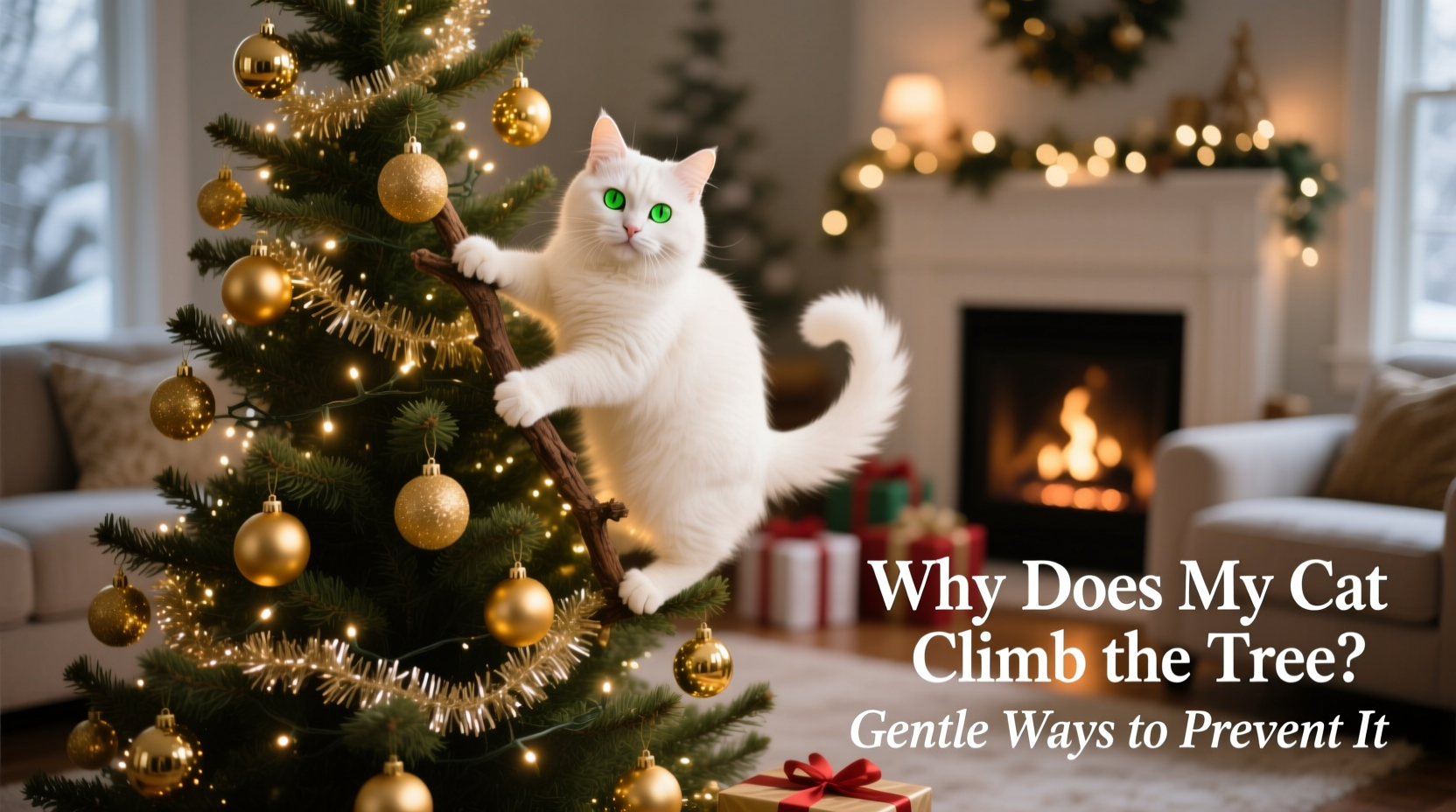
Cats don’t climb Christmas trees because they’ve read a holiday manual. They climb because their biology hasn’t caught up with our decor choices. Three core instincts drive this behavior:
- Vertical territory seeking: In the wild, cats use height to survey their domain, spot predators or prey, and assert social standing. A tall, stable, evergreen structure in the center of the living room is an irresistible invitation—especially if floor-level space feels crowded or contested.
- Novelty-driven exploration: Cats are neophilic—they’re drawn to new objects, textures, and scents. A freshly erected tree brings unfamiliar resin, pine needles, crinkling foil, dangling lights, and shifting shadows. To a curious feline, it’s less “holiday centerpiece” and more “interactive sensory installation.”
- Play and predatory impulse: Swinging ornaments mimic prey movement. Twinkling lights pulse like insects. Tinsel shimmers like water or small animals. Even the static charge of synthetic garlands can create subtle zaps that intrigue sensitive paws. What looks like decoration to us reads as stimulation—or even challenge—to a cat’s finely tuned nervous system.
This behavior peaks in kittens and young adults (under 3 years), but older cats may join in if their environment lacks enrichment or if household routines shift dramatically during the holidays—disrupting their sense of security.
Why Punishment Doesn’t Work (And What Happens Instead)
Shouting, spraying water, or tapping a cat’s nose when they approach the tree doesn’t teach them “this is off-limits.” It teaches them that *you* are unpredictable or threatening near the tree. Stress hormones like cortisol rise, often worsening the behavior through displacement—your cat may retreat briefly, then return with heightened intensity, or redirect frustration onto furniture, other pets, or even themselves.
More critically, punishment erodes trust. A 2022 study published in Applied Animal Behaviour Science found that cats subjected to aversive training methods showed increased avoidance of owners, reduced play initiation, and higher baseline stress markers—even weeks after interventions ended. As veterinary behaviorist Dr. Sarah Heath explains:
“Cats don’t associate punishment with the object they interacted with—they associate it with the person delivering it. If you want your cat to feel safe in your home during the holidays, safety must include predictability, choice, and positive association—not correction.” — Dr. Sarah Heath, RCVS Specialist in Veterinary Behavioural Medicine
Gentle prevention isn’t about control. It’s about collaboration—reshaping the environment so your cat’s natural drives are met *elsewhere*, making the tree irrelevant—not forbidden.
Gentle Prevention: A Step-by-Step Strategy
Effective prevention works on three levels: reducing appeal, increasing alternatives, and reinforcing safety—all without coercion. Follow this sequence over 3–5 days before tree setup (or immediately upon noticing climbing attempts):
- Assess your cat’s baseline needs: Track daily play sessions, vertical space access, and solo time for 48 hours. Note when climbing attempts occur (e.g., post-dinner, early morning). This reveals timing patterns and potential gaps in routine.
- Install dedicated vertical zones *before* the tree arrives: Place two or three sturdy cat trees or wall-mounted shelves at varying heights—ideally near windows (for bird-watching) and away from the planned tree location. Anchor them securely; wobbling undermines confidence.
- Introduce novel, tree-like enrichment *away* from the real tree: Hang a sisal-wrapped pole or a hanging toy bundle (feathers + bells + crinkle paper) from a ceiling hook in a high-traffic area. Rotate scents (catnip, silvervine) weekly to sustain interest.
- Tree-proof *during* setup—not after: Use a stable, weighted base. Wrap the bottom 24 inches of the trunk in double-sided tape (cats dislike the stickiness on paws) or aluminum foil (startled by texture and sound). Avoid citrus sprays—they irritate mucous membranes and can cause respiratory distress.
- Reinforce alternative behaviors consistently: Each time your cat uses a shelf or plays with a dangling toy, offer a high-value treat (e.g., freeze-dried chicken) *and* gentle praise. Never reward proximity to the tree—even for “just looking.” Reward only desired actions, elsewhere.
Do’s and Don’ts: A Practical Comparison
| Action | Do | Don’t |
|---|---|---|
| Tree Base Stability | Use a heavy, wide-based stand filled with water *and* sand or gravel for added weight | Rely solely on lightweight plastic stands or decorative buckets |
| Ornament Selection | Choose soft, fabric, or felt ornaments; avoid glass, mercury glass, or anything with small detachable parts | Hang fragile heirlooms, tinsel, ribbons, or ornaments with loops large enough for a paw to slip through |
| Lighting Safety | Use LED lights (cooler, lower voltage); secure cords inside cord covers or behind furniture | Leave cords exposed, use incandescent bulbs (heat risk), or drape lights loosely where paws can snag |
| Supervision Protocol | Designate “tree time” (e.g., 20 minutes post-dinner) when you actively engage your cat with wand toys near their shelves | Leave the tree unattended for >90 minutes when your cat is unsupervised—especially overnight |
| Post-Climb Response | Calmly lift your cat down, place them on their preferred shelf, and offer a treat + quiet petting | Yell, chase, or physically restrain while saying “no”—this increases arousal and reinforces the tree as a high-stakes zone |
A Real Example: The Miller Household
The Millers adopted Luna, a 14-month-old tabby, in October. By early December, she’d scaled their 6-foot Fraser fir twice—once knocking over three ornaments and once getting her paw tangled in loose garland. Frustrated, they initially tried citrus spray and verbal corrections. Luna began hiding under the sofa when guests arrived and stopped greeting them at the door.
They consulted a certified feline behavior consultant, who observed Luna’s routine: no elevated resting spots, minimal interactive play, and a tendency to stalk dust motes near the window each afternoon. The consultant recommended three changes: (1) installing a wall-mounted perch beside the window, (2) scheduling two 7-minute play sessions daily using a feather wand, and (3) wrapping the tree’s lower trunk in foil *before* decorating.
Within four days, Luna used the perch for 80% of her daytime resting. She initiated play more frequently. And when the tree was decorated, she investigated the foil briefly—sniffed, tapped once, then walked away to nap on her shelf. No climbing occurred over the next three weeks. Crucially, her confidence returned: she greeted visitors again and resumed sleeping on their bed.
This wasn’t about “breaking” a habit. It was about meeting Luna’s needs so the tree lost its magnetic pull.
FAQ: Addressing Common Concerns
My cat only climbs at night—can I use motion-activated deterrents?
No. Motion-activated air sprays, ultrasonic devices, or flashing lights increase anxiety and disrupt sleep cycles. Cats associate the startling stimulus with the *location*, not the action—so they may avoid the entire room, not just the tree. Instead, install a dim nightlight near your cat’s preferred shelf and place a calming pheromone diffuser (Feliway Optimum) in the living room 48 hours before tree setup.
What if my cat has already damaged the tree or injured herself?
First, consult your veterinarian—even minor falls can cause spinal misalignment or jaw trauma invisible to the naked eye. Next, pause tree access entirely for 72 hours. During this time, enrich alternative zones aggressively: add new scratching surfaces, rotate toys daily, and hand-feed meals in puzzle feeders placed on shelves. Reintroduce the tree gradually: start with the bare trunk for 24 hours, then add one low-hanging ornament (soft, non-breakable) for another 24 hours—only proceeding if zero interest is shown.
Will neutering/spaying reduce tree climbing?
Not directly. While sterilization lowers roaming and some hormonally driven behaviors, climbing is primarily instinctual and environmental—not hormonal. However, intact cats may be more reactive to novelty due to heightened vigilance, so sterilization can support overall calmness *as part of* a broader enrichment plan.
Building a Holiday That Works for Everyone
Your cat isn’t trying to sabotage your traditions. They’re navigating a world suddenly full of towering green structures, blinking lights, and unfamiliar scents—with no instruction manual. When we respond with curiosity instead of correction, with enrichment instead of exclusion, we honor who they are: sentient, instinct-driven companions deserving of dignity, safety, and joy.
The goal isn’t a perfectly still tree—it’s a home where wonder coexists with wellbeing. Where your cat chooses the sunbeam on the windowsill over the precarious tip of a branch. Where the scent of pine means comfort, not chaos. This requires patience, observation, and consistency—but the return is profound: deeper trust, calmer interactions, and holidays defined not by damage control, but by shared peace.
Start today. Move one shelf. Buy one sisal pole. Swap three ornaments. Small shifts compound into meaningful change—not just for December, but for every season ahead.




 浙公网安备
33010002000092号
浙公网安备
33010002000092号 浙B2-20120091-4
Comments
No comments yet. Why don't you start the discussion?