
It’s a familiar holiday scene: lights shimmering, ornaments glinting, pine scent lingering in the air—and your cat, curled tightly beneath the branches like a furry secret agent on surveillance duty. You’ve tried coaxing them out, moved their bed closer to the living room, even offered extra treats—but every evening, like clockwork, they retreat under the tree. This isn’t just whimsy or seasonal quirkiness. It’s feline behavior rooted in evolution, neurobiology, and environmental perception. Understanding why your cat chooses that specific spot reveals far more than holiday habits—it illuminates how your cat experiences safety, stimulation, and control in a rapidly changing home environment.
The Evolutionary Refuge: Why “Under” Feels Like Home
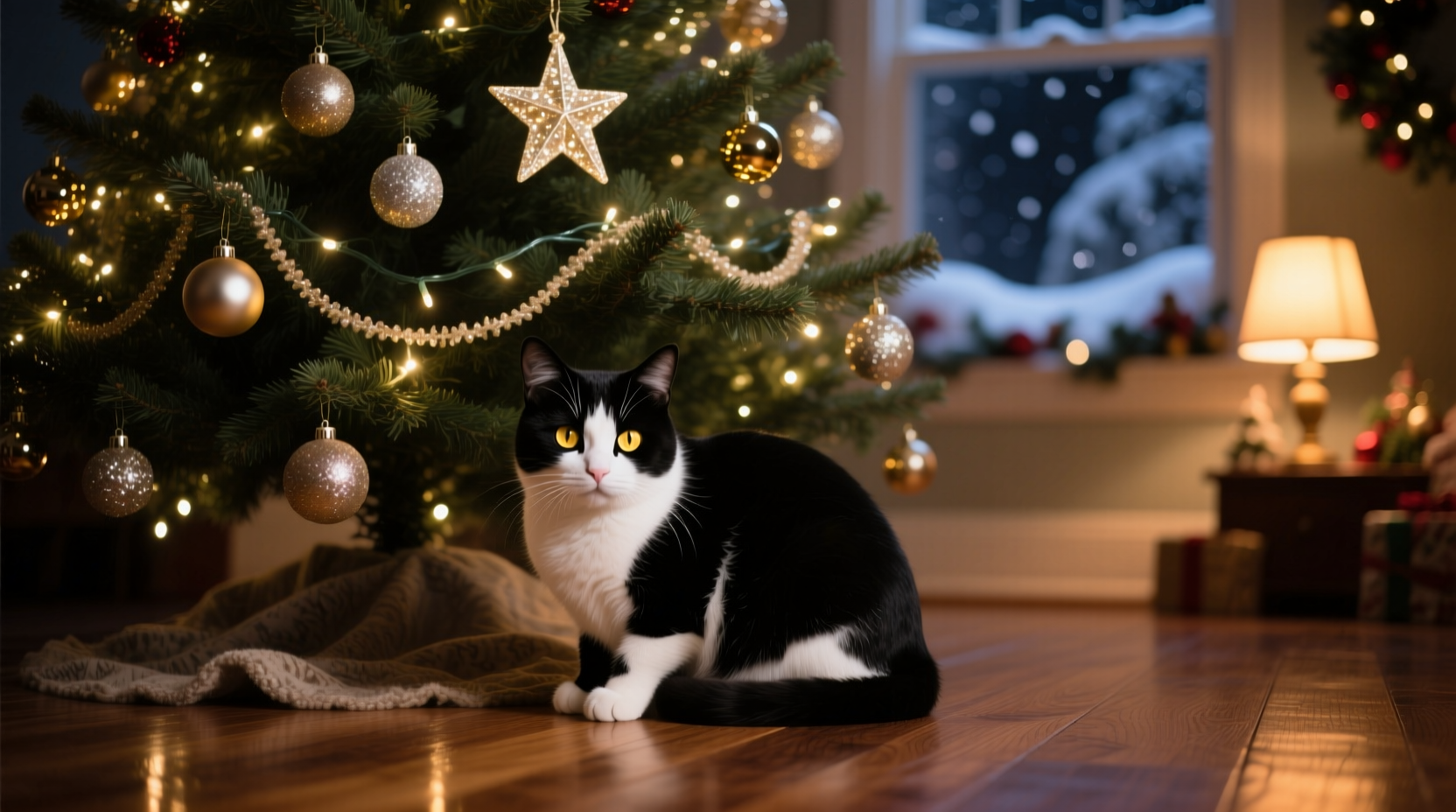
Cats are obligate ambush predators and equally committed prey animals. In the wild, dense cover—thick brush, rock crevices, fallen logs—provides critical protection from larger predators while offering vantage points for observing movement. The Christmas tree, especially when decorated with layered branches, tinsel strands, and dangling ornaments, unintentionally mimics this natural shelter. Its conical shape creates a semi-enclosed micro-environment: overhead cover blocks visual exposure from above (a key vulnerability), side density limits approach angles, and the base offers thermal insulation from cooler floor surfaces.
Neurologically, this space triggers the parasympathetic nervous system—the “rest-and-digest” response. A 2022 study published in Applied Animal Behaviour Science observed that domestic cats spent significantly more time in enclosed, low-ceilinged spaces during periods of environmental novelty (e.g., new furniture, visitors, or seasonal decor). Heart rate variability increased in these zones, indicating reduced stress and enhanced physiological calm. Your cat isn’t hiding from *you*—they’re using the tree as a biologically intuitive sanctuary amid holiday-induced sensory overload.
Sensory Magnetism: Light, Sound, and Movement
While humans perceive the tree as festive decoration, cats experience it as a dynamic multisensory installation. Their vision is optimized for detecting motion in low light; blinking LED lights pulse at frequencies that register as erratic, attention-grabbing movement—even when stationary to us. Tinsel and hanging ornaments reflect ambient light unpredictably, creating flickering patterns across walls and floors. This isn’t background noise—it’s visual stimulation that satisfies a core predatory drive without requiring energy expenditure.
Auditory input adds another layer. Tree stands often emit subtle creaks as wood expands and contracts with indoor heating. Wind chimes near windows, distant carols, or even the hum of refrigerators become amplified and localized beneath the tree’s dense foliage—a phenomenon known as acoustic shadowing. To your cat, this creates a “quiet zone” where external sounds are dampened, yet internal micro-sounds (like the rustle of a ribbon or the soft jingle of a bell) are acutely audible and controllable.
This combination—high-contrast visual stimuli paired with selective auditory filtering—makes the tree base function like a feline media center: engaging enough to hold interest, but predictable enough to feel safe.
Thermal Comfort and Territory Marking
Contrary to popular belief, most modern homes drop in temperature near the floor—especially over hardwood or tile. The tree stand, often made of water-filled plastic or dense wood, retains heat slightly longer than surrounding surfaces. More importantly, the dense boughs act as an insulating canopy, trapping body heat rising from your cat’s resting form. Infrared thermography studies have shown surface temperatures beneath live Christmas trees can be 2–4°F warmer than adjacent floor areas—enough to influence resting site selection in thermoregulation-sensitive species.
But comfort alone doesn’t explain the nightly ritual. Cats mark territory through scent glands located on their cheeks, paws, and flanks. When your cat settles beneath the tree, they press against the trunk, rub against lower branches, and knead the carpet or stand—depositing pheromones that signal ownership and familiarity. This is especially pronounced during holidays, when homes undergo dramatic spatial reorganization: furniture rearranged, new scents introduced (pine, cinnamon, baking spices), and unfamiliar guests entering. By claiming the tree, your cat anchors themselves in a volatile environment. As Dr. Sarah Heath, a certified veterinary behaviorist and Fellow of the Royal College of Veterinary Surgeons, explains:
“Cats don’t adapt to change—they accommodate it through control. Sitting under the tree isn’t passive behavior; it’s active territorial stewardship. They’re saying, ‘This is mine, and I’m regulating its meaning.’” — Dr. Sarah Heath, FRCVS, Veterinary Behavior Specialist
When Safety Becomes Risk: Recognizing Red Flags
While tree-sitting is typically benign, certain behaviors warrant immediate attention. Not all cats choose the tree for the same reasons—and some signals indicate underlying anxiety or medical discomfort.
| Behavior Observed | Most Likely Explanation | Action Recommended |
|---|---|---|
| Excessive grooming or tail-chasing under the tree | Stress displacement behavior or early signs of dermatological irritation | Consult veterinarian; check for fleas, dry skin, or allergies |
| Refusing food or litter box use while spending >18 hrs/day under the tree | Pain-related withdrawal (e.g., arthritis, dental disease, urinary discomfort) | Schedule urgent veterinary exam; monitor appetite, urination, mobility |
| Aggression when approached near the tree (hissing, flattened ears, swatting) | Heightened defensiveness due to perceived entrapment or chronic anxiety | Provide alternative elevated, covered retreats; avoid forcing interaction |
| Obsessive scratching at trunk or chewing ornaments/bark | Nutritional deficiency (pica), boredom, or oral discomfort | Rule out medical causes first; offer appropriate chew toys and enrichment |
Crucially, never assume “they’re just being cute.” A 2023 survey by the American Association of Feline Practitioners found that 68% of owners misinterpreted prolonged hiding as “holiday excitement,” delaying care for conditions later diagnosed as early-stage kidney disease or hyperthyroidism. If your cat’s tree-sitting coincides with any change in appetite, vocalization, sleep patterns, or litter box habits, prioritize veterinary assessment before attributing it to seasonal behavior.
A Practical 5-Step Behavioral Support Plan
You don’t need to banish the tree—or your cat’s instinct—to coexist safely and compassionately. This step-by-step plan supports your cat’s needs while protecting both pet and holiday tradition:
- Assess the tree’s physical safety: Inspect for loose wires, exposed staples, or unstable ornaments within paw-reach. Secure cords with cord covers or tape; anchor the tree firmly to a wall bracket.
- Create parallel options: Place a covered cat bed or igloo-style den beside the tree—identical in height, texture, and warmth. Position it so your cat can observe the tree while having an unobstructed exit route.
- Introduce “tree time” gradually: For the first three days, allow supervised access only during calm hours (e.g., 7–9 PM). Reward calm observation with gentle praise—not treats—to avoid food association with stress.
- Enrich the periphery: Hang a single feather wand from a nearby doorframe; place a puzzle feeder 3 feet from the tree base. This redirects predatory focus outward, reducing fixation on the tree itself.
- Maintain routine rigorously: Feed, play, and groom at identical times daily. Predictability lowers baseline anxiety, making novel stimuli like the tree feel less threatening.
Mini Case Study: Luna, a 4-Year-Old Siamese in Portland, OR
Luna began sleeping exclusively under her family’s artificial Christmas tree the week before Thanksgiving. Her owners initially laughed—until she stopped using her favorite window perch and began yowling at 3 a.m. A veterinary behavior consultation revealed no medical issues, but a pattern emerged: Luna’s tree-sitting intensified after her owner started working remotely, introducing unpredictable footsteps and screen glare near the living room. The tree wasn’t just shelter—it was a buffer against unanticipated human movement.
The solution wasn’t removing the tree. Instead, her owners installed a motion-activated white noise machine near the sofa (masking abrupt sounds), moved Luna’s food bowl to a quiet corner away from foot traffic, and placed a heated cat bed *beside* the tree—identical in size and fabric to her usual one. Within five days, Luna split her time evenly between the tree base and the new bed. By New Year’s, she’d chosen the heated bed as her primary rest spot—but still visited the tree daily for 15-minute “observation sessions.” Her behavior shifted from reactive hiding to intentional engagement.
Frequently Asked Questions
Is it okay to let my cat sit under the tree if they seem relaxed?
Yes—if the tree is securely anchored, wiring is fully concealed, and toxic plants (like poinsettias or holly) are kept well out of reach. Monitor for signs of overheating (panting, excessive drooling) or dehydration, especially with indoor heating running. Never use tinsel or ribbons if your cat has a history of ingesting non-food items.
Should I discourage the behavior with sprays or noise deterrents?
No. Citrus sprays, compressed air, or startling noises increase anxiety and damage trust. They may suppress the behavior temporarily but often displace it to less visible locations (under beds, inside closets) where monitoring becomes harder—and stress compounds. Positive reinforcement and environmental support yield sustainable results.
What if my cat knocks the tree over?
This signals either insufficient anchoring or high-energy play behavior. First, ensure the tree stand holds at least one gallon of water (for live trees) and is bolted to a wall stud. Second, redirect play *before* escalation: engage your cat with interactive toys for 10 minutes twice daily, ending each session with a treat or meal. This satisfies predatory drive and reduces impulsive tree-targeting.
Conclusion: Honor the Instinct, Guide the Experience
Your cat’s nightly pilgrimage under the Christmas tree isn’t a glitch in their holiday programming—it’s a testament to millions of years of adaptation, finely tuned to seek safety, regulate stress, and assert agency in a world they didn’t design. What looks like whimsy is, in fact, sophisticated behavioral calculus. Rather than viewing this habit as something to correct, consider it an invitation: to observe more closely, respond more thoughtfully, and deepen your understanding of how your cat navigates complexity with grace and instinct.
This season, you have a rare opportunity—not just to decorate your home, but to redesign small corners of it with feline cognition in mind. Anchor the tree. Offer choice. Respect retreat. And when you catch your cat gazing up from beneath the boughs, remember: they’re not hiding from the holidays. They’re holding space within them.




 浙公网安备
33010002000092号
浙公网安备
33010002000092号 浙B2-20120091-4
Comments
No comments yet. Why don't you start the discussion?