
It’s a familiar holiday frustration: you bring home a lush, fragrant Fraser fir or noble pine—carefully cut the trunk, place it in water, and within 48 to 72 hours, needles begin shedding like confetti. Branches stiffen. The scent fades. Within five days, your tree looks more like a fire hazard than a centerpiece. This isn’t bad luck or poor selection—it’s almost always preventable. Drying isn’t random; it’s the visible symptom of disrupted water uptake, accelerated by specific environmental and handling errors. Understanding the science behind tree hydration—and applying precise, timely interventions—can extend freshness from under a week to three full weeks, even in heated homes.
The Science of Tree Hydration (and Why It Fails So Quickly)
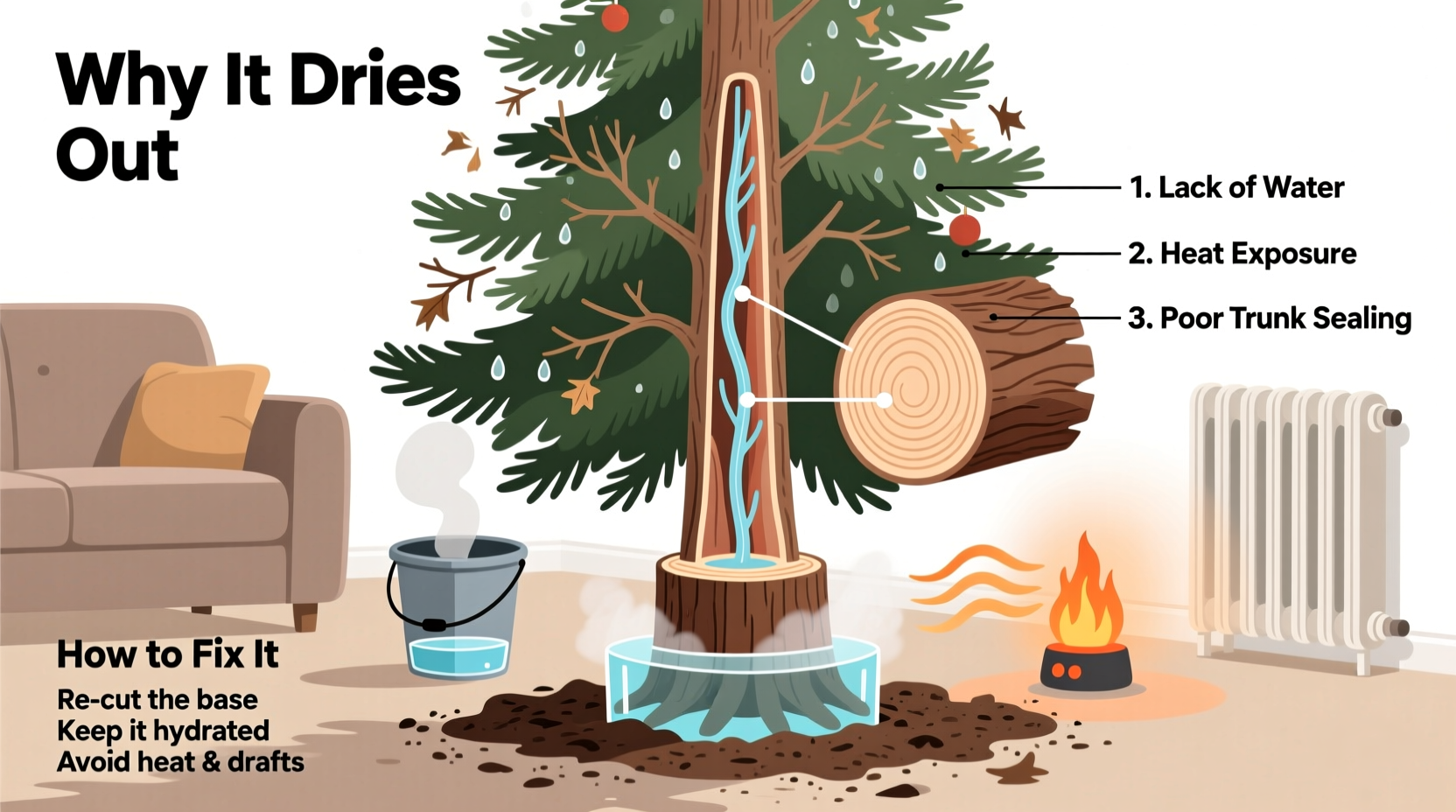
Unlike living plants with active root systems, a cut Christmas tree relies entirely on passive capillary action to draw water upward through microscopic vessels called tracheids. These vessels function like tiny straws—but only when their ends remain open and unobstructed. When a tree is cut, air is drawn into the cut surface, forming embolisms that block water flow. If the trunk isn’t re-cut *immediately before* placing it in water—or if the water level drops below the cut surface—even a brief exposure to air seals those vessels permanently. Once sealed, no amount of water will restore uptake. Research from the National Christmas Tree Association shows that trees placed in water within two hours of cutting retain 90% more moisture after seven days than those delayed just four hours.
Temperature and humidity compound the problem. Indoor heating typically drops relative humidity to 10–20%, far below the 40–50% trees need to minimize transpiration. A warm room (above 68°F/20°C) increases evaporation from needles up to 300% compared to cooler conditions. Add low humidity, high heat, and an improperly prepared trunk—and your tree isn’t just drying out. It’s dehydrating at a biologically unsustainable rate.
Five Critical Mistakes That Accelerate Drying
Most premature drying stems from one or more of these common oversights—each correctable with minimal effort:
- Skip the fresh cut: Over 70% of consumers place trees directly into stands without re-cutting the base. Even a clean-looking stump has oxidized cells blocking water entry.
- Let the water level fall below the cut: A single dry hour can permanently seal the trunk. Yet nearly half of households let water dip below the base at least once during the season.
- Use hot or chlorinated tap water: Warm water encourages bacterial growth in the stand, while chlorine can damage vascular tissue. Cold, clean water is optimal.
- Place near heat sources: Trees within 3 feet of radiators, fireplaces, vents, or direct sunlight lose moisture up to 4× faster.
- Ignore species-specific needs: Some trees—like Douglas fir—have naturally higher water demands than spruce. Assuming all trees hydrate identically leads to under-watering.
Step-by-Step: The 72-Hour Hydration Protocol
This evidence-based sequence, validated by extension horticulturists at Cornell and Ohio State, restores and sustains water uptake. Follow it precisely:
- Hour 0: Fresh cut & immediate immersion
Using a sharp handsaw (not pruning shears), cut ¼–½ inch off the trunk base at a 45° angle. Submerge the trunk fully in cold water within 30 seconds. Do not delay—even 90 seconds of air exposure begins vessel sealing. - Hours 0–24: Deep hydration soak
Keep the tree submerged in a large bucket or bathtub filled with cold water. Add no additives—sugar, aspirin, or commercial “preservatives” offer no proven benefit and may promote microbial growth. Let it soak for at least 12 hours (ideally 24). - Hour 24: Transfer to stand with precision
Fill your tree stand with cold water *before* lifting the tree. Lift the tree straight up—never drag or tilt—so the cut surface remains fully submerged until seated. Ensure the stand holds at least one gallon (larger trees need more). - Hours 24–72: Monitor & maintain rigorously
Check water level twice daily. Refill *before* it falls below the cut surface. Wipe condensation from the stand rim to prevent mold. Keep room temperature between 62–68°F and use a humidifier if indoor RH falls below 35%. - Day 4 onward: Sustain, don’t assume
Continue daily water checks. If uptake slows (less than 1 quart per day for a 6-foot tree), gently re-cut the trunk *while submerged* and return to the stand immediately.
Do’s and Don’ts: A Practical Hydration Checklist
| Action | Do | Don’t |
|---|---|---|
| Trunk preparation | Cut ¼–½ inch off base with sharp saw; submerge within 30 seconds | Use dull tools; skip re-cutting; wait >2 hours before watering |
| Water management | Use cold, clean tap water; check level twice daily; refill before cut is exposed | Add sugar, soda, bleach, or commercial preservatives; let water drop below cut |
| Placement | Position away from heat sources, vents, and direct sun; use a humidifier | Place near fireplace, radiator, or south-facing window; run ceiling fans nearby |
| Tree selection | Choose species known for longevity (Fraser fir, Balsam fir, Noble fir); test needle flexibility and bark moisture | Select based solely on shape or price; ignore freshness indicators |
| Maintenance | Wipe dust from needles weekly with damp cloth; mist lightly in low-humidity rooms | Use artificial snow sprays; hang heavy ornaments on outer tips; prune live branches |
Real-World Example: How the Anderson Family Extended Freshness by 14 Days
In December 2023, the Andersons in Portland, Oregon, purchased a 7-foot Douglas fir from a local farm. Their previous trees had dried out in 5 days despite using “premium” preservative mixes. This year, they followed the 72-hour protocol strictly: fresh cut on-site, 24-hour cold-water soak in their garage, and transfer to a 2-gallon stand filled with cold water. They placed the tree 6 feet from their gas fireplace, ran a humidifier set to 42% RH, and checked water levels every morning and evening. On Day 12, their tree remained supple, fragrant, and shed fewer than 10 needles when gently shaken. “We didn’t do anything fancy,” said Sarah Anderson. “Just stopped skipping the basics. The difference wasn’t incremental—it was total.” Their tree stayed fresh through New Year’s Day—19 days post-cut—without a single needle drop spike.
Expert Insight: What Arborists and Extension Agents Emphasize
“The biggest myth is that additives make a difference. Peer-reviewed trials consistently show plain cold water outperforms every ‘miracle’ solution. What matters is speed of initial hydration, consistency of water access, and minimizing evaporative stress. A tree doesn’t need chemistry—it needs physics done right.”
— Dr. Robert K. Miller, Senior Extension Forester, University of Maine Cooperative Extension
“Species matters, but care matters more. I’ve seen a poorly handled Fraser fir dry in 4 days—and a meticulously maintained Norway spruce last 22. The tree’s genetics set the ceiling; our habits determine whether we hit it.”
— Lisa Chen, Certified Arborist & Holiday Tree Specialist, Pacific Northwest Christmas Tree Association
Frequently Asked Questions
Can I revive a tree that’s already started dropping needles?
Yes—if the trunk hasn’t sealed completely. Remove the tree from the stand, re-cut ½ inch off the base *while submerged in cold water*, then immediately return it to a full stand. Monitor closely: if water uptake resumes (stand level drops 1+ quart in 24 hours), recovery is likely. If not, the vascular system is irreversibly blocked—and replacement is more practical than prolonged effort.
Does adding sugar, corn syrup, or aspirin help?
No peer-reviewed study supports these additives. Sugar feeds bacteria that clog water pathways. Aspirin’s salicylic acid offers no hydration benefit in cut conifers. Cornell University’s 2022 trial found trees given plain water absorbed 27% more moisture over 10 days than those given sugar-water solutions. Save your pantry staples—cold water is the only ingredient proven to work.
How much water should my tree drink daily?
A general rule: one quart per inch of trunk diameter per day. A 6-foot tree with a 4-inch trunk needs roughly 4 quarts (1 gallon) daily. But uptake varies by species and environment—monitor the stand, not the calendar. If water drops rapidly, it’s working. If it barely changes after 48 hours, re-cut the trunk.
Why Species Choice Matters More Than You Think
Not all evergreens are created equal when it comes to post-cut longevity. Fraser fir leads with an average 4–5 weeks of freshness under ideal care, thanks to its dense, resin-rich xylem that resists embolism formation. Balsam fir follows closely, retaining needles for 3–4 weeks. In contrast, Blue Spruce—though striking—averages just 2–3 weeks due to higher natural transpiration rates and thinner vascular tissue. Colorado Spruce fares even worse indoors, often showing significant drop by Day 6. Noble fir strikes a balance: excellent needle retention (3–4 weeks) and strong fragrance, but requires strict adherence to hydration protocols. When selecting, prioritize species known for indoor longevity—not just appearance or scent.
Environmental Adjustments You Can Make Today
Your home’s microclimate plays a decisive role. Start with these measurable adjustments:
- Lower the thermostat: Every degree above 68°F increases moisture loss by ~5%. Set it to 64–66°F during daytime and 60°F overnight.
- Run a humidifier: Place one within 6 feet of the tree. Target 35–45% relative humidity—use a hygrometer to verify. Dry air pulls moisture from needles faster than roots can replace it (even in cut trees, surface evaporation dominates).
- Strategic placement: Avoid corners with poor air circulation (stagnant air promotes mold on the stand) and open floor plans with drafts (wind accelerates evaporation). An interior room with moderate airflow is ideal.
- Lighting matters: LED lights generate negligible heat versus incandescent bulbs. Switching reduces localized drying by up to 40% around branch tips.
Conclusion: Your Tree’s Longevity Is in Your Hands—Not Fate’s
Your Christmas tree isn’t failing you. It’s responding predictably to conditions you control—trunk preparation, water consistency, ambient temperature, and species suitability. Drying isn’t inevitable; it’s a signal that one or more of these variables has drifted outside the narrow range where conifer physiology thrives. The 72-hour hydration protocol isn’t ritual—it’s applied botany. The checklist isn’t busywork—it’s a safeguard against the most common, costly errors. And the Anderson family’s 19-day success? It wasn’t luck. It was attention to detail, timed precisely, repeated daily. This season, choose one change: re-cut the trunk before setting it in water. Or commit to checking the stand twice a day. Or move the tree 3 feet from the heater. Small actions, rooted in science, yield outsized results. Your tree deserves that care—and your home deserves the quiet joy of a fresh, fragrant centerpiece, long after the wrapping paper is recycled.




 浙公网安备
33010002000092号
浙公网安备
33010002000092号 浙B2-20120091-4
Comments
No comments yet. Why don't you start the discussion?