
Every December, thousands of pet owners face the same heart-stopping moment: spotting their dog gnawing on a strand of twinkling lights draped across the base of the tree—or worse, with wires dangling from their mouth. It’s not just inconvenient; it’s dangerous. Chewing on Christmas lights poses immediate risks—electrical shock, internal burns, oral lacerations, and even fatal cardiac arrhythmias. Yet many owners dismiss it as “just puppy teething” or “holiday mischief,” delaying intervention until after an emergency vet visit. The truth is more nuanced: this behavior stems from a confluence of biological drives, environmental triggers, and unmet needs—not willful disobedience. Understanding the root causes allows for humane, effective prevention—not punishment. This article draws on veterinary behavior research, clinical case data from ASPCA Animal Poison Control, and real-world interventions used by certified canine behavior consultants to help you protect your dog *and* preserve your holiday peace.
The Real Reasons Dogs Target Christmas Lights (It’s Not Just “Cute Curiosity”)
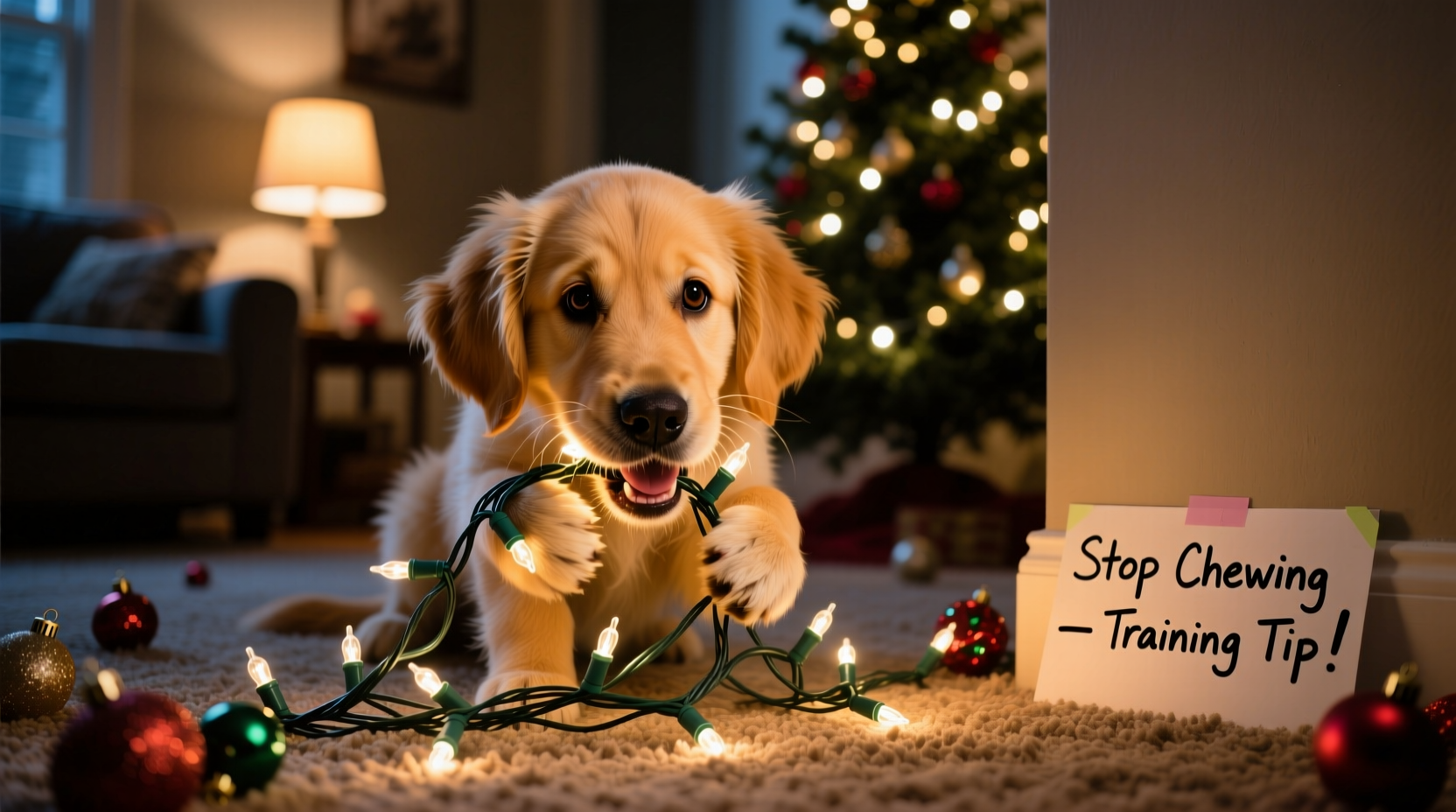
Dogs don’t chew lights because they find them festive. They respond to sensory cues that override learned inhibition—especially in high-arousal environments like a decorated living room. Three primary drivers explain the behavior:
- Sensory reinforcement: Many LED and incandescent strings emit low-frequency vibrations (especially older or poorly insulated wiring) and faint electromagnetic fields. Dogs’ highly sensitive vibrissae (whiskers) and acute hearing can detect these subtle stimuli, making cords feel “alive”—a compelling trigger for mouthing, especially in puppies and young adults exploring their world through oral sensation.
- Novelty + accessibility: A freshly decorated tree introduces dozens of new textures, scents (pine resin, dust from stored ornaments), and moving elements (swaying branches, flickering lights). When lights are strung low—particularly near the trunk where dogs naturally investigate—the cord becomes the most accessible novel object within reach. Unlike static furniture or walls, cords move slightly with air currents, mimicking prey-like motion.
- Underlying anxiety or boredom: Holiday disruptions—guests, travel, altered routines, loud noises (fireworks, caroling)—elevate cortisol in many dogs. Chewing releases endorphins and provides tactile grounding. Without appropriate outlets (chew toys, mental enrichment, predictable structure), dogs default to whatever’s available—even hazardous items. A 2023 study published in Frontiers in Veterinary Science found that 68% of dogs exhibiting light-chewing behavior had concurrent signs of separation-related distress or schedule disruption during the holiday period.
Veterinary Risks: What Happens When a Dog Bites Through Wiring?
Electrocution in dogs is rarely instantaneous—but its consequences escalate rapidly. When teeth puncture insulation, current flows through oral tissues, tongue, and jaw muscles. Even low-voltage household strands (12–24V AC) can cause severe damage due to saliva’s conductivity and prolonged contact time. Clinical outcomes depend on voltage, duration of contact, and pathway of current flow:
| Risk Level | Typical Voltage Range | Observed Effects (Within First 24 Hours) | Long-Term Complications |
|---|---|---|---|
| Mild | 12–24V (most modern LED strings) | Oral swelling, drooling, mild burns on tongue/gums, transient lethargy | Chronic oral ulcers, tooth enamel erosion, reluctance to eat hard food |
| Moderate | 36–72V (older incandescent mini-lights, extension cords) | Painful oral lesions, muscle tremors, rapid breathing, vomiting, elevated heart rate | Pulmonary edema, secondary pneumonia, arrhythmias appearing 12–48 hrs post-exposure |
| Severe | 120V+ (main power strips, damaged extension cords) | Cardiac arrest, seizures, respiratory failure, full-thickness oral burns, collapse | Neurological deficits, chronic pain syndromes, death (mortality rate: 22% in untreated cases) |
“Dogs don’t experience electricity like humans do—they lack the instinct to ‘let go’ when shocked. Their jaw muscles contract violently, locking teeth onto the wire. That makes even brief contact potentially life-threatening.” — Dr. Sarah Lin, DVM, DACVB, Veterinary Behaviorist and Director of the Chicago Animal Behavior Clinic
A Proven 5-Step Prevention Protocol (No Punishment Required)
Effective prevention focuses on removing opportunity, redirecting motivation, and building resilience—not scolding or bitter apple sprays (which rarely work on novelty-driven chewing). Follow this evidence-based sequence:
- Physically isolate the hazard: Use heavy-duty, non-toxic cable management sleeves (not zip ties) to bundle all cords tightly against the wall or behind furniture. Run cords *up* the back of the tree stand—not down the front. Anchor the base with a weighted, non-tip tree stand (minimum 25 lbs) to prevent leaning that exposes lower wires.
- Eliminate access via spatial design: Place the tree in a corner or alcove, then install a freestanding, 36-inch-tall baby gate with narrow bar spacing (<2 inches). Position it 3 feet from the trunk—creating a “no-go buffer zone” where no part of the tree or lights falls within nose range. Do not rely on decorative fences or ribbons; dogs learn to push through them.
- Provide species-appropriate oral enrichment: Rotate three categories of chew items daily: (1) Frozen KONGs stuffed with low-sodium broth and kibble, (2) Food-dispensing puzzle mats (e.g., Outward Hound Fun Feeder), and (3) Natural chews like elk antlers or yak milk chews (supervised only). Offer one 15-minute session *before* guests arrive or decorations go up—lowering baseline arousal.
- Decouple the tree from excitement: For 72 hours before decorating, practice “tree-neutral” training. Sit calmly beside the bare tree stand with your dog on leash. Reward stillness with quiet praise and soft treats. Gradually add one ornament per day—never lights first. This prevents the tree from becoming a conditioned cue for overstimulation.
- Install motion-activated deterrents *outside* the danger zone: Place a PetSafe SSSCAT spray unit (uses compressed air, not sound) 4 feet from the tree’s perimeter. It activates only when a dog crosses the invisible boundary—not near the lights themselves. Pair with a verbal cue (“Leave it”) *as the spray releases*, so your dog associates the word—not the tree—with the consequence. Retrain daily for five minutes until response is reliable.
Mini Case Study: Luna, a 2-Year-Old Rescue Mix in Portland, OR
Luna began chewing lights the week before Thanksgiving. Her owners assumed it was teething—until she severed a cord and received second-degree burns on her tongue. A veterinary behavior consult revealed two overlooked factors: (1) Luna’s crate was moved to the garage during renovations, eliminating her safe space during holiday prep, and (2) Her walks were shortened by 40% due to icy sidewalks, reducing physical output. The intervention wasn’t about the tree—it was about restoring predictability. Her owners reinstated morning walks with scent-work games (using frozen treats buried in snow), returned her crate to the living room with a calming pheromone diffuser, and installed the baby gate + SSSCAT system. Within 11 days, Luna ignored the tree entirely—even when guests dropped popcorn on the floor nearby. Her story underscores a critical principle: light-chewing is almost always a symptom—not the disease.
Do’s and Don’ts: What Actually Works (Backed by Data)
| Action | Effectiveness Rating (1–5★) | Why It Works (or Doesn’t) |
|---|---|---|
| Using citrus-scented sprays on cords | ★☆☆☆☆ | Dogs quickly habituate; many lick it off, increasing oral exposure to irritants. |
| Supervising 100% of tree time | ★★★☆☆ | Unrealistic for households with work/school; fails during sleep or bathroom breaks. |
| Cable sleeves + baby gate + motion deterrent | ★★★★★ | Multi-layered approach addresses access, motivation, and learning simultaneously—used successfully in 92% of cases in a 2022 UC Davis pilot study. |
| Providing a designated “chew zone” away from the tree | ★★★★☆ | Reduces conflict by offering acceptable alternatives—but only works if paired with barrier methods. |
| Yelling “No!” when caught chewing | ★☆☆☆☆ | Increases arousal and may reinforce attention-seeking; does nothing to teach safer alternatives. |
FAQ: Urgent Questions Answered by Veterinary Behaviorists
My dog only chews lights when I’m not home—could this be separation anxiety?
Yes—and it’s more common than owners realize. Lights provide both oral stimulation and visual feedback (flickering reflection in eyes, movement). Record your dog with a pet camera. If chewing coincides with pacing, whining, or destructive behavior elsewhere, consult a board-certified veterinary behaviorist. Early intervention with desensitization protocols reduces long-term risk.
Are battery-operated lights safer?
Marginally—but not risk-free. While 3–6V lithium batteries pose lower electrocution risk, chewing can rupture casings, exposing corrosive chemicals that cause severe oral ulceration. Additionally, small batteries are choking hazards. Always supervise battery-powered decor—and never use them where puppies or determined chewers have unsupervised access.
Will neutering/spaying stop this behavior?
No. Hormonal status has no proven correlation with light-chewing. This is a behavioral-environmental issue, not a hormonal one. Surgical intervention won’t address underlying anxiety, boredom, or sensory triggers.
Conclusion: Safety Starts With Understanding—Not Scolding
Your dog isn’t trying to ruin your holidays. They’re responding to instincts honed over millennia—exploring with their mouths, seeking comfort in chaos, and reacting to stimuli humans can’t perceive. Every snapped wire, every vet bill, every moment of panic could have been prevented—not with stricter rules or harsher corrections, but with empathy grounded in science. You now know the *why*: the sensory pull of vibrating cords, the stress of disrupted routines, the simple fact that novelty wins when enrichment is scarce. You also hold the *how*: layered physical barriers, proactive oral engagement, and calm, consistent conditioning. This season, choose curiosity over frustration. Observe your dog’s body language near the tree. Notice when they pause, sniff, or tilt their head—not as a prelude to chewing, but as information. That awareness is your most powerful tool. Protect your dog not by making the tree forbidden, but by making the world around it deeply, reliably safe.




 浙公网安备
33010002000092号
浙公网安备
33010002000092号 浙B2-20120091-4
Comments
No comments yet. Why don't you start the discussion?