
Dogs are often described as man’s best friend, but few behaviors illustrate that bond more clearly than their tendency to trail their owners from one room to the next. Whether padding quietly behind you or wedging themselves between your legs at the bathroom door, this behavior is both endearing and sometimes puzzling. While some owners find it comforting, others wonder if it signals anxiety, overdependence, or a deeper issue. The truth is, there’s no single explanation—this behavior stems from a complex blend of instinct, emotion, and learned patterns. Understanding why your dog follows you can deepen your relationship and help you respond appropriately to their needs.
The Evolutionary Roots of Canine Attachment
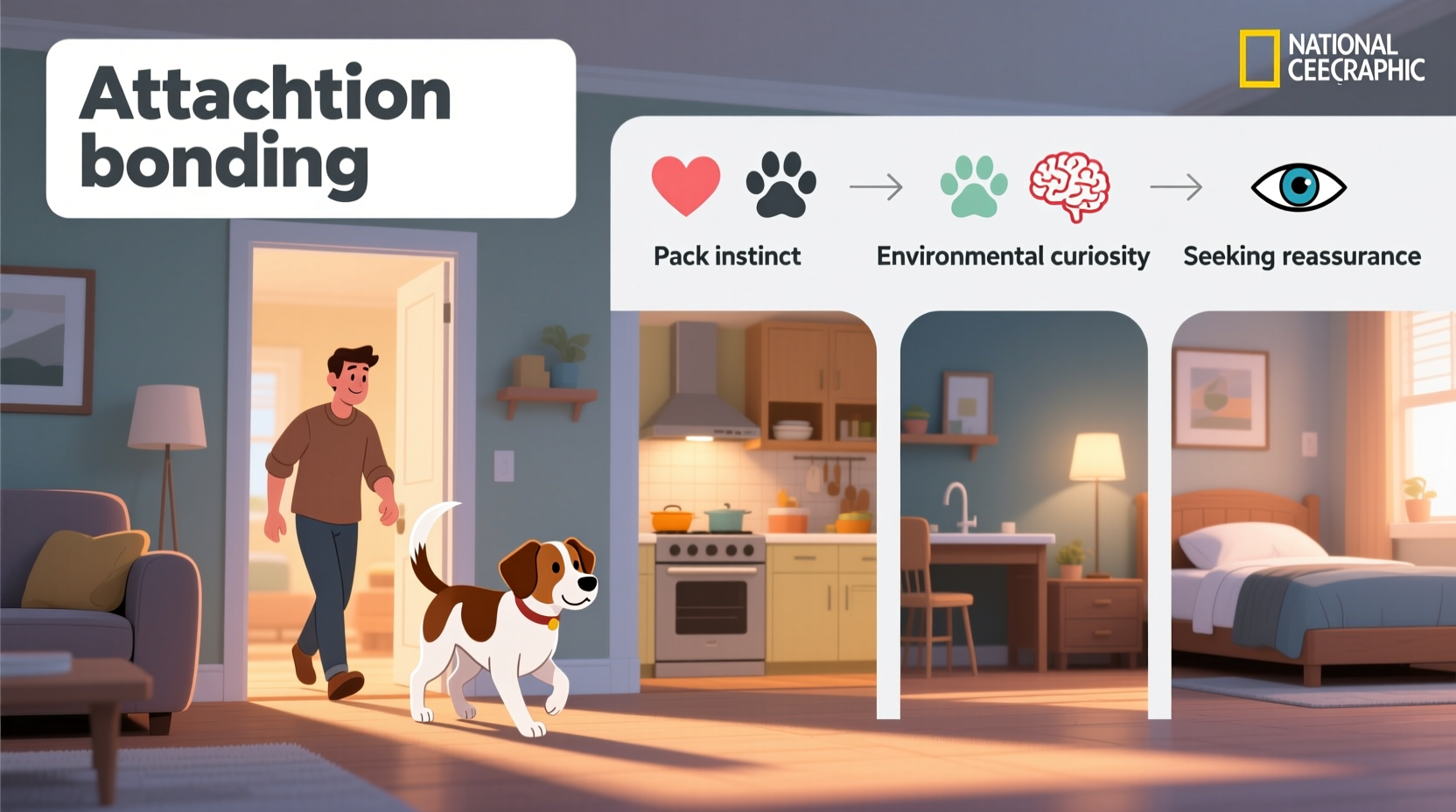
To understand why dogs follow their humans so closely, we must first look back to their origins. Domesticated from wolves thousands of years ago, dogs evolved not just physically but socially. Unlike their wild ancestors, who operate in hierarchical packs with defined roles, domestic dogs have adapted to form strong emotional bonds with humans—often treating them as part of their \"pack.\"
In the wild, pack members stay close to maintain safety, coordinate hunting, and reinforce social bonds. Your dog’s instinct to remain near you may be a modern echo of this survival mechanism. Staying close to a trusted leader (you) ensures protection and access to resources like food, warmth, and affection. This proximity isn’t just about physical safety—it also provides psychological comfort.
“Dogs don’t see humans as other dogs, but they do apply similar attachment strategies to us. Their following behavior is often an expression of secure bonding.” — Dr. Patricia McConnell, Certified Applied Animal Behaviorist
Studies using the “Strange Situation Test”—adapted from infant psychology—show that many dogs display attachment styles similar to human children. When separated from their owner, they may show signs of distress; upon reunion, they seek contact and quickly calm down. This reinforces the idea that your presence is not just preferred but essential to their sense of security.
Emotional and Psychological Drivers
Beyond evolution, emotional factors play a major role in why your dog sticks by your side. Dogs are highly attuned to human emotions and routines. They learn when you’re preparing food, heading out for a walk, or settling in for the night. Their following behavior is often a way of staying involved in activities that matter to them.
Some key emotional drivers include:
- Companionship: Dogs are social animals. Left alone too long, they can experience loneliness. Following you allows them to participate in household life.
- Anticipation: If you typically feed them, take them outside, or initiate play after certain actions, your dog learns to shadow you in hopes of being included.
- Anxiety: In some cases, constant following may signal separation anxiety or generalized insecurity. These dogs become distressed when out of sight and use proximity as a coping mechanism.
- Reinforcement: Unintentionally, owners often reward this behavior. A quick pet, shared snack, or verbal acknowledgment tells the dog, “Staying near you works.”
When Following Is Normal vs. Problematic
Not all following behavior is cause for concern. In fact, moderate attachment is healthy and reflects a strong human-canine bond. However, there’s a difference between loyal companionship and compulsive dependency.
A dog that calmly lies nearby while you work, then gets up to stretch or drink water independently, is likely well-adjusted. One that whines, paces, or refuses to eat when you leave the room—even briefly—may be exhibiting signs of hyperattachment or anxiety.
| Normal Following | Potentially Problematic Behavior |
|---|---|
| Follows but self-soothes when needed | Cannot settle unless in direct contact with owner |
| Enjoys independent time in safe spaces | Whines, barks, or destroys items when left alone |
| Responds to redirection | Ignores commands when separated from owner |
| Shows relaxed body language | Tail tucked, ears back, trembling when apart |
If your dog exhibits multiple signs from the right column, it may be worth consulting a veterinarian or certified animal behaviorist. Underlying medical issues—such as cognitive dysfunction in older dogs—can also contribute to clingy behavior.
Real-Life Example: Max the Rescue Terrier
Max, a three-year-old mixed-breed terrier, was adopted from a shelter after spending eight months in temporary foster care with multiple handlers. His new owner, Sarah, noticed he followed her everywhere—even into the shower. At first, she found it sweet. But soon, Max began panting and scratching at the door if she closed it, and he wouldn’t eat his dinner unless she stood beside his bowl.
After ruling out medical causes, Sarah consulted a dog trainer. It turned out Max had developed an insecure attachment due to early instability. He didn’t trust that people would stay. The solution wasn’t to stop him from following entirely, but to build confidence through structured independence.
Using gradual desensitization, Sarah started leaving Max in a cozy corner with a stuffed Kong for just 30 seconds, then slowly increased the time. She taught him a “place” command and rewarded calm behavior. Within weeks, Max could relax in the living room while Sarah cooked in the kitchen—a small win that significantly improved their quality of life.
How to Encourage Healthy Independence
If your dog’s following behavior borders on obsessive, it’s important to foster a sense of security without discouraging connection. The goal isn’t to push your dog away, but to help them feel safe even when apart. Here’s a step-by-step approach:
- Establish a Safe Zone: Designate a comfortable area with a bed, toys, and water. Use positive reinforcement to encourage your dog to spend time there voluntarily.
- Practice Short Separations: Start by stepping out of sight for just a few seconds while saying a calm phrase like “I’ll be back.” Return before your dog becomes anxious and reward calmness.
- Use Engaging Distractions: Offer puzzle toys, chew bones, or treat-dispensing devices when you move to another room. This redirects focus and builds positive associations with being alone.
- Avoid Reinforcing Anxiety: Don’t soothe a frantic dog with excessive petting or high-pitched reassurance. Wait until they’re calm, then offer quiet praise.
- Maintain Routine: Predictable schedules reduce uncertainty. Regular feeding, walking, and resting times help dogs feel secure.
Checklist: Building Balanced Attachment
Use this checklist to assess and improve your dog’s relationship with space and independence:
- ✅ Provide a designated safe space with bedding and familiar scents
- ✅ Practice brief departures daily, gradually increasing duration
- ✅ Reward calm behavior with treats or praise—not attention during distress
- ✅ Introduce interactive toys that require problem-solving
- ✅ Avoid punishing your dog for following you—it may increase anxiety
- ✅ Ensure your dog gets adequate physical and mental exercise each day
- ✅ Consult a professional if your dog shows destructive or self-harming behaviors
Frequently Asked Questions
Is it bad if my dog follows me everywhere?
Not necessarily. Many dogs naturally prefer to stay close to their owners, especially if they’ve formed a strong bond. As long as the behavior doesn’t interfere with their ability to rest, eat, or cope when alone, it’s usually a sign of affection rather than a problem.
Can I train my dog to stop following me?
You shouldn’t aim to eliminate the behavior completely—it’s natural and often rooted in love. Instead, focus on teaching balance. Train commands like “stay” or “go to your mat” so your dog can choose to be near you or in their own space comfortably.
Why does my dog only follow me and not other family members?
This often comes down to who feeds, walks, or spends the most time with the dog. Dogs form individual bonds based on consistency, attention, and positive experiences. If you’re the primary caregiver, your dog will naturally gravitate toward you. Encourage other family members to engage in care routines to strengthen those relationships.
Conclusion: A Sign of Love—And a Call for Balance
Your dog’s habit of following you from room to room is more than just a quirky trait—it’s a window into their emotional world. For most dogs, it’s a heartfelt expression of loyalty, trust, and love. They see you as their anchor in a complex world, and their presence at your heels is a silent declaration: “I belong with you.”
Yet, like any deep bond, it requires balance. True companionship includes the freedom to be apart without fear. By understanding the roots of this behavior and responding with patience and structure, you can nurture a relationship where closeness is a choice, not a compulsion.




 浙公网安备
33010002000092号
浙公网安备
33010002000092号 浙B2-20120091-4
Comments
No comments yet. Why don't you start the discussion?