
If you’ve ever looked in the mirror at noon only to find your foundation sliding off, caked into fine lines, or forming unflattering patches, you’re not alone. Foundation separation—also known as “makeup meltdown”—is one of the most common frustrations for makeup wearers. Despite using high-end products and applying them carefully, many still battle midday breakdown. The good news: this issue is rarely about poor technique alone. It’s usually a mismatch between your skin type, skincare routine, product choices, and environmental factors. Understanding the root causes allows you to build a resilient base that lasts from morning coffee to evening plans.
The Science Behind Foundation Separation
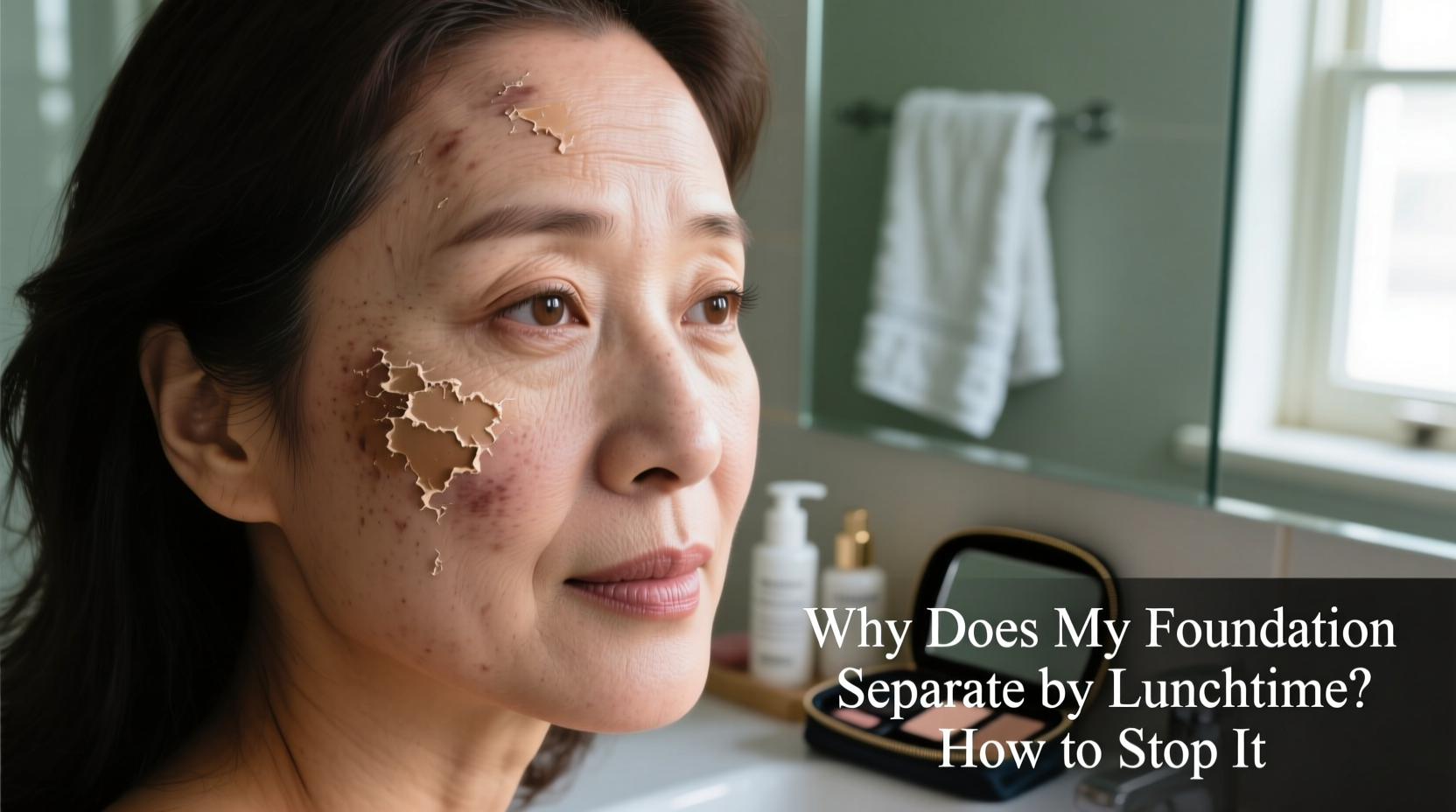
Foundation separation occurs when the makeup emulsion breaks down on your skin, causing it to crack, slide, or mix with oils, sweat, or skincare ingredients. This isn’t just cosmetic—it’s chemistry. Foundations are typically oil-in-water or water-in-oil emulsions designed to blend seamlessly over the skin. But when they interact with incompatible substances or unfavorable conditions, the structure destabilizes.
Skin naturally produces sebum, which increases during hormonal shifts, stress, or high temperatures. When excess oil rises to the surface, it pushes against the foundation layer, especially if the base wasn’t properly prepped or sealed. Similarly, moisturizers that haven’t fully absorbed can create a slippery layer underneath, leading to slippage. Even certain sunscreen actives or silicone-heavy serums can repel foundation rather than support it.
“Makeup longevity starts long before the first brushstroke. Your canvas—your skin—must be balanced, hydrated, and stable.” — Lena Torres, Celebrity Makeup Artist & Skincare Consultant
Common Causes of Midday Breakdown
Several interrelated factors contribute to foundation failure. Identifying which apply to you is the first step toward lasting wear.
1. Incompatible Skincare Layering
Applying foundation too soon after moisturizer or serum traps active ingredients that continue to absorb—or worse, migrate. Water-based products under silicone-heavy foundations often cause pilling. Oil-based moisturizers under matte formulas lead to separation as oils rise through the layers.
2. Overloading on Product
Using too much moisturizer, primer, or foundation overwhelms the skin. Thick layers don’t adhere well and become prone to creasing and lifting, especially around dynamic areas like the nose and mouth.
3. Skin Type Mismatch
Oily skin types may choose overly drying products in an attempt to control shine, but this triggers rebound oil production. Conversely, dry skin types using alcohol-heavy or mattifying bases end up flaky and patchy. Combination skin requires targeted solutions, not one-size-fits-all formulas.
4. Environmental Stressors
Heat, humidity, and pollution accelerate oxidation and emulsification. Indoor air conditioning can dehydrate skin, while outdoor exposure adds oxidative stress, darkening foundation over time.
5. Improper Setting Techniques
Skipping setting powder or mist leaves the foundation vulnerable. Without proper locking mechanisms, even the best formula won’t last past midday.
How to Stop Foundation From Separating: A Step-by-Step Fix
Long-lasting foundation isn’t about buying more products—it’s about optimizing your routine. Follow this timeline-tested method to prevent separation and maintain a fresh finish.
- Cleanse with Purpose
Start with a gentle cleanser suited to your skin type. Avoid stripping formulas that leave skin tight or shiny within hours. Rinse thoroughly and pat dry—never rub. - Exfoliate Weekly (Not Daily)
Use a mild chemical exfoliant (like lactic or salicylic acid) 2–3 times per week to remove dead skin buildup. Physical scrubs used too often damage the moisture barrier, leading to flakiness under foundation. - Layer Skincare Strategically
Apply products from thinnest to thickest consistency:- Toner (if used)
- Serum (vitamin C, hyaluronic acid)
- Eye cream (dabbed gently, not dragged)
- Moisturizer (lightweight for oily skin, richer for dry)
- Sunscreen (non-negotiable, wait 5 minutes to set)
- Prime with Precision
Choose a primer based on your concern:- Pore-filling? Use silicone-based primers sparingly on T-zone.
- Oily skin? Opt for mattifying primers with silica.
- Dryness? Hydrating primers with glycerin work best—but avoid overapplication.
- Apply Foundation Correctly
Use minimal product. One pump is usually enough for full coverage. Apply with a damp sponge for sheer blending or a dense brush for precision. Build coverage only where needed—concealer after foundation reduces layer overload. - Set Immediately and Smartly
After foundation, set with:- A light dusting of translucent powder on oily zones (T-zone, under eyes).
- A hydrating setting spray to reactivate and meld layers.
- A second *very* light layer of powder if needed—press, don’t swipe.
- Maintain Throughout the Day
Carry blotting papers—not powder—for touch-ups. Blot first, then lightly re-spray and press with tissue if necessary. Avoid layering more foundation unless absolutely required.
Product Pairing Guide: What Works and What Doesn’t
Not all products play well together. This table outlines common combinations that either enhance or sabotage foundation wear.
| Skincare Base | Foundation Type | Result | Recommendation |
|---|---|---|---|
| Heavy oil-based moisturizer | Mattifying liquid foundation | Separation, greasy patches | Switch to gel-cream moisturizer; use oil-control primer |
| Hyaluronic acid serum (well-absorbed) | Hydrating cushion foundation | Smooth, dewy finish | Ideal combo for dry or mature skin |
| Silicone-heavy primer | Silicone-based foundation | Pilling, balling up | Use less primer or switch to water-based alternative |
| Chemical sunscreen (set for 5 min) | Lightweight mineral foundation | Even adherence, no flashback | Great for sensitive or acne-prone skin |
| Alcohol-heavy toner | Full-coverage matte foundation | Flaking, tightness, cracking | Replace toner with soothing mist; add hydrating primer |
Real-Life Example: Sarah’s 9-to-5 Makeup Fix
Sarah, a 32-year-old project manager in Miami, struggled with her foundation melting by 11 a.m., despite reapplying daily. Her routine included a rich night cream used in the morning, a silicone primer, SPF 50, and a full-coverage matte foundation. She skipped setting powder, fearing a cakey look, and relied on touch-up sticks by afternoon.
After consultation, she adjusted her routine: switched to a lightweight gel moisturizer, waited 5 minutes after sunscreen, used a mattifying primer only on her T-zone, applied foundation with a stippling brush, and set with a micro-fine translucent powder. She finished with a matte-setting spray. Result? Her foundation stayed intact until 6 p.m., with only minor touch-ups needed. The key was reducing occlusive layers and sealing strategically.
Essential Tips for Long-Lasting Wear
Checklist: Foundation Longevity Audit
- ✅ Am I waiting 3–5 minutes after skincare before applying makeup?
- ✅ Is my moisturizer appropriate for my skin type and fully absorbed?
- ✅ Am I using primer correctly—not too much, not too little?
- ✅ Did I apply foundation with the right tool and minimal product?
- ✅ Have I set with both powder and setting spray?
- ✅ Are my products within their shelf life?
- ✅ Do I blot, not powder, for midday touch-ups?
Frequently Asked Questions
Can drinking more water really help my foundation last longer?
Indirectly, yes. Well-hydrated skin maintains a stronger moisture barrier, reducing flakiness and excess oil production. While water alone won’t stop separation, it supports overall skin balance—a critical factor in makeup adherence.
Should I avoid moisturizer if I have oily skin?
No. Skipping moisturizer signals dehydration to your skin, prompting it to produce more oil. Instead, use an oil-free, non-comedogenic gel moisturizer. Proper hydration prevents the cycle of over-drying and rebound greasiness.
Is there a difference between setting spray and finishing spray?
In practice, they’re often used interchangeably. However, true setting sprays are designed to lock makeup in place, often containing film-forming agents. Finishing sprays may focus more on tone-down flashiness or adding glow. For longevity, choose a setting spray labeled “long-wear” or “matte.”
Final Thoughts: Building a Flawless, Lasting Base
Foundation separation isn’t inevitable. It’s a signal—your skin and products aren’t in harmony. By refining your prep, choosing compatible formulas, and setting with intention, you can achieve a finish that looks freshly applied hours later. Remember, makeup is only as strong as its foundation, and that begins with skincare. Invest time in understanding your skin’s behavior throughout the day, adjust seasonally, and prioritize balance over coverage. A little patience and precision go a long way.
You don’t need ten products to make your foundation last. You need the right five, used the right way. Start tonight: audit your current routine, eliminate redundancies, and test one change tomorrow morning. Notice the difference by lunchtime.




 浙公网安备
33010002000092号
浙公网安备
33010002000092号 浙B2-20120091-4
Comments
No comments yet. Why don't you start the discussion?