
You’ve likely stood in front of two mirrors—a bathroom mirror at home and one in a department store dressing room—and wondered: Why do I look so different? One makes you appear slimmer, another adds weight, and yet another highlights every flaw under harsh light. The answer isn’t just in your perception; it lies in the physics of reflection, manufacturing inconsistencies, environmental conditions, and optical illusions. Understanding these factors demystifies the inconsistency and helps you interpret your reflection more accurately.
The Science Behind Mirror Reflections
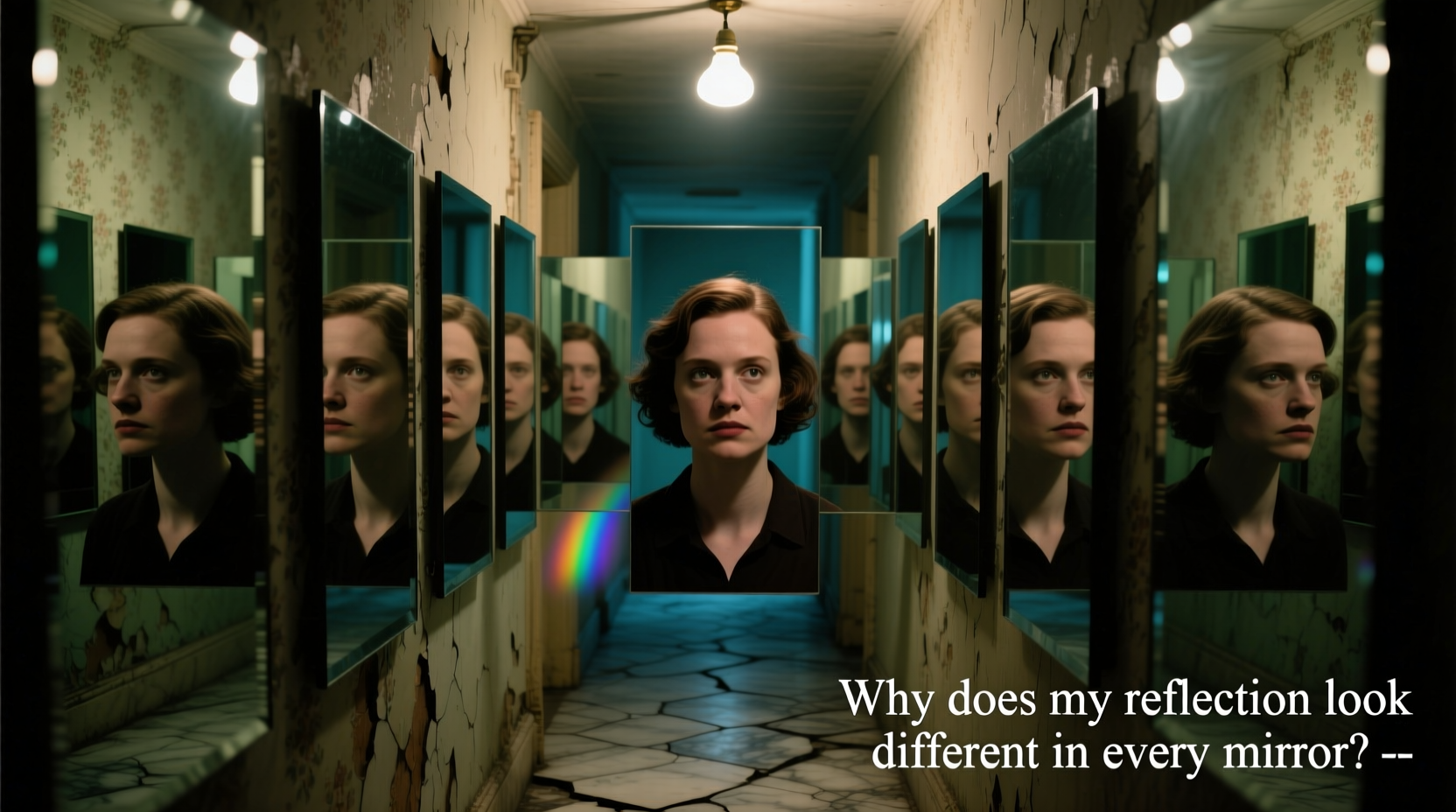
A mirror works by reflecting light rays that bounce off its surface. When light hits a smooth, silvered backing behind glass, it reflects at the same angle it arrived, preserving the image’s proportions—this is known as specular reflection. In theory, a perfect flat mirror should produce an undistorted, life-size reflection. But real-world mirrors are rarely perfect.
Manufacturing processes introduce subtle imperfections. Glass may not be uniformly thick, or the reflective coating might be unevenly applied. Even minor warping during cooling can create convex or concave surfaces that magnify or compress parts of your image. These physical deviations alter how light reflects, changing the shape, size, and even perceived posture of your reflection.
“Not all mirrors are created equal. What you see depends as much on the mirror’s construction as on your own appearance.” — Dr. Lena Torres, Optical Physicist, MIT Media Lab
Key Factors That Distort Your Reflection
Multiple elements interact to change how you appear in different mirrors. These include mirror curvature, glass quality, frame mounting, lighting, viewing distance, and surrounding environment.
Mirror Curvature: The Hidden Warper
Even slight curvature—imperceptible to the naked eye—can drastically distort reflections. A mirror with a convex surface (bulging outward) makes you appear shorter and wider. A concave surface (curved inward) stretches and elongates features. This often occurs when large mirrors are improperly mounted or supported only at the corners, causing the center to bow forward or backward over time.
Department stores sometimes use slightly concave mirrors to create a slimming effect, making clothing appear more flattering. Conversely, poorly installed bathroom mirrors can develop a convex warp from humidity and temperature shifts, adding unwanted width.
Lighting: The Mood Setter and Image Shaper
Lighting plays a crucial role in how you perceive your reflection. The color temperature, direction, intensity, and source placement all influence facial shadows, skin tone, and body contours.
- Cool white light (5000K–6500K): Common in pharmacies and offices, this bluish light enhances contrast, revealing fine lines and blemishes.
- Warm light (2700K–3000K): Found in homes and hotel bathrooms, it softens edges and creates a forgiving glow.
- Overhead lighting: Casts downward shadows, accentuating nose prominence and under-eye hollows.
- Side or front lighting: Reduces shadows and evens out skin texture, often used in makeup mirrors.
Makeup artists and photographers rely on ring lights or softboxes to achieve balanced illumination. Without such control, everyday mirrors deliver inconsistent visual feedback.
Glass Quality and Silvering Thickness
The clarity of a mirror depends on the optical quality of the glass and the uniformity of the silver or aluminum backing. Low-cost mirrors often use “plate glass” with minor ripples or thickness variations. As light passes through the glass before reflecting, these inconsistencies refract the beam slightly, skewing the final image.
Additionally, older mirrors may suffer from “mirror rot,” where moisture penetrates the seal and corrodes the reflective layer. This causes dark spots, waviness, or a foggy appearance, especially along edges. High-end mirrors use low-iron glass and precision coatings to minimize distortion and color cast.
Viewing Distance and Angle
Your position relative to the mirror affects perspective. Standing too close exaggerates facial features due to parallax—the same reason selfies make noses look larger. At arm’s length, your face occupies a disproportionate part of the reflection, distorting proportions.
Conversely, standing farther away provides a more accurate full-body view but may obscure details. The optimal viewing distance for a realistic self-image is 5 to 7 feet, allowing both proportion and detail to be assessed naturally.
Surroundings and Framing Effects
The environment around a mirror influences perception. A cluttered background distracts the eye, while neutral walls enhance focus on the reflection. Frame color and width also matter—dark, thick frames can make your reflection appear lighter or smaller by contrast.
In retail spaces, mirrors are often placed between bright displays or colored walls, creating chromatic adaptation effects. Your eyes adjust to ambient hues, temporarily altering how skin tones appear in the mirror.
Comparative Analysis: Mirror Types and Their Effects
| Mirror Type | Common Locations | Typical Distortion | Tips for Accurate Viewing |
|---|---|---|---|
| Flat Wall Mirror | Bathrooms, hallways | Minimal if high-quality; warping possible | Check for straightness with a level; avoid corner mounts |
| Dresser/Armoire Mirror | Bedrooms | Slight magnification if curved | Stand back 6+ feet for true proportions |
| Dressing Room Mirror | Retail stores | Often subtly concave (slimming effect) | Cross-check with phone camera or full-length home mirror |
| Vanity/Magnifying Mirror | Makeup stations | High magnification (2x–10x) | Use only for detail work, not overall assessment |
| Security/Convex Mirror | Stores, parking garages | Severe fisheye distortion | Ignore for personal appearance; designed for wide-angle view |
Step-by-Step Guide: How to Evaluate a Mirror’s Accuracy
If you want to know whether a mirror shows a true reflection, follow this systematic approach:
- Inspect the Surface: Look closely for waves, bubbles, or discoloration in the glass. Run your hand across it—if you feel any unevenness, the mirror is likely distorted.
- Test with a Straight Edge: Hold a ruler or credit card against the mirror. If the reflected edge curves, the mirror is warped.
- Compare Multiple Angles: Move side to side. If your reflection changes shape or seems to \"flow,\" the mirror has curvature.
- Check Lighting Consistency: Turn off artificial lights and use natural daylight. Note differences in skin tone and shadow depth.
- Cross-Reference with Photos: Take a photo in front of the mirror using a flashless camera (to avoid glare). Compare it to images taken in other settings.
- Observe Symmetry: Stand centered. Your left and right sides should mirror each other. Asymmetry suggests optical distortion.
Mini Case Study: Sarah’s Wardrobe Dilemma
Sarah, a 32-year-old marketing executive, noticed her outfits looked great in the store but awkward at work. She blamed her taste until she tested a hypothesis. She tried on the same black blazer in three locations: the store’s dressing room, her office restroom, and her bedroom at home.
In the store, the mirror made her appear taller and slimmer. At the office, under fluorescent lights, the fabric looked dull and her shoulders seemed broad. At home, in warm lighting, the blazer appeared oversized. Confused, she measured the mirrors and found the store’s was slightly concave, compressing her silhouette by nearly 10%.
After installing a high-quality, flat mirror with balanced LED lighting, Sarah gained confidence in her choices. She now evaluates clothes under consistent conditions, avoiding costly returns and wardrobe regrets.
Expert Insight: What Optometrists Say
Dr. Rajiv Mehta, a clinical optometrist specializing in visual perception, explains: “Our brains are wired to process faces and bodies holistically. When a mirror distorts proportions—even subtly—it disrupts this processing, leading to misjudgments about appearance. People often think they’ve gained weight when it’s just a warped mirror playing tricks.”
“The human visual system compensates for known distortions, but only after repeated exposure. That’s why you might ‘look wrong’ in a new mirror until your brain adapts.” — Dr. Rajiv Mehta, OD, FAAO
Frequently Asked Questions
Can a mirror really make me look fatter or thinner?
Yes. Slight convex curvature spreads your reflection horizontally, making you appear wider. Concave mirrors pull the center inward, creating a slimming illusion. This is common in budget mirrors or those improperly mounted.
Why does my face look different in selfies versus mirrors?
Mirrors show a reversed (left-right flipped) image, which you’re accustomed to. Selfies show the non-mirrored version, which feels unfamiliar. Additionally, camera lenses, especially wide-angle smartphone cameras, distort facial features when held close, exaggerating the nose and forehead.
Are LED mirrors more accurate than regular ones?
LED mirrors aren’t inherently more optically accurate, but their integrated lighting can improve consistency. Mirrors with daylight-balanced LEDs (around 5000K) reduce color distortion and provide even illumination, helping you see truer skin tones and clothing colors.
Checklist: Ensuring Honest Reflections
- ✅ Use a full-length, flat mirror securely mounted on the wall
- ✅ Avoid mirrors mounted only at corners or edges
- ✅ Install lighting at eye level, front-facing (not overhead)
- ✅ Choose bulbs with 4000K–5000K color temperature
- ✅ Test for warping using a straight object
- ✅ View yourself from 5–7 feet away for full-body accuracy
- ✅ Replace old mirrors showing dark spots or cloudiness
Conclusion: Seeing Yourself Clearly
Your reflection is not a fixed truth but a dynamic interplay of optics, environment, and perception. Recognizing that mirrors vary in quality and behavior empowers you to seek consistency and accuracy. By choosing well-made mirrors, optimizing lighting, and understanding the science behind distortions, you gain a more reliable sense of how you truly appear.




 浙公网安备
33010002000092号
浙公网安备
33010002000092号 浙B2-20120091-4
Comments
No comments yet. Why don't you start the discussion?