
In recent months, investors have watched as Advanced Micro Devices (AMD) stock has faced notable downward pressure. Once a high-flying semiconductor darling during the tech boom of 2020–2021, AMD’s share price has struggled amid shifting market dynamics, intensified competition, and broader economic headwinds. While long-term fundamentals remain strong for many analysts, short-term volatility has raised concerns. This article breaks down the key reasons behind AMD’s stock decline, backed by expert insights, data comparisons, and real-world context to help investors understand what’s really happening under the surface.
Market-Wide Semiconductor Sector Volatility
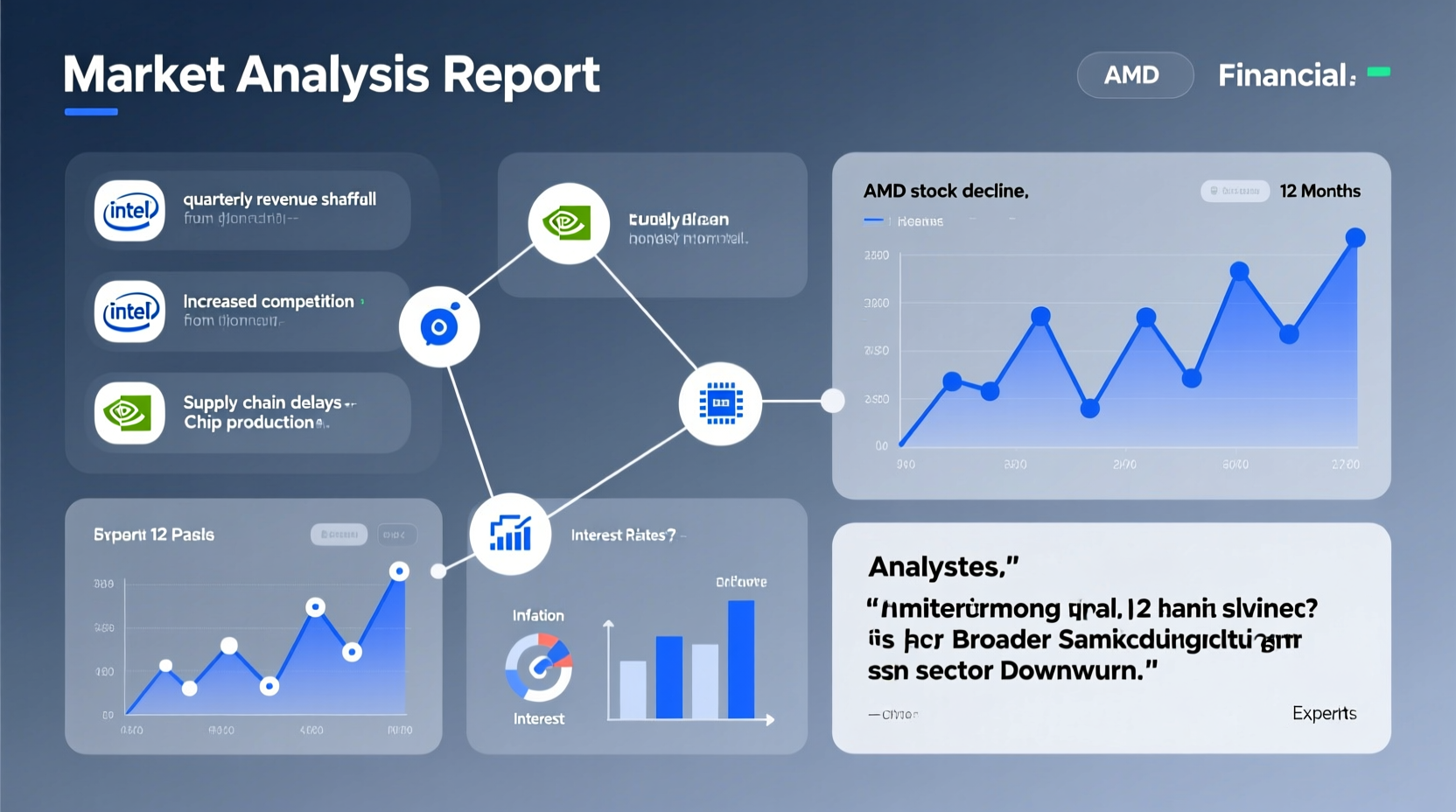
The semiconductor industry has experienced significant turbulence since 2022. After a surge in demand during the pandemic-driven remote work and cloud expansion era, the sector entered a correction phase marked by inventory overhangs, reduced consumer electronics spending, and tighter monetary policy. As interest rates rose, high-growth tech stocks—especially those without consistent profitability—came under pressure.
AMD, despite its innovation in CPUs and GPUs, was not immune. The broader Philadelphia Semiconductor Index (SOX), which tracks leading chipmakers, declined nearly 15% in 2023 before recovering slightly in early 2024. This sector-wide pullback affected investor sentiment across the board.
Intensifying Competition from NVIDIA and Intel
One of the most cited reasons for AMD’s recent stock weakness is escalating competition, particularly in artificial intelligence (AI) and data center markets—the two fastest-growing segments in semiconductors.
NVIDIA has dominated the AI accelerator space with its Hopper and Blackwell GPU architectures, capturing over 80% of the AI training market. Its partnership ecosystem, software stack (CUDA), and performance lead have made it the go-to choice for hyperscalers like Microsoft, Meta, and Google. In contrast, AMD’s MI300 series, while competitive on paper, is still ramping up production and adoption.
Intel, meanwhile, has regained some footing in the server CPU market with its fourth-generation Xeon processors and aggressive pricing. Though still trailing AMD in efficiency and core density, Intel’s foundry roadmap and government-backed investments through the CHIPS Act could alter long-term competitive dynamics.
“AMD built momentum with EPYC and Ryzen, but maintaining leadership requires continuous execution. Right now, NVIDIA holds the mindshare in AI.” — Sarah Kim, Senior Analyst at TechInsight Research
Revenue Growth Slowdown and Earnings Misses
Financial performance has also contributed to declining investor confidence. In Q4 2023, AMD reported revenue of $5.7 billion, missing analyst expectations by $200 million. While Data Center revenue grew year-over-year, it fell short of forecasts due to delayed customer deployments and softer cloud spending.
Additionally, Client Group revenue—which includes PC processors—declined 12% YoY, reflecting ongoing weakness in global PC shipments. According to Gartner, worldwide PC shipments dropped 15.7% in 2023 compared to 2022, impacting all major vendors, including AMD.
| Quarter | Revenue (Billions) | EPS | Analyst Revenue Expectation | Stock Reaction (Next Week) |
|---|---|---|---|---|
| Q2 2023 | $5.35 | $0.58 | $5.40B | -4.2% |
| Q3 2023 | $5.89 | $0.70 | $5.85B | +6.1% |
| Q4 2023 | $5.70 | $0.62 | $5.90B | -8.7% |
| Q1 2024 (Est.) | $5.30 (est.) | $0.55 (est.) | $5.45B | Flat to -3% |
The pattern is clear: even slight misses trigger outsized sell-offs due to elevated expectations set during AMD’s earlier growth phase. The market now demands flawless execution, and any sign of deceleration is punished quickly.
Valuation Concerns Amid Rising Interest Rates
Another structural factor affecting AMD’s stock is valuation sensitivity. During periods of low interest rates, investors favored high-growth tech companies, assigning premium multiples based on future earnings potential. AMD’s price-to-earnings (P/E) ratio peaked above 50x in 2021.
With the Federal Reserve holding rates at 5.25%–5.5% in 2024, discount rates for future cash flows have increased. As a result, forward-looking valuations have compressed. AMD now trades at around 40x forward P/E—a rich multiple relative to the S&P 500 average of 20x—making it vulnerable to further downside if growth slows.
Moreover, AMD continues to invest heavily in R&D and manufacturing partnerships (e.g., TSMC). While these are essential for long-term competitiveness, they weigh on near-term margins and free cash flow, raising questions about capital efficiency in a higher-cost environment.
Real Example: How One Institutional Investor Reacted
In late 2023, a mid-sized technology-focused hedge fund reviewed its semiconductor holdings after Q3 earnings. Despite believing in AMD’s long-term architecture advantages, the fund manager noted increasing risks in the short term.
\"We trimmed our AMD position by 30% post-Q4 results,\" said James Liao, portfolio manager at Apex Tech Fund. \"Not because we lost faith in the product pipeline, but because the risk-reward didn’t justify full exposure. With NVIDIA pulling away in AI and Intel stabilizing, AMD needs to prove it can capture meaningful share—not just compete.\"
This sentiment echoes across Wall Street: AMD isn’t failing, but it’s no longer seen as the undisputed disruptor it once was. That shift in perception directly impacts trading behavior and institutional positioning.
Actionable Checklist for AMD Investors
- Monitor quarterly data center GPU shipment numbers and design win announcements
- Track cloud provider capex trends (AWS, Azure, Google Cloud)
- Compare gross margin guidance against NVIDIA and Intel
- Watch for MI300X adoption milestones in large AI clusters
- Evaluate management commentary on AI software ecosystem development
- Assess macroeconomic indicators like inflation and interest rate projections
What Could Turn AMD’s Stock Around?
Despite current challenges, several catalysts could reignite investor enthusiasm:
- Strong MI300 Adoption in 2024: If AMD secures major design wins with hyperscalers or achieves faster-than-expected ramp, it could close the perception gap with NVIDIA.
- Improved Software Stack: Performance alone isn’t enough. Success depends on ROCm (Radeon Open Compute) maturing to rival CUDA in developer support and ease of use.
- PC Market Recovery: A rebound in enterprise and consumer PC demand would boost Ryzen processor sales and improve overall revenue mix.
- Strategic Partnerships: Expansion in custom silicon (e.g., gaming consoles, AI edge devices) or foundry collaborations could diversify revenue streams.
Frequently Asked Questions
Is AMD still a good long-term investment?
Many analysts believe so. AMD maintains technological leadership in x86 CPUs and has a growing presence in data centers and embedded markets. If it executes well in AI and adapts to cyclical downturns, it remains positioned for multi-year growth. However, long-term success hinges on gaining traction in AI accelerators and sustaining margins amid competition.
Why is AMD stock falling while the overall market rises?
Stocks don’t move in lockstep. Even during bull markets, individual companies face company-specific risks. In AMD’s case, concerns about AI competitiveness, earnings misses, and high valuation multiples make it more sensitive than the average stock. Additionally, rotation into value and dividend-paying sectors has pulled capital away from growth-oriented tech names.
Will the acquisition of Xilinx help AMD’s stock recover?
The $50 billion Xilinx deal, completed in 2022, expanded AMD’s footprint in adaptive computing, automotive, and aerospace. While integration has been smooth, the benefits are long-term. Short-term stock movements depend more on core business performance than past acquisitions. Over time, however, Xilinx strengthens AMD’s diversification beyond PCs and data centers.
Conclusion: Navigating Uncertainty with Informed Strategy
AMD’s stock decline isn’t due to a single failure but a confluence of external pressures and internal challenges. From fierce AI competition to macroeconomic constraints and lofty investor expectations, the path forward demands precision and patience. Yet, the company retains strong engineering talent, a robust product roadmap, and strategic positioning in critical computing markets.
For investors, the key is not panic but perspective. Short-term volatility doesn’t erase long-term potential—but it does require reassessment. Stay informed, track execution closely, and avoid emotional decisions based on headlines. The semiconductor industry rewards those who look beyond the noise.




 浙公网安备
33010002000092号
浙公网安备
33010002000092号 浙B2-20120091-4
Comments
No comments yet. Why don't you start the discussion?