
Nothing dampens the holiday spirit like a silent, dark Christmas village—lights unlit, trains motionless, and miniature storefronts shrouded in shadow. When your carefully curated winter scene fails to power up, frustration mounts quickly. But before you pack away the figurines or assume the entire set is ruined, pause. Power failure in a Christmas village is rarely catastrophic—and almost always solvable. Most issues stem from one of three places: the wall outlet, the transformer (the unsung heart of the system), or the delicate low-voltage wiring network connecting buildings, lights, and accessories. This guide walks through each failure point with precision—not as generic advice, but as field-tested diagnostics used by professional holiday display technicians and experienced collectors alike. You’ll learn how to verify outlet functionality, safely measure transformer output, interpret voltage readings, identify hidden wiring damage, and avoid the top five mistakes that turn simple troubleshooting into costly replacements.
Understanding Your Village’s Power Architecture
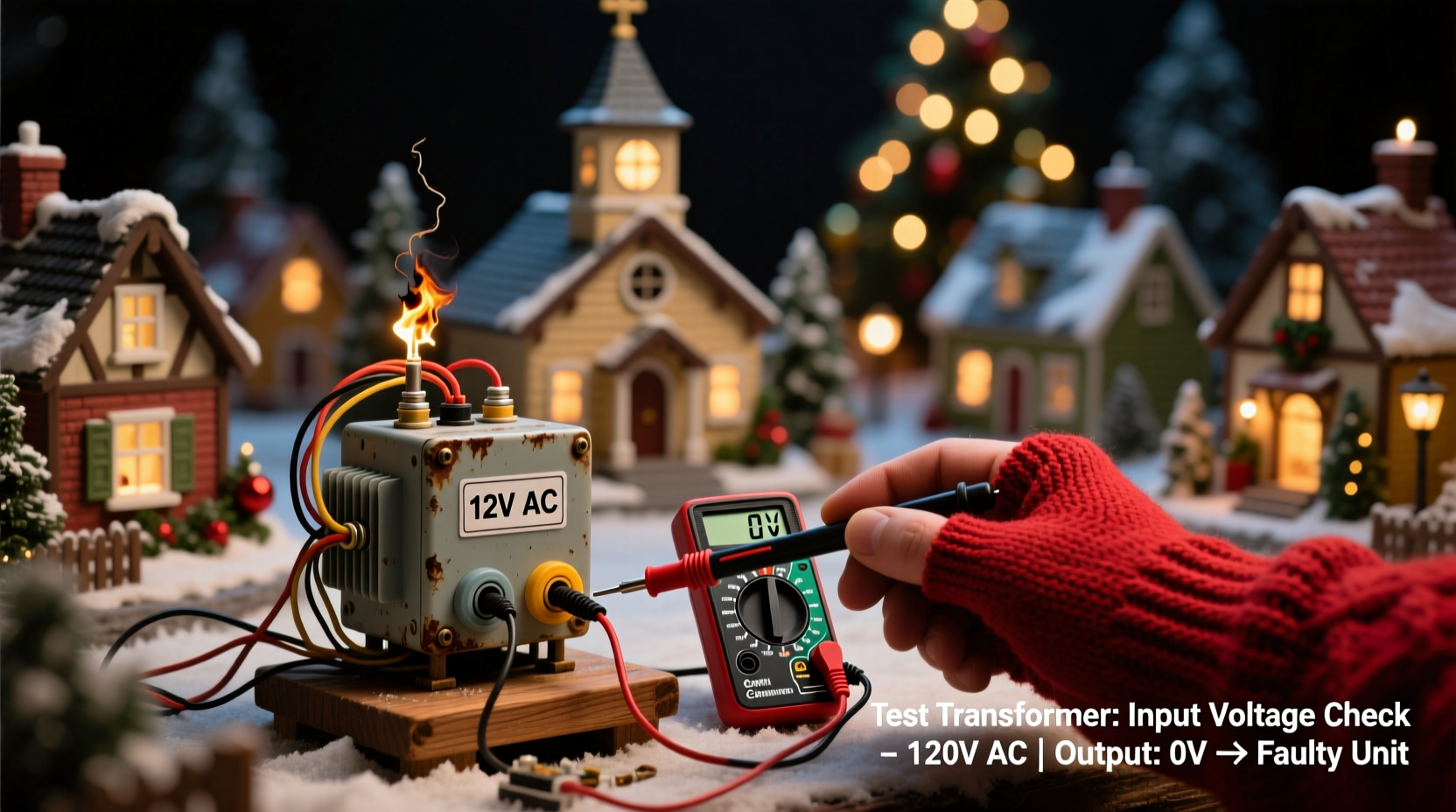
A typical Christmas village operates on a low-voltage DC or AC system—usually 12V, 14V, or 18V—delivered via a plug-in transformer that converts standard 120V household current. Unlike string lights that daisy-chain in parallel, many villages use a “hub-and-spoke” or segmented series-parallel configuration. One transformer may feed multiple buildings through separate circuits, each with its own inline fuse or current limiter. Some premium sets even include dual-output transformers—one for lighting, another for animated elements like rotating carousels or flickering fireplaces. Misunderstanding this architecture leads directly to misdiagnosis. For example, if only the bakery’s lights are out but the adjacent post office glows brightly, the fault isn’t at the transformer—it’s isolated to that building’s internal wiring or bulb socket.
Crucially, most village transformers are *not* constant-voltage regulators. They’re unregulated “wall-wart” style adapters whose output voltage rises significantly under no-load conditions—sometimes 20–30% above nominal rating. That means a labeled “12V” transformer may read 15.2V when unplugged from the village. This behavior is normal—but it also means voltage readings alone can’t confirm transformer health. Load testing is essential.
Step-by-Step Transformer Testing Protocol
Testing a transformer requires more than checking if it’s warm or listening for a hum. Follow this sequence precisely—each step eliminates ambiguity and prevents false conclusions.
- Verify input power: Plug a known-working device (e.g., phone charger) into the same outlet. If it doesn’t operate, check the circuit breaker and GFCI reset button. Do not proceed until the outlet is confirmed live.
- Inspect physical condition: Examine the transformer’s casing for cracks, melted plastic, or burn marks near the cord entry. Smell for acrid odor—a telltale sign of internal winding failure.
- Measure no-load voltage: Set a multimeter to AC voltage (or DC, depending on label). Insert probes into the transformer’s output terminals (not the plug end). Record the reading. A healthy 12V AC transformer should read 14–16.5V; 14V AC units typically read 16–18.5V. Readings below 12V or above 20V indicate failure.
- Apply load test: Connect a 12V automotive tail light bulb (e.g., #194 or #168) across the output terminals using alligator clip leads. The bulb must glow steadily—not dimly or flicker. Re-measure voltage under load. It should drop no more than 1.5V from the no-load reading. A drop exceeding 3V signals weak regulation or winding degradation.
- Check continuity of output cord: Unplug transformer. Set multimeter to continuity mode. Touch one probe to the metal tip of the output plug, the other to the transformer’s output terminal. Repeat for the sleeve (outer ring) connection. A solid beep confirms internal cord integrity. No beep means broken wire inside the cord—common at stress points near the plug or transformer housing.
Common Wiring & Connection Failures (Beyond the Transformer)
Even with a fully functional transformer, power won’t reach village components without intact connections. These are the most frequently overlooked culprits:
- Corroded or oxidized plug contacts: Over time, brass or copper prongs develop a dull gray film that impedes conductivity. Clean gently with a pencil eraser or electrical contact cleaner—not sandpaper, which removes plating.
- Loose terminal screws: Many village bases have screw-terminal blocks where wires connect. Vibration from nearby foot traffic or HVAC systems gradually loosens them. Tighten with a 2.5mm hex key—do not overtighten, as stripped threads ruin the terminal.
- Micro-fractured wires inside flexible cords: Repeated coiling/uncoiling causes copper strands to fatigue and break internally while insulation remains intact. Test by gently bending the cord near connectors while monitoring voltage at the far end—if reading fluctuates, replace the cord.
- Water-damaged junction boxes: Outdoor or basement displays expose wiring to condensation. Look for white crystalline residue (corrosion byproduct) inside weatherproof enclosures. Replace affected connectors with waterproof gel-filled wire nuts (e.g., Scotchlok 314G).
- Incorrect polarity in DC systems: Reversing positive/negative leads on LED buildings often prevents illumination without damaging components. Verify color coding: red = positive, black = negative. Use a multimeter’s diode test to confirm LED orientation if labels are faded.
Do’s and Don’ts of Village Power Maintenance
| Action | Do | Don’t |
|---|---|---|
| Storing transformers | Keep in original box with cord loosely coiled (figure-8 method) in climate-controlled space | Store in attics/basements where temperature swings exceed 30°F annually |
| Cleaning contacts | Use isopropyl alcohol (90%+) and lint-free cloth; let dry 5 minutes before reassembly | Apply WD-40—it leaves conductive residue that attracts dust and degrades over time |
| Extending cords | Use 16-gauge outdoor-rated extension cords rated for continuous low-voltage use | Daisy-chain multiple thin indoor cords—voltage drop exceeds 10% beyond 25 feet |
| Testing bulbs | Test individual LEDs with a 3V coin-cell battery and two paperclips as probes | Assume all bulbs are identical—village sets mix 2.2V, 2.8V, and 3.2V LEDs even within one building |
| Replacing fuses | Match exact amperage and voltage rating (e.g., 1A/250V slow-blow); verify fuse holder isn’t corroded | Substitute with automotive blade fuses—they lack proper thermal cutoff characteristics |
Real-World Diagnostic Case Study
Janice K., a collector in Portland, OR, assembled a 27-piece Department 56 Snow Village over seven years. In late November, her entire “Main Street” section went dark—no lights, no train movement—while the “Winter Park” section remained fully operational. She replaced the transformer twice, assuming it was faulty. On the third attempt, she contacted a local holiday display technician. Here’s what the technician found:
First, he measured voltage at the transformer’s output: 15.8V AC (normal for a 12V unit). Then he traced the 18-gauge feeder wire from the transformer to the first building—the “General Store.” At the store’s input terminal, voltage dropped to 0.3V. Cutting back 6 inches of wire revealed brittle, chalky insulation—a classic sign of UV degradation from years of display near a sunlit window. The copper strands were intact but completely insulated by cracked plastic. He spliced in a new 12-inch section with marine-grade tinned copper wire and heat-shrink butt connectors. Power restored instantly. Janice learned that transformer replacement was unnecessary—the real failure was environmental wear on a single 18-inch wire segment.
“Transformers fail less than 7% of the time in village power issues. The vast majority involve connections, corrosion, or physical wire damage—especially at transition points between indoor and outdoor zones.” — Mark R. Delaney, Senior Technician, Holiday Illuminations Co. (25+ years servicing commercial displays)
Frequently Asked Questions
Can I use a different brand’s transformer with my village?
Only if it matches all specifications: output voltage (AC/DC), amperage rating (must meet or exceed original), connector type (barrel size, polarity), and safety certifications (UL/ETL listed for indoor use). Using a higher-amperage transformer is safe; a higher-voltage unit will destroy LED modules and incandescent bulbs. Never substitute a 24V transformer for a 12V system—even briefly.
My village worked last year but not this year—could storage be the issue?
Absolutely. Storing villages in humid garages or cardboard boxes accelerates corrosion on brass terminals and solder joints. Condensation forms microscopic galvanic cells between dissimilar metals (e.g., copper wire and steel screws), eating away at conductivity. Always store components in sealed plastic bins with silica gel packs, and inspect all connections with a magnifier before reassembly.
Why do some buildings flicker intermittently?
Flickering usually indicates a high-resistance connection—not a failing transformer. Check for loose spring clips in modular track systems, bent pins in plug-and-play connectors, or oxidation on aluminum foil tape used in DIY wiring. True transformer instability manifests as uniform dimming across all connected buildings, not selective flickering.
Preventative Maintenance Checklist
Perform this annually, before Thanksgiving, to avoid December-day emergencies:
- ☑ Clean all plug contacts with isopropyl alcohol and soft brush
- ☑ Inspect transformer cord for kinks, cracks, or exposed copper near strain reliefs
- ☑ Measure no-load and loaded voltage on every transformer (record values for future comparison)
- ☑ Test continuity of every feeder wire longer than 12 inches
- ☑ Replace all glass fuses—even if intact—with new ones matching exact specs
- ☑ Verify ground-fault protection: plug transformer into a GFCI outlet and press TEST button. Reset should cut power immediately.
Conclusion
Your Christmas village isn’t just decoration—it’s a tactile memory, a seasonal ritual, a quiet testament to patience and care. When power fails, it feels like losing a piece of that tradition. But now you hold the knowledge to reclaim it: how to distinguish a dead transformer from a corroded terminal, why load testing matters more than voltage labels, and where to look for the invisible breaks that hide in plain sight. You don’t need specialized tools—just a $15 multimeter, a spare bulb, and methodical attention. Start tonight. Pull one transformer from storage, run the four-step test, and document your readings. That small act transforms uncertainty into control—and ensures next year’s first light-up moment is exactly as magical as it should be.




 浙公网安备
33010002000092号
浙公网安备
33010002000092号 浙B2-20120091-4
Comments
No comments yet. Why don't you start the discussion?