
Depth perception—the ability to judge the distance between yourself and objects in your environment—is essential for everyday tasks like driving, pouring a drink, or catching a ball. When this sense feels disrupted, it can lead to disorientation, clumsiness, or even anxiety. If you've noticed that things seem flatter than usual, distances are harder to judge, or the world feels slightly \"off,\" you're not imagining it. Several medical, neurological, and environmental factors can interfere with depth perception. The good news is that many of these causes are treatable or manageable with the right approach.
Understanding Depth Perception and How It Works
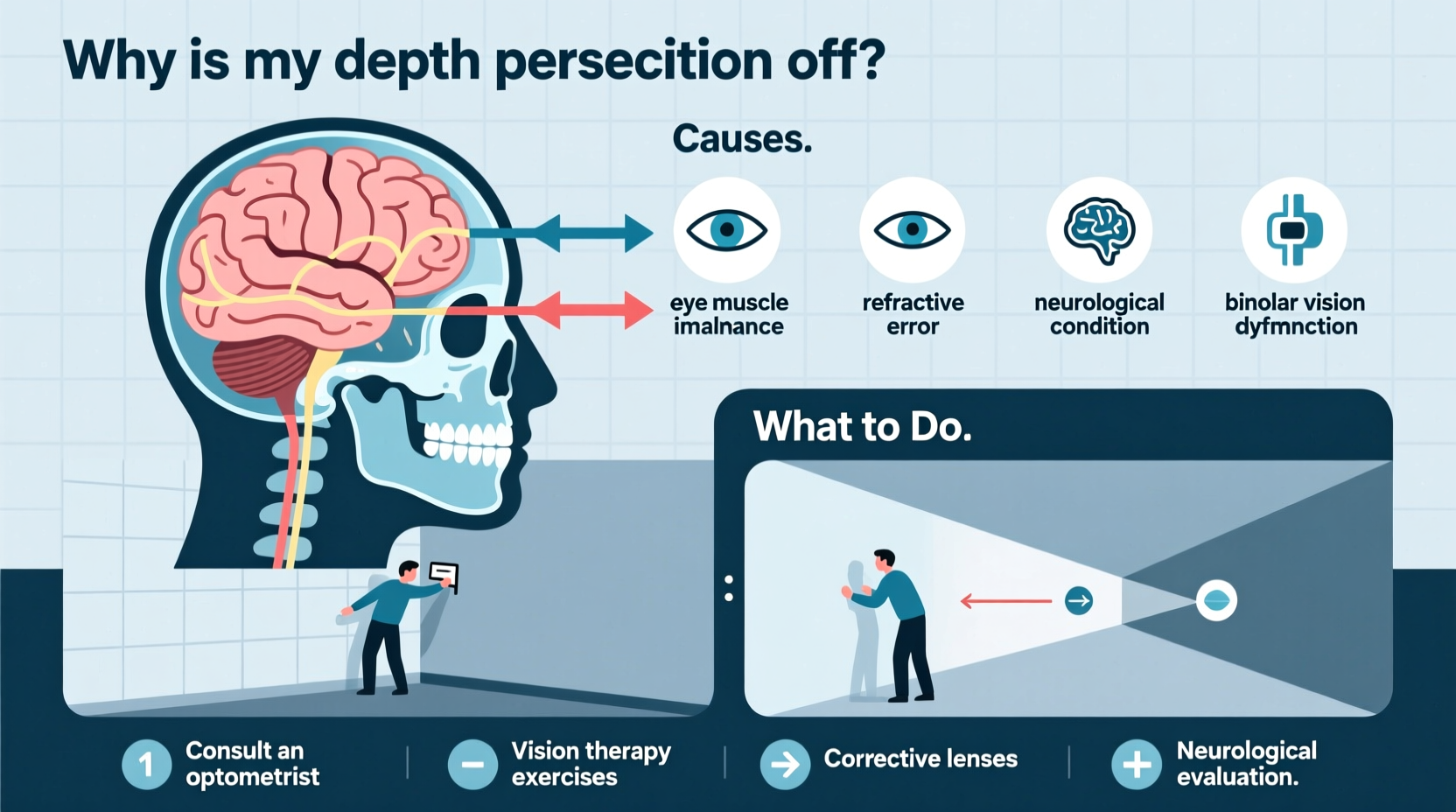
Depth perception relies on both eyes working together—a process called binocular vision. Each eye captures a slightly different image due to their horizontal separation. The brain combines these two perspectives to create a single 3D image, allowing us to perceive depth and distance accurately. This coordination involves the eyes, optic nerves, and visual processing centers in the brain.
When one part of this system falters—whether due to misalignment, poor focus, or neurological disruption—depth perception can weaken or fail. Some people may have never developed strong depth perception due to childhood vision issues, while others experience a sudden change later in life.
Common Causes of Impaired Depth Perception
Several conditions and circumstances can disrupt depth perception. Identifying the root cause is the first step toward correction.
- Strabismus (crossed eyes): Misaligned eyes prevent proper fusion of images, leading the brain to suppress input from one eye and lose depth cues.
- Amblyopia (lazy eye): One eye is significantly weaker, often from childhood. The brain favors the stronger eye, reducing 3D vision.
- Convergence insufficiency: Difficulty turning the eyes inward when focusing on near objects, causing double vision and depth issues during reading or computer work.
- Neurological conditions: Stroke, traumatic brain injury (TBI), or multiple sclerosis can damage visual processing pathways.
- Recent eye surgery: Procedures like cataract removal or LASIK may temporarily alter visual input, requiring time for the brain to adapt.
- Medications: Sedatives, antihistamines, or certain psychiatric drugs can impair coordination and visual clarity.
- Age-related changes: Reduced pupil size, slower eye movements, and diminished contrast sensitivity affect spatial judgment.
“Many patients don’t realize they’ve lost depth perception until they experience balance issues or difficulty with hand-eye coordination.” — Dr. Lena Patel, Neuro-Ophthalmologist
What to Do: Steps to Diagnose and Improve Depth Perception
If you suspect your depth perception is compromised, don’t ignore it. A structured approach can help identify the cause and guide treatment.
- Schedule a comprehensive eye exam: Visit an optometrist or ophthalmologist who specializes in binocular vision. Standard eye charts won’t reveal depth issues—specific tests like the Randot stereotest or cover-uncover test are needed.
- Assess neurological health: If the problem appeared suddenly, especially after a head injury or with other symptoms (dizziness, numbness), see a neurologist.
- Review medications: Discuss any drugs you’re taking with your doctor. Some may contribute to visual disturbances.
- Try vision therapy: A growing body of evidence supports vision therapy for convergence insufficiency and mild strabismus. Exercises strengthen eye coordination and retrain the brain to use both eyes together.
- Use adaptive strategies: Until vision improves, rely on monocular cues—shadows, motion parallax, and relative size—to estimate distance.
Vision Therapy Exercises to Try (Under Professional Guidance)
| Exercise | Purpose | How to Perform |
|---|---|---|
| Pencil Push-Ups | Improve convergence | Hold a pencil at arm’s length, focus on the tip, and slowly move it toward your nose while keeping one clear image as long as possible. |
| Brock String | Enhance eye alignment | String with colored beads: Focus on each bead and observe double strings converging into one at the point of focus. |
| Computer-Based Binocular Training | Retrain brain-eye coordination | Software-guided games that require both eyes to work together to complete tasks. |
Real-Life Example: Recovering Depth Perception After a Concussion
Mark, a 34-year-old graphic designer, began experiencing dizziness and trouble judging distances six weeks after a minor car accident. He struggled to pour coffee without spilling and misjudged curbs while walking. An initial eye exam showed 20/20 vision, but further testing revealed convergence insufficiency linked to a mild traumatic brain injury.
His optometrist referred him to a vision therapist. Over three months, Mark performed daily pencil push-ups and used a virtual reality-based vision program twice a week. By week ten, he reported improved clarity in depth judgment. At his follow-up, he passed the stereopsis test and returned to driving confidently.
This case highlights that even when standard vision is intact, functional vision—including depth perception—can be impaired and rehabilitated.
Do’s and Don’ts When Addressing Depth Perception Issues
| Do’s | Don’ts |
|---|---|
| Seek evaluation from a specialist in binocular vision | Assume it’s “just aging” without assessment |
| Practice prescribed vision exercises consistently | Ignore sudden changes in vision or balance |
| Use adequate lighting to enhance contrast and cues | Drive at night if depth perception is severely impaired |
| Wear prescribed glasses or prisms if recommended | Self-diagnose using online tools alone |
Frequently Asked Questions
Can depth perception be improved in adults?
Yes. While it was once believed that the visual system could only be corrected in childhood, neuroplasticity research shows adults can develop or regain depth perception through vision therapy, especially for conditions like convergence insufficiency or post-injury adaptation.
Is poor depth perception dangerous?
It can be, particularly when driving, climbing stairs, or operating machinery. Misjudging distances increases the risk of falls, accidents, or errors in tasks requiring hand-eye coordination. If you’re affected, take precautions until the issue is addressed.
Can glasses or contact lenses fix depth perception problems?
Corrective lenses improve clarity but don’t automatically restore depth perception. However, specialized lenses—such as prism glasses—can realign visual input and help the brain fuse images properly, especially in cases of eye misalignment.
Conclusion: Take Action to Restore Your Spatial Clarity
Disrupted depth perception isn’t something to dismiss as a minor quirk. It’s a sign that your visual or neurological system may need attention. Whether the cause is subtle eye misalignment, a past injury, or medication side effects, solutions exist. Early diagnosis and targeted therapy can significantly improve quality of life, restoring confidence in movement and interaction with the physical world.




 浙公网安备
33010002000092号
浙公网安备
33010002000092号 浙B2-20120091-4
Comments
No comments yet. Why don't you start the discussion?