
You’ve probably noticed it during a morning walk or while standing in your backyard: some days, your shadow looks sharp and deep black, almost like a silhouette painted on the ground. Other days, it’s faint, blurry, or barely visible. Why does this happen? It’s not magic—it’s physics. The darkness and clarity of your shadow depend on a delicate balance of light intensity, atmospheric conditions, and the sun’s position. Understanding this isn’t just fascinating—it connects us to the natural rhythms of our planet and the behavior of light itself.
Shadows are more than just the absence of light; they’re dynamic indicators of how sunlight interacts with Earth’s atmosphere and surface. By breaking down the science behind shadow formation, we can decode why they vary from day to day—and even hour to hour.
The Basics of Shadow Formation
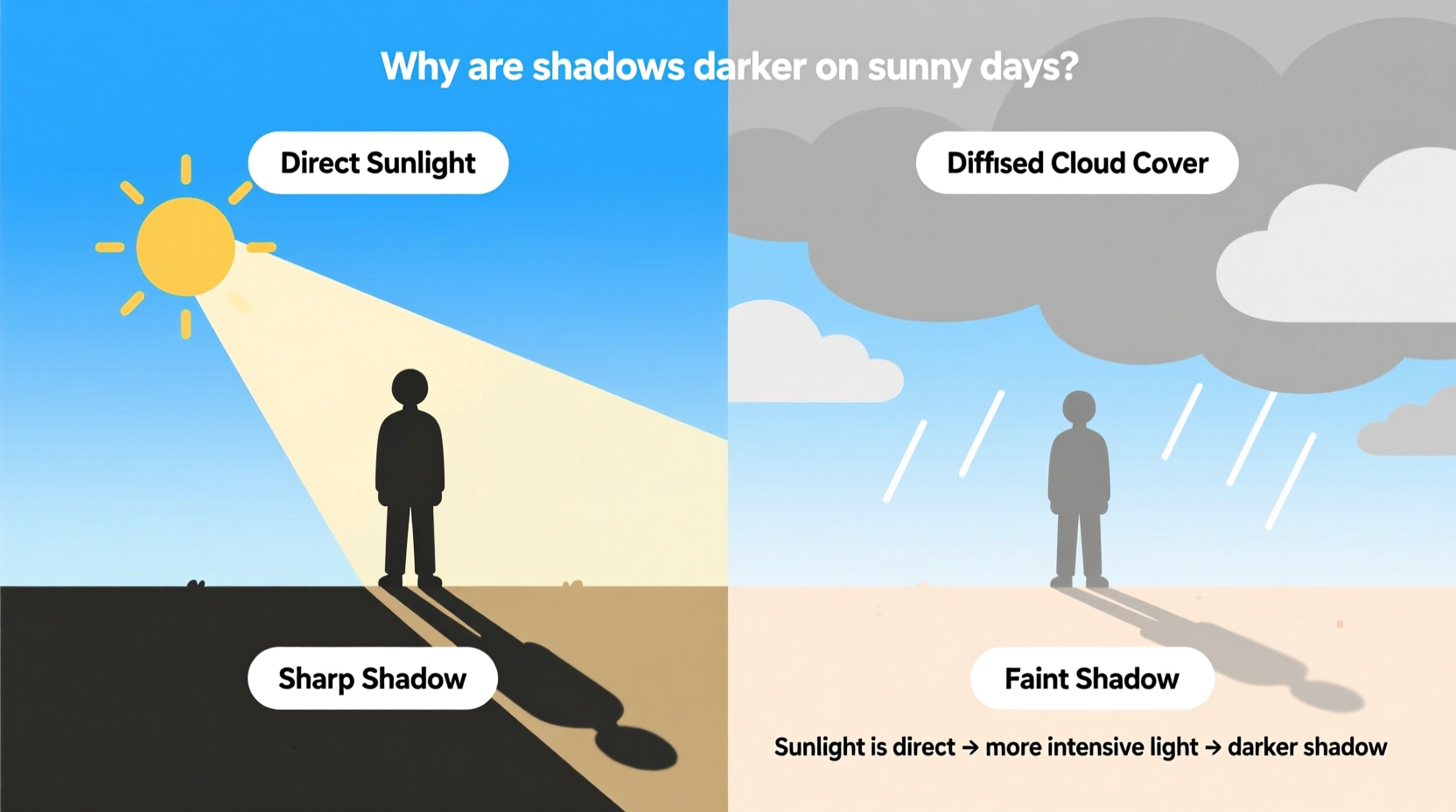
A shadow forms when an object blocks light. In the case of sunlight, your body interrupts the path of photons traveling from the sun to the ground. Where light is blocked, a shadow appears. But not all shadows are created equal. The quality of a shadow—its darkness, edge sharpness, and size—depends on three key factors:
- Light source intensity: Brighter light creates stronger contrasts between lit and unlit areas.
- Atmospheric clarity: Particles in the air scatter light, softening shadows.
- Sun angle: The height of the sun in the sky affects shadow length and concentration of light.
When sunlight is direct and unimpeded, shadows appear dark and sharply defined. When light is diffused—scattered by clouds, dust, or humidity—the contrast drops, and shadows fade.
Why Some Days Produce Darker Shadows
The primary reason your shadow appears darker on certain days comes down to atmospheric transparency. On crisp, dry, cloudless days—especially after rain or in high-altitude locations—the air contains fewer particles to scatter sunlight. This means more direct solar radiation reaches the ground without being deflected, resulting in higher contrast between illuminated surfaces and shadowed ones.
Conversely, on humid, hazy, or polluted days, water vapor, dust, smoke, or smog act like tiny mirrors, bouncing light in multiple directions. This phenomenon, known as diffuse sky radiation, fills in the shadowed areas with scattered light, making shadows appear lighter and less defined.
Consider this real-world example:
Mini Case Study: Mountain Hike vs. City Walk
Jenna hikes in the Rockies on a clear September morning. The air is thin and dry. Her shadow stretches ahead, jet-black and razor-edged. A week later, she walks through downtown Los Angeles under a smoggy sky. Despite similar sun angles, her shadow is pale and fuzzy. The difference? Atmospheric scattering. In the mountains, minimal particulates allow for clean, directional light. In the city, pollution scatters light, washing out shadows.
How the Sun’s Position Affects Shadow Darkness
The time of day and season also play crucial roles. Around solar noon—when the sun is highest in the sky—sunlight travels through less atmosphere. This reduces scattering and increases intensity, leading to darker shadows.
In contrast, during sunrise or sunset, sunlight passes through a thicker layer of atmosphere. More scattering occurs, especially of shorter blue wavelengths (which is why skies turn red), leaving the remaining light softer and more diffuse. As a result, early-morning and late-afternoon shadows are longer and lighter.
Seasonal changes matter too. In winter, the sun stays lower in the sky even at midday, increasing atmospheric filtering. Combined with potential snow cover—which reflects ambient light into shadow regions—this often results in less contrasted shadows compared to summer days with high sun angles and dry air.
| Condition | Shadow Darkness | Reason |
|---|---|---|
| Clear, dry day at noon | Very dark | Minimal atmospheric scattering, maximum direct sunlight |
| Hazy or humid day | Faint or gray | High diffusion from water vapor and particles |
| Sunrise or sunset | Pale and long | Long atmospheric path, strong scattering |
| Overcast sky | Nearly invisible | Light comes from all directions; no dominant source |
| High altitude, low humidity | Exceptionally dark | Thinner air = less scattering |
Scientific Insight: Rayleigh and Mie Scattering
To go deeper, two physical principles explain how light behaves in the atmosphere: Rayleigh scattering and Mie scattering.
- Rayleigh scattering affects shorter wavelengths (blue and violet light) and is responsible for the blue sky. It occurs when light interacts with molecules smaller than its wavelength, like nitrogen and oxygen. This type of scattering is more effective when the sun is low, contributing to softer lighting and lighter shadows.
- Mie scattering happens when light hits larger particles—dust, pollen, water droplets, or pollution. Unlike Rayleigh scattering, Mie scattering affects all wavelengths more evenly, creating a whitish haze that floods shadows with ambient light.
On days dominated by Rayleigh scattering (clear skies), shadows remain dark because most light still travels directly from the sun. But when Mie scattering prevails—such as during fog or high pollution—light comes from many directions, reducing contrast.
“Shadow contrast is one of the most intuitive ways to perceive atmospheric clarity. A sharp shadow tells you the air is clean and dry.” — Dr. Lena Patel, Atmospheric Physicist, University of Colorado
Step-by-Step Guide: Observing Shadow Changes Over Time
You don’t need special equipment to study shadow science. Here’s how to conduct your own observation experiment over a week:
- Pick a fixed location: Choose a flat, open area where your shadow falls clearly (e.g., a sidewalk or patio).
- Visit daily at the same time: Ideally around solar noon (usually 12:30–1:30 PM local time due to daylight saving and time zones).
- Observe and record: Note the darkness, edge sharpness, and visibility of your shadow. Use descriptive terms like “jet black,” “soft gray,” or “barely visible.”
- Check weather conditions: Record cloud cover, humidity, air quality index (AQI), and whether it rained recently.
- Compare results: After a week, correlate shadow appearance with environmental data. You’ll likely see a pattern: clearest shadows on dry, clear days.
This simple routine reveals how environmental variables influence everyday optical phenomena—and sharpens your awareness of subtle changes in your surroundings.
Common Misconceptions About Shadows
Several myths persist about shadows and light. Let’s clarify them:
- Myth: Shadows are always black. Reality: Shadows aren’t inherently black. They can appear blue (from scattered skylight), purple, or even colored depending on ambient light sources.
- Myth: Clouds block all direct sunlight. Reality: Even under overcast skies, some direct light may penetrate. True “shadowless” conditions occur only when clouds completely diffuse light from all directions.
- Myth: Shadow darkness depends only on brightness. Reality: Two equally bright days can produce different shadows if one has higher humidity or pollution.
Practical Checklist: Maximizing Shadow Clarity (For Photography & Observation)
If you're a photographer, educator, or simply curious, use this checklist to capture or observe the darkest, sharpest shadows:
- ✅ Choose a day with low humidity and high visibility
- ✅ Schedule activities near solar noon for shortest, darkest shadows
- ✅ Avoid days following heavy pollution events or dust storms
- ✅ Seek elevated or rural locations where air is cleaner
- ✅ Wear contrasting clothing to enhance shadow definition
- ❌ Don’t rely on brightness alone—check AQI and humidity reports
- ❌ Avoid shaded or reflective environments (e.g., near white buildings) that alter perception
FAQ: Your Shadow Questions Answered
Can shadows exist without the sun?
Absolutely. Any light source—lamps, flashlights, fire—can cast shadows. However, outdoor shadows are most noticeable under sunlight due to its intensity and directionality.
Why do shadows sometimes have two edges or look doubled?
This can happen due to partial obstruction, such as dappled light through leaves (creating a \"pinhole camera\" effect), or when multiple light sources (like streetlights and the moon) interact. It can also be a visual illusion caused by peripheral vision.
Do shadows change color?
Yes. While shadows appear dark, they often contain bluish tones from scattered skylight. Under artificial lighting, shadows may take on complementary colors—for example, a warm lamp can cast cool blue shadows.
Conclusion: Embrace the Science in the Everyday
Your shadow is more than a fleeting silhouette—it’s a real-time indicator of atmospheric physics. Its darkness reveals the cleanliness of the air, the clarity of the sky, and the precision of sunlight’s path. By paying attention to these subtle shifts, you gain a deeper appreciation for the interplay between light and environment.
Next time you step outside, pause for a moment. Look down. Is your shadow bold and defined, or soft and faint? That simple observation connects you to centuries of scientific inquiry—from ancient sundials to modern climate monitoring. Light science isn’t confined to labs; it’s written on the ground in real time.




 浙公网安备
33010002000092号
浙公网安备
33010002000092号 浙B2-20120091-4
Comments
No comments yet. Why don't you start the discussion?