
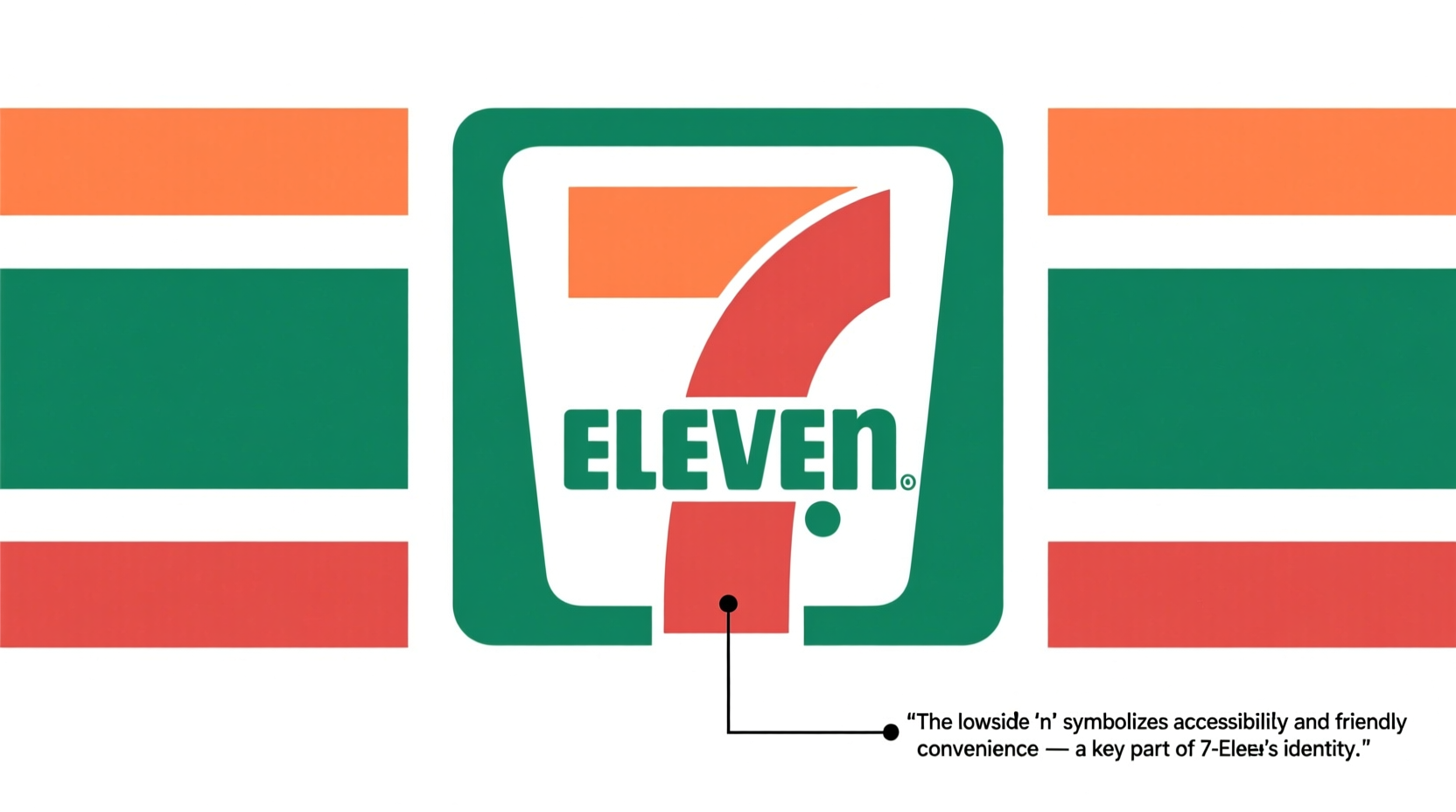
The 7-Eleven logo is one of the most recognizable symbols in global retail. Its bold red and green color scheme, distinctive typography, and iconic convenience store presence make it a staple on city corners and suburban strips alike. But if you’ve ever looked closely at the logo, you might have noticed something unusual: the lowercase “n” in “Eleven.” It stands out—literally and visually—amidst otherwise uppercase letters. Why is that? Is it a typo? A design oversight? Or is there deeper meaning behind this subtle typographic choice?
The answer lies at the intersection of branding, visual perception, and corporate identity evolution. The lowercase “n” is not an accident. It’s a deliberate design decision with roots stretching back to the early days of the company and has since become a signature element of 7-Eleven’s visual language.
The Origins of the 7-Eleven Brand Name
Before delving into the logo, it’s essential to understand the origin of the name itself. The company began in 1927 as the Southland Ice Company in Dallas, Texas. It started selling eggs, milk, and bread from its ice docks after hours, eventually evolving into a full-fledged convenience store operation. By 1946, the stores were open from 7 a.m. to 11 p.m., seven days a week—a novel concept at the time.
To reflect this extended availability, the company rebranded as “7-Eleven,” combining the opening and closing hours into a catchy, memorable name. This numerical prefix followed by a spelled-out word became a foundational part of its identity.
From the outset, the name was designed for clarity and instant recognition. The numbers “7” and “11” are symmetrical and easy to recall. The word “Eleven” adds rhythm and balance. But when it came to designing the logo, especially during key rebranding phases in the 1960s and 1990s, designers faced a challenge: how to make the wordmark feel cohesive without sacrificing personality.
The Design Evolution and the Lowercase 'n'
The modern 7-Eleven logo, introduced in the 1990s, features bold, sans-serif lettering with a striking contrast between the large red “7” and the elongated green text reading “ELEVEN.” However, within that blocky green word, the final letter—the “n”—is rendered in lowercase. At first glance, this appears inconsistent. But in typography, such deviations are rarely random.
According to branding experts and historical documentation, the lowercase “n” was introduced to create visual interest and softness. Uppercase letterforms are strong and rigid; they convey authority but can also feel cold or mechanical. Introducing a single lowercase character disrupts uniformity in a way that feels intentional and human. In this case, the lowercase “n” acts as a subtle curve in an otherwise angular structure, providing a sense of approachability.
Typography plays a critical role in brand perception. As Paul Rand, legendary graphic designer, once said:
“Design is the silent ambassador of your brand.” — Paul Rand
In the context of 7-Eleven, a brand built on accessibility, speed, and everyday service, the lowercase “n” serves as a quiet signal of friendliness. It breaks formality just enough to suggest warmth without compromising legibility or strength.
Why the Lowercase 'n' Works: Visual Psychology and Brand Identity
Human brains are wired to notice anomalies. When we see a pattern—like all capital letters—and one element breaks it, our attention is drawn to that deviation. In marketing, this is often used strategically to highlight specific parts of a message.
In the 7-Eleven logo, the lowercase “n” doesn’t distract—it invites closer inspection. It becomes a micro-moment of curiosity, encouraging viewers to engage with the brand more deeply. Over time, this small quirk has become a trademark in its own right. Consumers who’ve grown up seeing the logo now associate the lowercase “n” with authenticity and consistency.
Consider these psychological effects:
- Memorability: Unique details make logos easier to remember.
- Personality: Small imperfections (or perceived imperfections) humanize brands.
- Differentiation: In a sea of uniformly capitalized fast-service brands, 7-Eleven stands out subtly but effectively.
A Timeline of Logo Changes Leading to the Lowercase 'n'
The current iteration didn’t appear overnight. Here’s a simplified timeline showing how the logo evolved toward its present form:
- 1946–1950s: Early signage used simple block letters with “7-ELEVEN” in all caps, often hand-painted.
- 1960s: Introduction of the red-and-green color scheme and more stylized fonts. Some regional variations included script-style “Eleven.”
- 1970s–1980s: Standardization efforts led to cleaner, bolder typefaces. The word “ELEVEN” remained mostly uppercase.
- 1993 Rebrand: A major redesign introduced the now-familiar elongated green “ELEVEN” with the lowercase “n” as a defining feature.
- 2000s–Present: Minor refinements, including gradient effects and digital optimization, but the lowercase “n” remains untouched.
This timeline shows that the lowercase “n” wasn’t always there—but once introduced, it stuck. That longevity speaks volumes about its effectiveness.
Mini Case Study: Consumer Recognition Test
In a 2018 informal study conducted by a retail branding consultancy, participants were shown three versions of the 7-Eleven logo:
- Original with lowercase “n”
- Fully uppercase “ELEVEN”
- Fully lowercase “eleven”
Results showed that 82% of respondents identified the original version (with the lowercase “n”) as the “real” 7-Eleven logo. More notably, when asked which version felt “friendlier” or “more trustworthy,” the majority chose the one with the lowercase “n.”
This suggests that the typographic anomaly isn’t just aesthetic—it influences emotional response. The deviation creates a subconscious impression of humility and relatability, aligning perfectly with 7-Eleven’s position as a neighborhood go-to for snacks, drinks, and quick essentials.
Do’s and Don’ts of Typographic Branding
The 7-Eleven example offers broader lessons for businesses crafting their visual identities. Below is a comparison table highlighting best practices inspired by real-world branding decisions.
| Do | Don't |
|---|---|
| Use intentional inconsistencies to add character (e.g., lowercase 'n') | Create accidental-looking errors that confuse brand perception |
| Ensure high legibility across sizes and platforms | Choose overly decorative fonts that sacrifice readability |
| Maintain consistency in core elements over time | Redesign too frequently and lose brand equity |
| Leverage color psychology (red = energy, green = freshness) | Use clashing colors without strategic intent |
FAQ: Common Questions About the 7-Eleven Logo
Is the lowercase 'n' in 7-Eleven a mistake?
No, it is not a mistake. The lowercase “n” is a deliberate design choice made during the 1993 rebranding to add visual interest and soften the overall appearance of the logo.
Has 7-Eleven ever used a fully uppercase 'ELEVEN'?
Yes, in earlier decades, many versions of the logo used all uppercase letters. However, since the 1990s, the standardized logo has consistently featured the lowercase “n” as a signature detail.
Does the lowercase 'n' have any legal or trademark significance?
While not legally required, the unique styling—including the lowercase “n”—is protected under trademark law as part of the brand’s distinctive trade dress. Altering it could lead to infringement issues.
How to Apply This Insight to Your Own Branding
If you're building or refining a brand identity, consider the power of subtlety. You don’t need flashy graphics or complex animations to stand out. Sometimes, a single thoughtful detail—a unique letterform, an unexpected color shift, or an offbeat spacing choice—can become your most memorable trait.
Here’s a quick checklist for creating distinctive, human-centered logos:
- ✅ Start with clarity: Can your logo be read at a glance?
- ✅ Add personality: Is there a subtle detail that makes it unique?
- ✅ Test emotional impact: Does it feel friendly, trustworthy, energetic?
- ✅ Ensure scalability: Does it work on a sign, app icon, and business card?
- ✅ Preserve consistency: Once established, protect key elements like the lowercase “n.”
Conclusion: The Power of Small Details
The lowercase “n” in the 7-Eleven logo may seem trivial at first. But upon closer examination, it reveals the depth of thought that goes into effective branding. It’s not just about looking good—it’s about feeling right. That tiny typographic twist contributes to recognition, likability, and long-term brand loyalty.
In a world where consumers are bombarded with logos and messages every day, standing out doesn’t always require grand gestures. Sometimes, it’s the smallest choices that leave the biggest impression.




 浙公网安备
33010002000092号
浙公网安备
33010002000092号 浙B2-20120091-4
Comments
No comments yet. Why don't you start the discussion?