
The sky isn't always blue. At dawn and dusk, it often blazes with vivid oranges, reds, and pinks that seem almost otherworldly. This transformation isn’t magic—it’s physics. The phenomenon behind the orange sky lies in a branch of science called atmospheric optics, which explores how sunlight interacts with Earth’s atmosphere. Understanding this process reveals not only why the sky changes color but also what those colors can tell us about air quality, weather patterns, and even distant volcanic activity.
The Science of Light Scattering
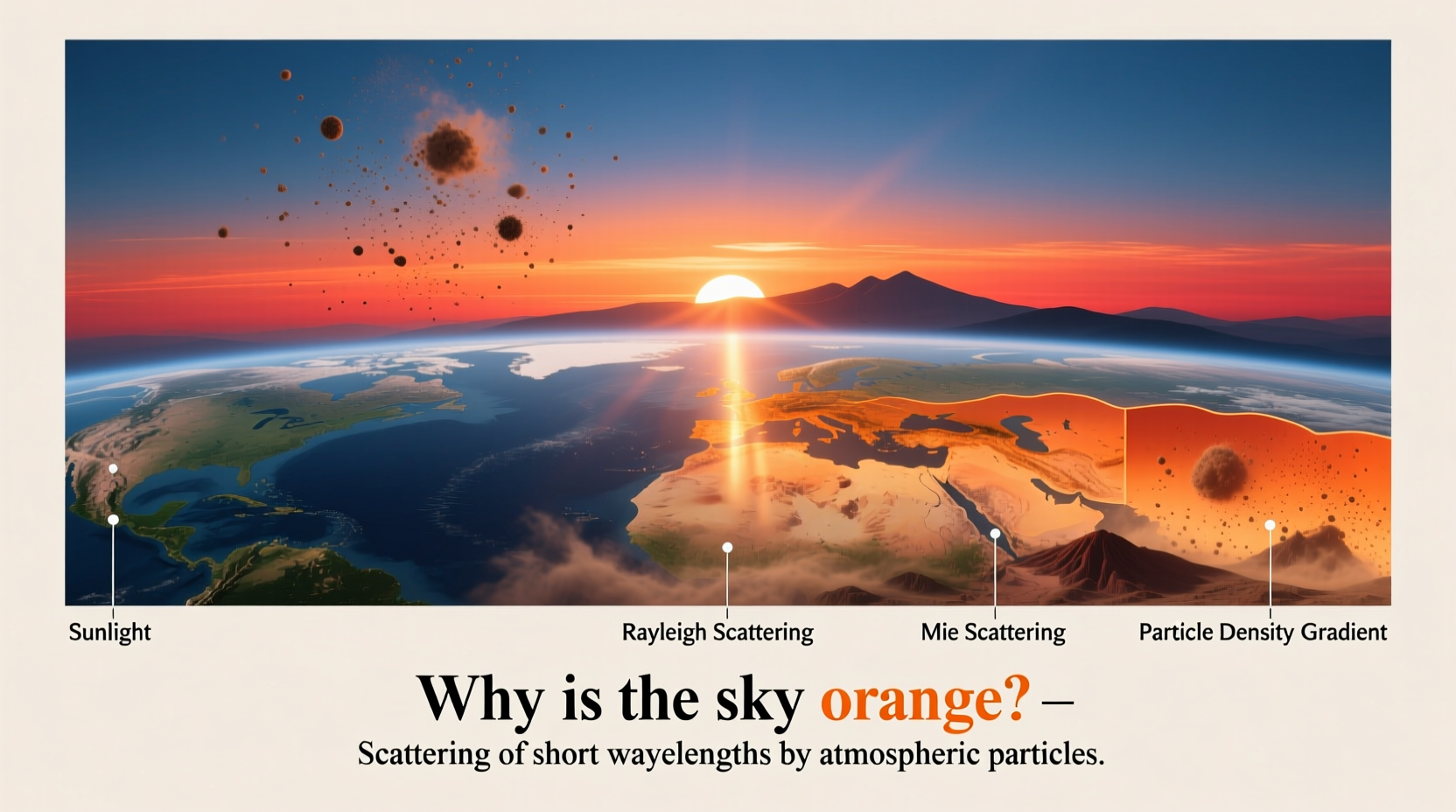
Sunlight appears white, but it contains all the colors of the visible spectrum. When sunlight enters Earth’s atmosphere, it collides with gas molecules, dust, water droplets, and pollutants. These particles scatter the light in different directions—a process known as Rayleigh scattering. Shorter wavelengths (blue and violet) scatter more easily than longer ones (red, orange, yellow).
During midday, when the sun is high in the sky, sunlight travels through a relatively thin layer of atmosphere. Blue light dominates because it's scattered across the sky, giving us the familiar blue canopy. But at sunrise and sunset, the sun sits near the horizon, and its light must pass through a much thicker slice of the atmosphere. This extended path filters out most of the shorter wavelengths, leaving the longer orange and red tones to reach our eyes.
“Sunset colors are not just beautiful—they’re a real-time map of what’s in the air above us.” — Dr. Lena Patel, Atmospheric Physicist, NOAA
Factors That Influence Sky Color Intensity
While Rayleigh scattering explains the basic mechanism, several environmental variables determine just how intense and widespread the orange hues become:
- Aerosol concentration: Tiny particles from pollution, smoke, or sea salt increase scattering and can deepen orange and red tones.
- Humidity levels: Water vapor enhances light diffusion, often softening colors but sometimes creating richer gradients.
- Altitude: Observers at higher elevations see less atmospheric filtering, so sunsets may appear less fiery.
- Weather systems: High-pressure zones often produce clearer skies and more vivid sunrises due to stable air and reduced cloud interference.
Volcanic eruptions, for example, inject sulfur dioxide and ash into the stratosphere, where they form fine sulfate aerosols. These particles can circle the globe and produce spectacularly colorful sunsets for months. Historical records show that after the 1883 eruption of Krakatoa, people worldwide reported blood-red and deep-orange skies—so intense that some believed cities were on fire.
Real-World Example: The Australian Bushfire Sunsets of 2020
In early 2020, massive bushfires swept across Australia, releasing unprecedented amounts of smoke into the atmosphere. Residents in cities hundreds of miles away noticed an eerie orange glow during daylight hours, and sunsets turned dramatically darker and redder than usual. Satellite data confirmed that smoke plumes had reached the upper troposphere and were being carried globally by wind currents.
This event wasn’t just visually striking—it provided scientists with valuable data on long-range aerosol transport. The unusual sky colors served as a visible indicator of particulate density and atmospheric circulation patterns. Similar effects were observed in parts of New Zealand and South America, where the normally blue skies took on a hazy orange tint despite no local fires.
Do’s and Don’ts of Observing Orange Skies
| Action | Recommended? | Reason |
|---|---|---|
| Observe sunrises/sunsets from open areas | ✅ Yes | Unobstructed views maximize color visibility and clarity |
| Use polarized sunglasses during observation | ⚠️ Caution | Polarization can alter perceived sky color; remove for true visual assessment |
| Photograph the sky without adjusting white balance | ❌ No | Auto settings may underrepresent warm tones; manual mode preserves accuracy |
| Interpret intense orange skies as purely aesthetic | ❌ No | They may signal poor air quality or approaching weather changes |
| Check local air quality reports alongside sky observations | ✅ Yes | Correlates visual cues with health and environmental data |
Step-by-Step Guide to Predicting Vivid Orange Skies
You don’t need a meteorology degree to anticipate a stunning sunset. Follow this practical timeline to increase your chances of witnessing dramatic sky displays:
- Monitor the forecast (24–48 hours ahead): Look for clear skies post-sunset or pre-sunrise, especially after a cold front has passed.
- Check air quality indices: Elevated PM2.5 or AQI levels often correlate with enhanced scattering and deeper colors.
- Watch for high-altitude clouds: Cirrus or altocumulus clouds act as natural screens, reflecting and diffusing warm light.
- Arrive early (30 minutes before sunset): Colors evolve rapidly; the peak orange phase often occurs just after the sun dips below the horizon.
- Face east during sunrise (or west at sunset): Position yourself with an unobstructed view toward the solar horizon.
- Record your observations: Note sky color intensity, cloud cover, and any haze—this builds personal awareness over time.
Frequently Asked Questions
Why isn’t the sky orange every evening?
Not all sunsets produce orange skies because the effect depends on atmospheric conditions. If the air is too clean, there aren’t enough particles to scatter light effectively. Conversely, heavy cloud cover or storms can block sunlight entirely. The most vibrant displays occur under specific combinations of humidity, particle load, and cloud positioning.
Can pollution cause orange skies during the day?
Yes. In extreme cases—such as during wildfires or industrial smog events—dense aerosol layers can filter sunlight so heavily that daytime skies turn orange or yellow. This isn’t typical scattering but rather selective absorption and forward scattering caused by larger particles like soot or ash.
Are orange skies dangerous?
The color itself isn’t harmful, but it can be a warning sign. Persistent orange or red haze during daylight may indicate unhealthy air quality, especially if accompanied by a smell of smoke or respiratory irritation. It’s wise to consult local air quality reports and limit outdoor exertion when such conditions persist.
How to Use This Knowledge Practically
Beyond aesthetic appreciation, understanding atmospheric optics has real-world applications. Photographers use knowledge of light angles and particle effects to time their shoots. Pilots and navigators monitor sky color changes as informal indicators of shifting weather systems. Environmental scientists track long-term changes in sky clarity as proxies for air pollution trends.
For everyday observers, recognizing the causes behind orange skies fosters a deeper connection to the environment. It turns passive viewing into active interpretation—a way to “read” the atmosphere like a living textbook.
Conclusion: Look Up With Purpose
The next time you see an orange sky, pause and consider what’s really happening above you. It’s not just a pretty backdrop—it’s a dynamic interaction between sunlight and the invisible world of molecules and particles surrounding our planet. From Rayleigh scattering to wildfire smoke drifting across continents, each hue tells a story of physics, chemistry, and Earth’s interconnected systems.




 浙公网安备
33010002000092号
浙公网安备
33010002000092号 浙B2-20120091-4
Comments
No comments yet. Why don't you start the discussion?