
Ronald Reagan, the 40th President of the United States, remains one of the most polarizing figures in modern American political history. While celebrated by many for revitalizing conservative ideology and overseeing the end of the Cold War, Reagan’s presidency also drew sharp criticism for policies that deepened inequality, expanded military interventionism, and neglected urgent social crises. A balanced assessment reveals significant controversies that continue to shape debates about his legacy.
Economic Inequality and the Rise of Trickle-Down Economics
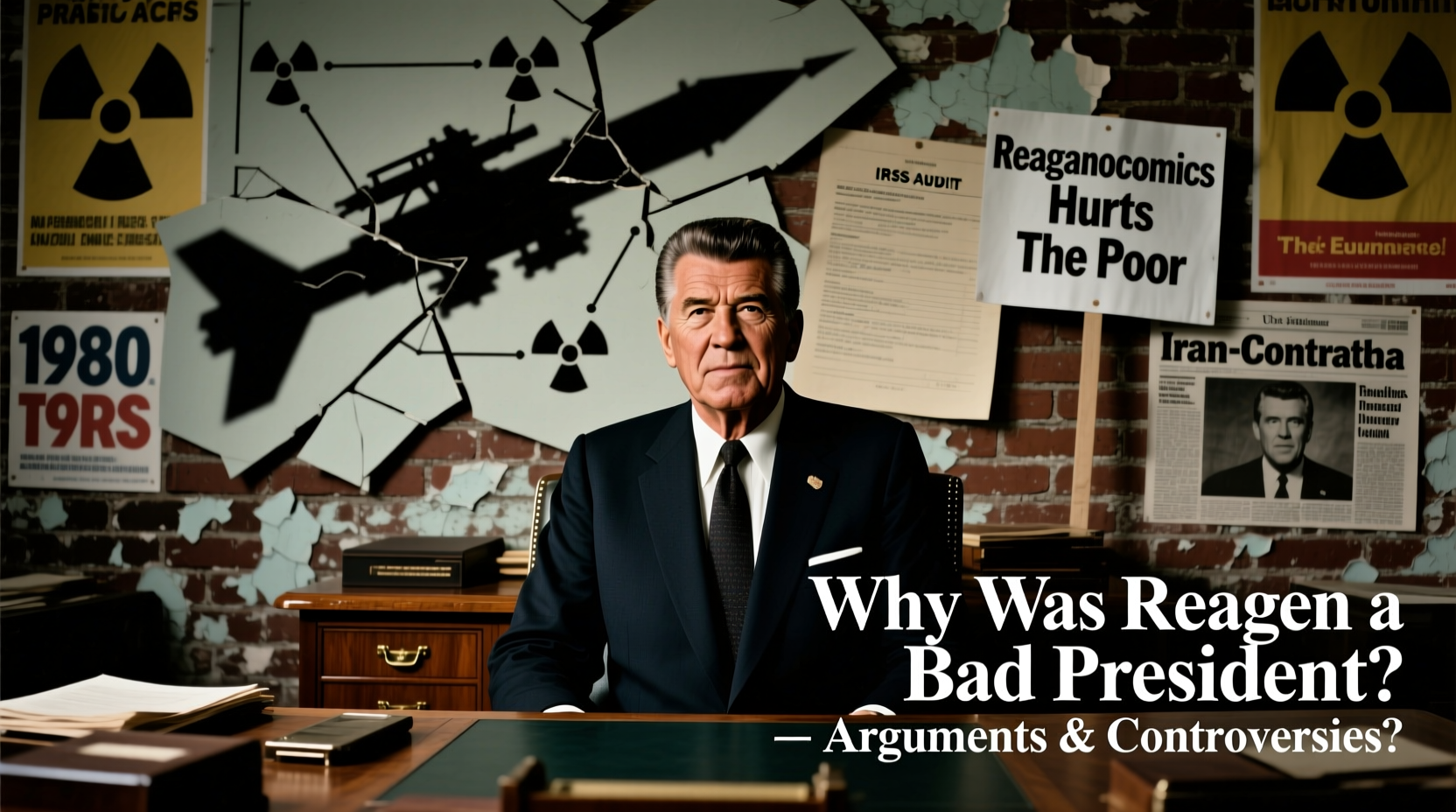
Reaganomics—his signature economic policy—centered on tax cuts, deregulation, reduced government spending (except on defense), and anti-union measures. The core idea was that reducing taxes on the wealthy and corporations would stimulate investment, create jobs, and ultimately benefit all Americans through “trickle-down” growth.
In practice, the results were uneven. While GDP grew during the 1980s, the benefits were disproportionately captured by the top income brackets. According to the Congressional Budget Office, the after-tax income of the top 1% rose by 74% between 1979 and 1988, while the bottom 20% saw only a 6% increase.
| Income Group | After-Tax Income Growth (1979–1988) |
|---|---|
| Top 1% | +74% |
| Middle 60% | +13% |
| Bottom 20% | +6% |
Critics argue that Reagan’s tax reforms, particularly the Economic Recovery Tax Act of 1981, laid the groundwork for long-term wealth concentration. Federal debt nearly tripled during his tenure, rising from $997 billion in 1981 to $2.85 trillion in 1989, largely due to increased defense spending combined with reduced revenue from tax cuts.
Foreign Policy Interventions and Human Rights Concerns
While Reagan is often credited with accelerating the end of the Cold War, his administration’s foreign policy included controversial military actions that drew condemnation from human rights advocates and international bodies.
In Central America, the Reagan administration supported anti-communist forces in Nicaragua, El Salvador, and Guatemala—often at the expense of democratic principles. The Contra War in Nicaragua involved covert funding of rebel groups despite a congressional ban (leading to the Iran-Contra scandal). These Contras were linked to widespread human rights abuses, including massacres of civilians.
In 1983, U.S. troops invaded Grenada to depose a Marxist government, an action criticized by the United Nations as a violation of international law. Similarly, support for authoritarian regimes in South Korea, the Philippines, and Zaire raised ethical concerns.
“We are supporting regimes that are brutal, undemocratic, and deeply corrupt—all in the name of fighting communism.” — Rep. Tony Hall, House Foreign Affairs Committee, 1984
The Iran-Contra Affair: A Constitutional Crisis
Perhaps the most damaging controversy of Reagan’s second term was the Iran-Contra scandal. Senior officials secretly facilitated arms sales to Iran—then under an embargo—in hopes of securing the release of American hostages in Lebanon. Proceeds were then funneled to the Nicaraguan Contras, bypassing Congress.
Though Reagan claimed he was unaware of the fund diversion, investigations concluded that the operation violated both legal statutes and constitutional norms regarding congressional oversight. Oliver North, a key figure, was convicted (later overturned), and several officials were indicted. The scandal eroded public trust and exposed dangerous levels of executive overreach.
Neglect of the AIDS Crisis
One of the most enduring criticisms of Reagan’s presidency is his delayed response to the HIV/AIDS epidemic. First identified in 1981, AIDS initially affected gay men, intravenous drug users, and marginalized communities—groups that faced stigma and political neglect.
For nearly six years, the administration remained largely silent. Reagan did not publicly mention AIDS until September 1985, by which time over 12,000 Americans had been diagnosed and more than 6,000 had died. Funding for research and public health initiatives lagged significantly behind the scale of the crisis.
Activists accused the White House of indifference rooted in homophobia. As Larry Kramer, co-founder of ACT UP, stated: “Silence equals death. And Reagan’s silence killed thousands.”
By the time federal funding increased in the late 1980s, the epidemic had become entrenched. Public health experts agree that earlier intervention could have slowed transmission and saved lives.
Environmental Rollbacks and Deregulation
Reagan’s administration pursued aggressive deregulation across multiple sectors, including environmental protection. He appointed James Watt as Secretary of the Interior, who advocated opening protected lands to mining, logging, and drilling. Watt’s controversial statements—such as referring to a diverse advisory panel as a “beauty queen” selection—sparked public backlash and led to his resignation.
The Environmental Protection Agency (EPA) also came under fire when Anne Gorsuch Burford, its administrator, sought to weaken enforcement and reduce budgets. Her tenure ended amid a congressional investigation into mismanagement and suppression of Superfund data.
During Reagan’s presidency, enforcement actions against polluters dropped by over 30%, and numerous environmental regulations were rolled back. Critics argue this set back conservation efforts for decades and prioritized corporate interests over ecological sustainability.
Social Impact and the War on Drugs
Reagan escalated the War on Drugs with policies that disproportionately impacted low-income and minority communities. The Anti-Drug Abuse Act of 1986 introduced mandatory minimum sentences, including a 5-year prison term for possession of just 5 grams of crack cocaine—versus 500 grams of powder cocaine.
This 100:1 sentencing disparity fueled mass incarceration, especially among Black Americans, despite similar usage rates across racial groups. By 1989, the federal prison population had nearly doubled since 1980.
First Lady Nancy Reagan’s “Just Say No” campaign emphasized individual responsibility over structural causes of addiction, drawing criticism for oversimplifying a complex public health issue. Harm reduction strategies, treatment access, and socioeconomic factors received little attention.
“The War on Drugs became a war on people—particularly poor people and people of color.” — Michelle Alexander, author of *The New Jim Crow*
FAQ
Did Reagan shrink the size of government?
No. Despite rhetoric about reducing government, federal spending increased by 82% during his presidency. While domestic discretionary spending was cut in some areas, defense spending nearly doubled, and overall government size grew. The number of federal employees also increased slightly.
Was Reagan responsible for ending the Cold War?
Historians debate this. Reagan’s military buildup and firm stance pressured the Soviet Union, but diplomacy with Mikhail Gorbachev, internal Soviet economic decline, and global peace movements played crucial roles. Attributing the Cold War’s end solely to Reagan overlooks broader geopolitical dynamics.
Did Reagan raise taxes?
Yes—despite promising never to do so. Facing mounting deficits, Reagan signed the Tax Equity and Fiscal Responsibility Act of 1982, which reversed some of his earlier cuts. Additional tax increases followed in 1984 and 1987, totaling over $120 billion in new revenue.
Conclusion
Judging Ronald Reagan as simply “good” or “bad” oversimplifies a complex presidency. His leadership reshaped American politics, energized the conservative movement, and influenced global geopolitics. Yet serious critiques remain—on economic fairness, civil liberties, humanitarian interventions, and social justice.
Understanding these controversies is essential for informed civic discourse. They remind us that presidential legacies are not monolithic, and that power must be exercised with accountability, compassion, and foresight.




 浙公网安备
33010002000092号
浙公网安备
33010002000092号 浙B2-20120091-4
Comments
No comments yet. Why don't you start the discussion?