
When Microsoft launched the Xbox Series X and Series S in 2020, it introduced a bold dual-console strategy: one machine built for peak performance, the other for affordability and accessibility. The Xbox Series X delivers native 4K, high frame rates, and robust hardware. The Series S, its smaller sibling, targets 1440p at 60fps with less storage and reduced graphical power. But as next-gen gaming evolves, a growing debate has emerged: Is the Xbox Series S undermining the promise of next-generation experiences?
The answer isn't simple. While the Series S brings undeniable value to budget-conscious gamers and space-limited setups, its technical limitations raise legitimate concerns about game development priorities, optimization trade-offs, and the future of visual fidelity across the Xbox ecosystem.
The Hardware Divide: Series S vs. Series X
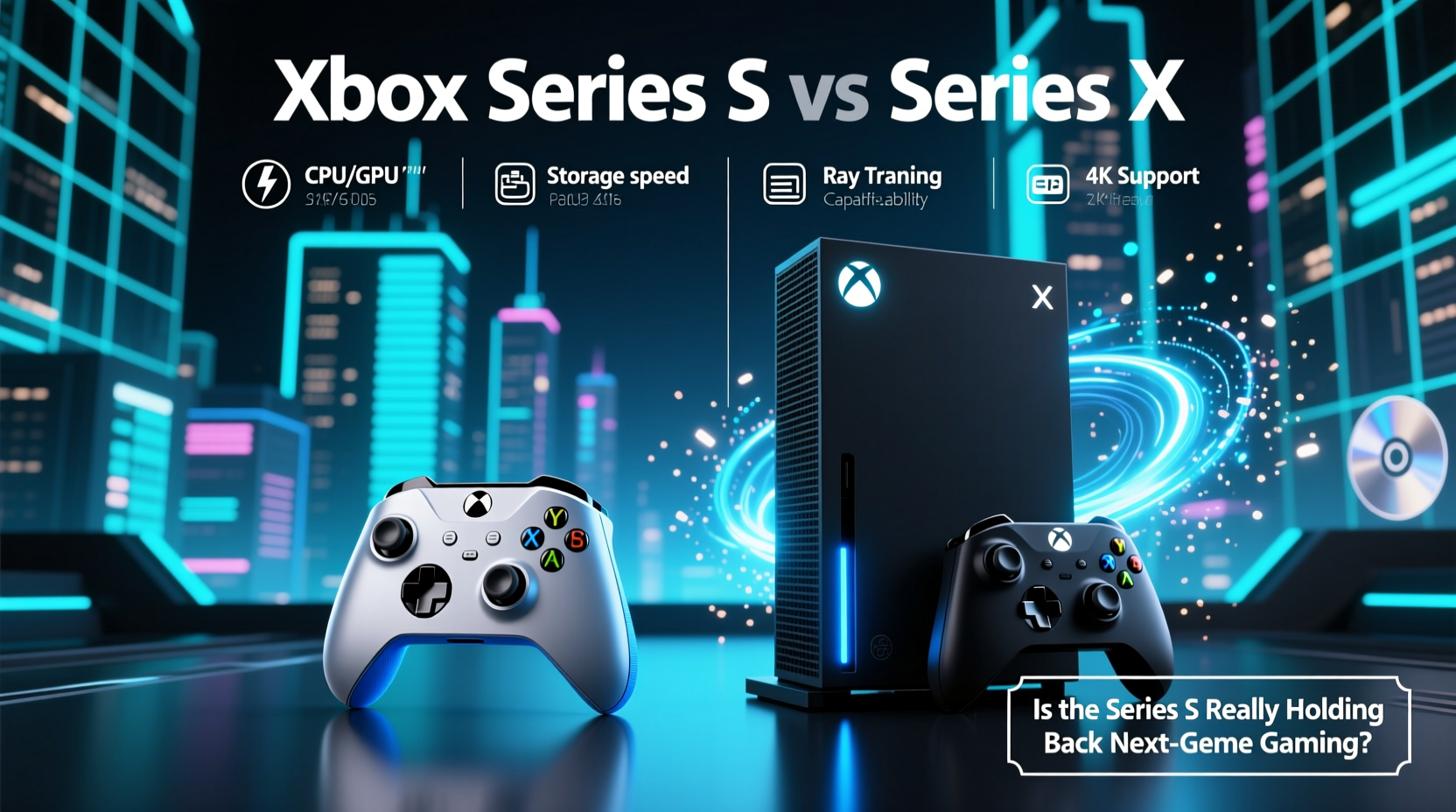
The most obvious difference between the two consoles lies in their hardware specifications. The Series X features a full-power RDNA 2 GPU with 12 teraflops of processing power, 16GB of GDDR6 RAM, and a 1TB NVMe SSD. It supports native 4K resolution, ray tracing, variable refresh rate (VRR), and quick resume functionality across multiple titles.
In contrast, the Series S uses a cut-down version of the same architecture—4 teraflops of GPU power, 10GB of shared RAM, and a 512GB SSD. It targets 1440p output (upscaled to 4K) and prioritizes performance efficiency over graphical intensity. While both run the same operating system and support Smart Delivery, the disparity in raw capability is significant.
| Feature | Xbox Series X | Xbox Series S |
|---|---|---|
| GPU Performance | 12 TFLOPS (RDNA 2) | 4 TFLOPS (RDNA 2) |
| Resolution Target | Native 4K | 1440p (up to 4K upscaled) |
| RAM | 16GB GDDR6 | 10GB GDDR6 |
| Storage | 1TB NVMe SSD | 512GB NVMe SSD |
| Ray Tracing | Full support | Supported, but limited by memory and bandwidth |
| Disc Drive | Yes (4K UHD Blu-ray) | No (digital-only) |
| Price at Launch | $499 | $299 |
This table illustrates more than just specs—it reflects two distinct philosophies. The Series X embodies Microsoft’s commitment to cutting-edge performance. The Series S represents a push toward inclusivity, lowering the entry point into next-gen gaming by nearly $200.
Does the Series S Limit Game Development?
A common argument against the Series S is that its weaker hardware forces developers to \"lowest-common-denominator\" optimization. In theory, studios must scale back textures, reduce draw distances, or limit effects to ensure playability on the lower-end model. Over time, this could result in fewer visually ambitious titles across the board.
However, Microsoft anticipated this issue. Through its Smart Delivery program and dynamic resolution scaling, games are expected to adapt based on the host console. For example, *Halo Infinite* runs at up to 4K/120fps on Series X but drops to 1440p/60fps on Series S—with adjusted shadow quality, texture streaming, and level-of-detail models.
“Developers aren’t designing for the weakest link—we’re building scalable frameworks so every player gets the best possible experience on their device.” — Phil Spencer, Head of Xbox
Still, some evidence suggests compromises exist. In *Forza Horizon 5*, the Series S version disables certain ambient occlusion and reflection effects. Texture pop-in is more noticeable, and the lack of a disc drive means larger downloads and reliance on external storage expansion—a costly addition.
But here’s the nuance: Most major third-party studios already develop for multiple platforms, including mid-tier PCs and last-gen consoles. The real bottleneck isn’t the Series S itself—it’s how publishers prioritize resources. When budgets are tight, optimization for lower-spec hardware can delay feature rollouts or reduce polish on higher-end systems.
Real-World Impact: A Mini Case Study
Consider the launch of *Starfield*. Bethesda’s ambitious RPG was designed with the Series X as the lead platform. However, due to performance issues even on that console, the Series S version launched with mandatory 30fps caps, reduced UI resolution, and longer loading sequences when switching planets.
While playable, the experience highlighted a troubling trend: Even first-party Microsoft titles struggle to deliver parity. Fans noted that areas like underground bases suffered from aggressive fogging and texture degradation on Series S—design choices likely made to maintain stability.
This doesn’t mean the Series S “ruined” *Starfield*. But it does show that supporting two vastly different performance tiers adds complexity. In cases where development timelines are tight, the lower-spec console often dictates which features get cut or scaled back—not because of technical necessity, but resource allocation.
Who Benefits From the Series S?
The Series S wasn’t designed for hardcore enthusiasts with 4K HDR setups. It was built for three key audiences:
- First-time console buyers seeking an affordable entry into modern gaming
- Secondary household consoles (e.g., kids’ rooms, dorms)
- Players transitioning from mobile or last-gen systems who value digital convenience
For these users, the Series S delivers remarkable value. Fast boot times, quick resume, and access to Game Pass make it a compelling package. At $299, it undercuts the PS5 Digital Edition by $100 and offers comparable performance to many budget gaming PCs.
Moreover, the rise of cloud gaming through Xbox Cloud Gaming (xCloud) complements the Series S perfectly. Users can stream high-fidelity versions of games directly to the device, effectively bypassing local hardware limits. This hybrid approach may represent the future: lightweight local devices paired with powerful remote servers.
Checklist: Is the Series S Right for You?
Before purchasing, consider the following:
- Display Resolution: Are you using a 1080p or 1440p monitor? If yes, the Series S makes sense. If you have a 4K TV, you’ll miss out on full visual fidelity.
- Storage Needs: With only 512GB (and ~364GB usable), do you plan to expand via a $220 Seagate expansion card?
- Game Library: Do you prefer digital-only titles? No disc drive means no used games or physical collections.
- Future-Proofing: Will you still be satisfied in 2027 when AAA games demand higher specs?
- Budget: Can you save for a Series X, or is $299 your ceiling?
The Long-Term Outlook: Fragmentation vs. Accessibility
Critics argue that dual SKUs fragment the user base and dilute innovation. Sony took a different path with the PS5, offering only minor differences between standard and digital editions—same GPU, same resolution target, same internal architecture.
Microsoft’s approach is riskier but potentially more inclusive. By offering a low-cost alternative, they’ve expanded the Xbox install base faster than if relying solely on the $499 Series X. More users mean stronger network effects for services like Game Pass and multiplayer communities.
Yet, there’s a tipping point. If too many players adopt the Series S, developers may begin treating it as the de facto baseline. That could slow the adoption of advanced rendering techniques, higher-resolution assets, or complex physics simulations that define “next-gen” beyond marketing slogans.
So far, that hasn’t happened. Most multiplatform titles still showcase their best visuals on Series X and PC. First-party studios continue pushing boundaries with technologies like DirectStorage and hardware-accelerated ray tracing—features fully supported on Series X but constrained on Series S.
Frequently Asked Questions
Can the Xbox Series S run the same games as the Series X?
Yes, all games are cross-compatible thanks to Smart Delivery. However, performance, resolution, texture quality, and features may be reduced on Series S to maintain stable frame rates.
Will future games stop supporting the Series S?
Unlikely during this console generation. Microsoft has committed to supporting both consoles through at least 2028. However, games may become increasingly optimized for Series X/PC, making Series S versions feel outdated sooner.
Is the Series S a good choice for Game Pass?
Absolutely. With Game Pass, you avoid high upfront game costs, which aligns perfectly with the Series S’s budget-friendly design. Just ensure you have enough storage and a strong internet connection for frequent downloads.
Conclusion: Balancing Vision and Inclusivity
The Xbox Series S isn’t holding back next-gen gaming—but it does force tough trade-offs. It democratizes access to modern gaming technology, bringing features like SSD-speed loading, quick resume, and high frame rates to millions who couldn’t afford a $500 console. That’s a win for inclusivity.
At the same time, it introduces constraints that influence how games are built and optimized. While not the sole factor, its presence contributes to a broader industry challenge: how to innovate without leaving players behind.
Ultimately, the Series S serves a vital role in Microsoft’s ecosystem. It’s not meant to replace the Series X, but to complement it—offering a stepping stone into a world where cloud integration, subscription services, and scalable experiences define the future of play.




 浙公网安备
33010002000092号
浙公网安备
33010002000092号 浙B2-20120091-4
Comments
No comments yet. Why don't you start the discussion?