
When shopping for affordable gemstone jewelry, two names often come up: zircon and cubic zirconia. Despite sounding nearly identical—and both being used as diamond alternatives—they are fundamentally different materials. One is a naturally occurring mineral; the other is entirely lab-created. Yet many consumers confuse the two, assuming they’re interchangeable. The real question isn’t just whether you can tell them apart—it’s whether that distinction should influence your purchase.
Understanding the differences between zircon and cubic zirconia involves more than just optics. It touches on durability, value, ethical considerations, and personal style. For engagement rings, heirloom pieces, or everyday accessories, knowing what you're buying—and why—can make all the difference.
Nature vs. Laboratory: What Are These Stones Made Of?
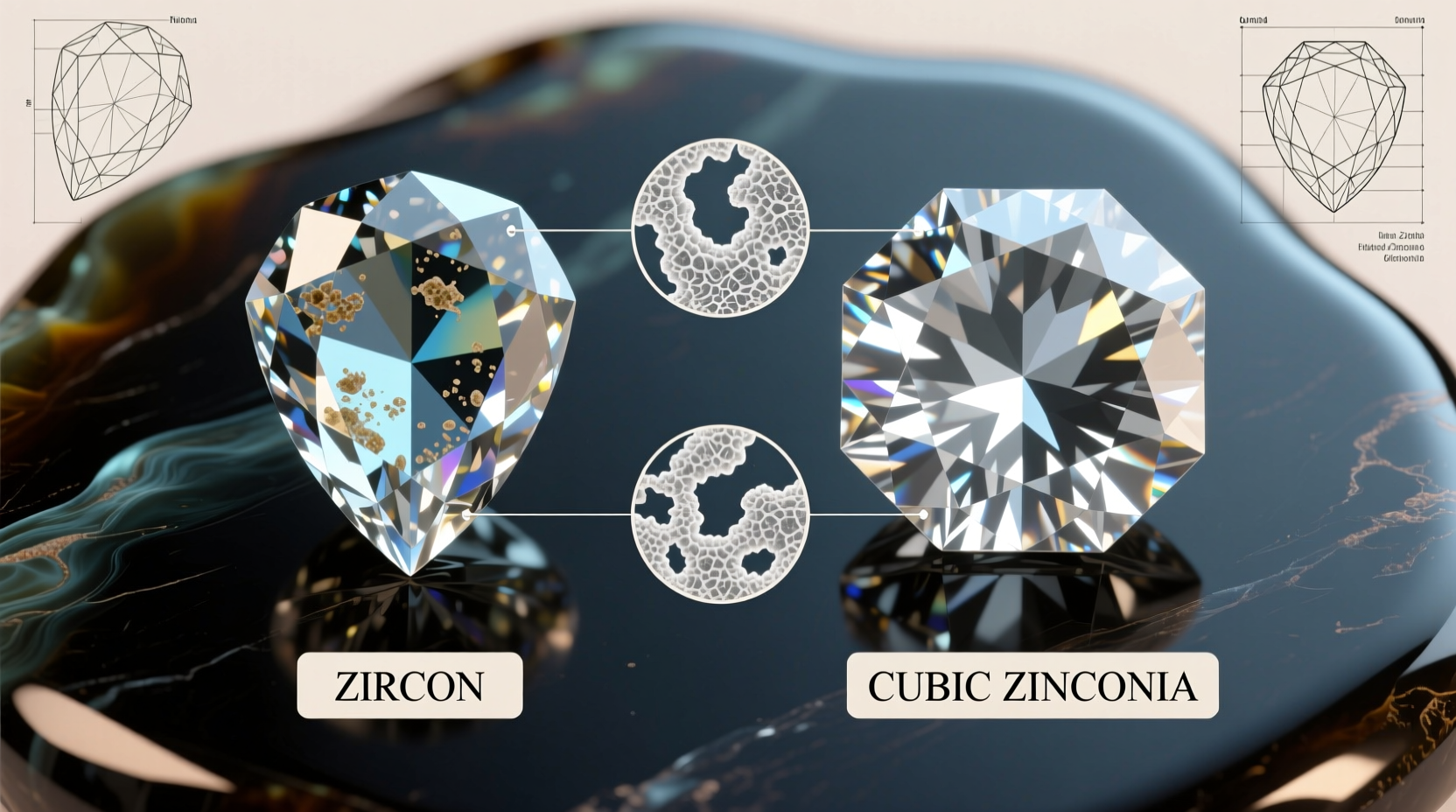
Zircon (zirconium silicate, ZrSiO₄) is a natural gemstone found in various parts of the world, including Cambodia, Sri Lanka, and Australia. It has been used in jewelry for centuries, prized for its brilliance and fire. Natural zircon forms deep within the Earth’s crust under intense heat and pressure. Some specimens are billions of years old, making zircon one of the oldest minerals known to science.
In contrast, cubic zirconia (CZ), while chemically related (zirconium dioxide, ZrO₂), is completely synthetic. First developed in the 1970s in Soviet laboratories, CZ was engineered specifically to mimic diamonds at a fraction of the cost. Unlike zircon, which may be heated to enhance color, cubic zirconia does not occur in nature and must be manufactured using high-pressure, high-temperature processes.
This fundamental origin story shapes everything from appearance to price. But visually, especially to the untrained eye, they can appear strikingly similar—especially when set in white gold or platinum settings.
Visual Comparison: How Do They Differ in Appearance?
Both stones sparkle, but their light performance varies significantly due to refractive index and dispersion.
| Property | Zircon | Cubic Zirconia |
|---|---|---|
| Refractive Index | 1.81–2.01 (high) | 2.15–2.18 (very high) |
| Dispersion (Fire) | 0.038 (noticeable) | 0.058–0.066 (extreme) |
| Luster | Vitreous to sub-adamantine | Adamantine (diamond-like) |
| Color Range | Natural blues, browns, greens; colorless via heat treatment | Mostly colorless; available in every hue |
| Clarity | Often included; natural imperfections common | Typically flawless; lab-controlled growth |
Zircon tends to have a warmer, slightly oily luster compared to the sharp, glassy brilliance of cubic zirconia. High-quality blue zircons, especially those from Cambodia, are renowned for their vivid saturation and strong fire—sometimes appearing almost surreal under incandescent light. However, untreated zircons often carry brownish tones, requiring heat treatment to achieve marketable clarity and color.
Cubic zirconia, by design, aims for perfection. Its flawlessness can actually be a giveaway: natural stones almost always show minor inclusions or color zoning. CZ’s extreme fire—more colorful flashes than a diamond—can look impressive but also artificial under close inspection.
“Cubic zirconia wins on uniformity, but zircon wins on authenticity. There's a depth to natural zircon that synthetics struggle to replicate.” — Dr. Lena Patel, Gemologist & Faculty Member, Gemological Institute of America (GIA)
Durability and Longevity: Which Stone Lasts Longer?
Hardness and toughness determine how well a gemstone withstands daily wear. On the Mohs scale of mineral hardness:
- Zircon: 6.5–7.5 (varies by source)
- Cubic Zirconia: 8–8.5
- Diamond: 10
At first glance, CZ seems superior. But hardness isn’t the only factor. Zircon, despite its lower average rating, is brittle and prone to cleavage—meaning it can chip along crystal planes if struck sharply. This makes it less ideal for rings worn daily, particularly in tension-prone settings like solitaires.
CZ is tougher in terms of scratch resistance and impact resilience, but it suffers from long-term wear issues. Prolonged exposure to sunlight, lotions, and household cleaners can cause CZ to develop a cloudy film over time. This degradation is rarely reversible and diminishes sparkle significantly after several years.
Zircon, when properly cared for, retains its luster indefinitely. However, avoid ultrasonic cleaners and steam cleaning—these can fracture or dull the surface. Store zircon jewelry separately to prevent abrasion from harder materials.
Real Example: Choosing for an Engagement Ring
Sophie, a graphic designer from Portland, wanted an affordable yet meaningful engagement ring. She loved vintage aesthetics and initially considered a colorless cubic zirconia because of its diamond-like look. After consulting with a local jeweler, she learned about high-hope blue zircon—a natural stone with historical significance and unique brilliance.
She opted for a cushion-cut blue zircon in a halo setting, mounted in recycled silver. Five years later, the ring remains her favorite piece. While she avoids wearing it during gardening or workouts, she appreciates that it feels like a “real gem,” not a substitute. Her partner later added a small engraving inside the band: “Not perfect, but truly ours.”
Cost, Value, and Ethical Considerations
Price is where the comparison gets interesting. A one-carat, high-clarity cubic zirconia costs between $10 and $30. A comparable natural zircon—especially if it’s untreated or exhibits rare colors like red or green—can range from $50 to over $200 per carat.
Why the difference? Scarcity. While zircon is relatively common in granitic rocks, gem-quality material suitable for faceting is rare. In contrast, CZ can be mass-produced with near-zero marginal cost increases.
Ethically, both options offer advantages over mined diamonds. Neither requires destructive mining practices associated with conflict zones. However, some CZ production relies on energy-intensive methods, though newer manufacturers are adopting greener technologies.
Zircon mining, particularly in Southeast Asia, raises concerns about artisanal labor conditions and environmental oversight. Buyers seeking ethical assurance should request documentation or choose vendors committed to traceable sourcing.
FAQ: Common Questions About Zircon and Cubic Zirconia
Is zircon the same as cubic zirconia?
No. Zircon is a natural mineral (zirconium silicate), while cubic zirconia is a man-made crystal (zirconium dioxide). They differ in chemical composition, formation, and physical properties.
Can you use a diamond tester to tell them apart?
Some advanced diamond testers can distinguish CZ from diamond based on thermal conductivity, but zircon often gives false positives because its heat dispersion mimics diamond. Accurate identification usually requires magnification and refractive testing by a professional.
Which is better for everyday jewelry?
Cubic zirconia is generally more durable for rings and bracelets due to its higher hardness and resistance to chipping. Zircon is better suited for earrings or pendants unless protected in a bezel setting.
Final Verdict: Does the Difference Really Matter?
Yes—but perhaps not in the way most expect. If your priority is maximum sparkle on a budget and short-to-medium term use, cubic zirconia delivers consistently. It’s predictable, widely available, and performs well in fashion jewelry.
But if you value uniqueness, geological history, and the subtle imperfections that signal authenticity, natural zircon offers something no lab-grown stone can replicate: character. It carries age, origin, and a quiet elegance that appeals to collectors and mindful consumers alike.
The choice ultimately reflects personal values. Is jewelry a temporary accessory or a lasting symbol? Do you want perfection, or do you appreciate the beauty of natural variation?
“People don’t fall in love with specs on a chart. They fall in love with stories, light, and meaning. Sometimes, the ‘lesser’ stone tells the richer story.” — Rafael Mendez, Independent Jewelry Designer
Take Action: Make an Informed Choice
Next time you’re considering a diamond alternative, pause before defaulting to cubic zirconia. Explore what natural zircon has to offer—not just in appearance, but in provenance and personality. Ask questions. Request disclosures. Compare side by side under natural light.
Jewelry should reflect who you are. Whether you choose the engineered brilliance of CZ or the earth-born charm of zircon, let intention guide your decision—not marketing myths or name confusion.




 浙公网安备
33010002000092号
浙公网安备
33010002000092号 浙B2-20120091-4
Comments
No comments yet. Why don't you start the discussion?