
A cluttered desk doesn’t just look messy—it disrupts focus, slows productivity, and adds mental strain. As remote work and hybrid setups become the norm, more people are reevaluating how they organize their workspace. Two popular solutions dominate the market: desktop storage boxes and drawer organizers. Both promise order, but which one truly delivers a less chaotic desk? The answer isn’t universal—it depends on your habits, space, and workflow.
This article breaks down the strengths and limitations of each option, backed by ergonomic principles, user behavior patterns, and real-life testing. Whether you're setting up a home office or optimizing a corporate workstation, understanding these tools can transform how you interact with your environment.
The Core Differences: Functionality and Design
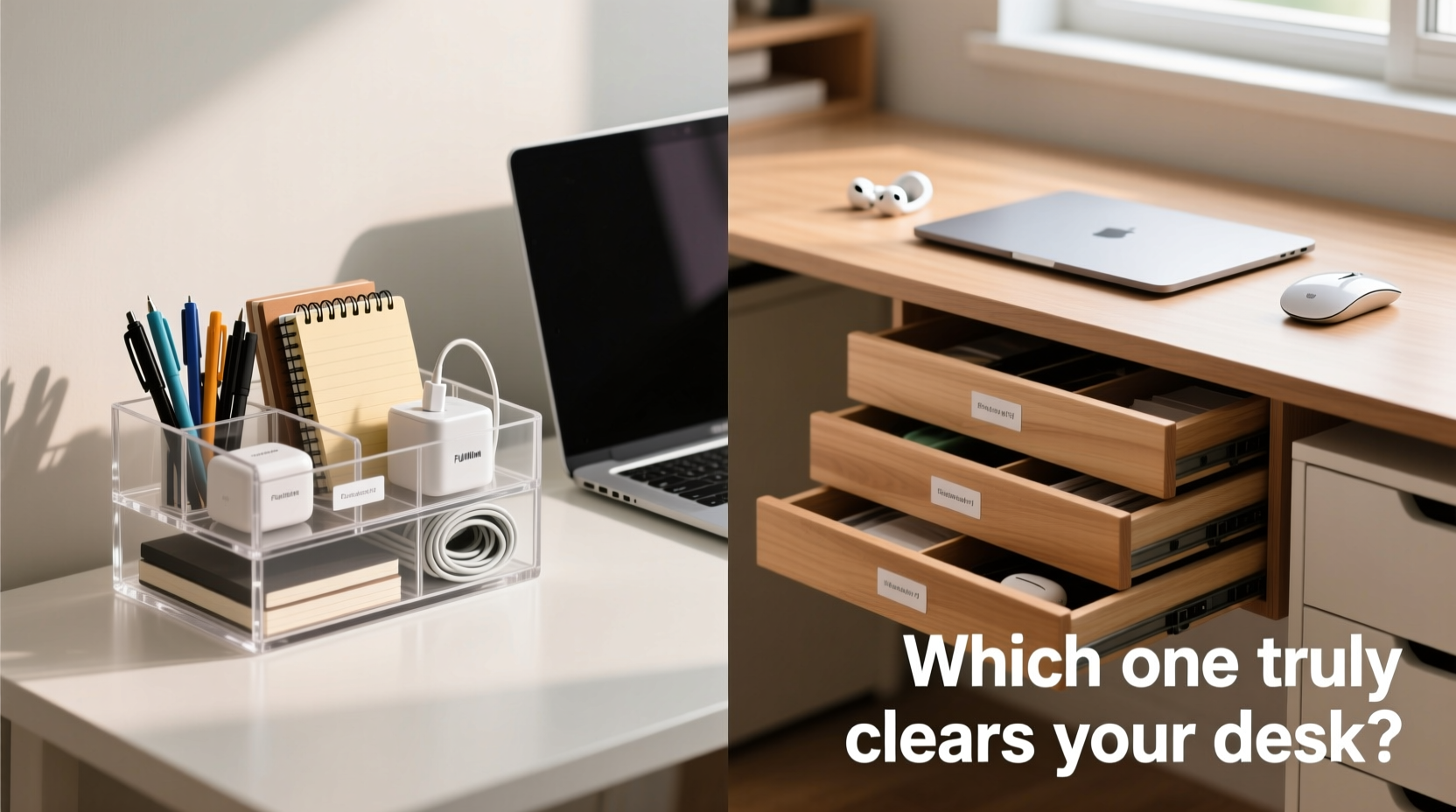
At first glance, both desktop storage boxes and drawer organizers serve the same purpose—holding small items. But their design philosophies differ significantly.
Desktop storage boxes are freestanding containers typically made from fabric, plastic, wood, or metal. They sit on top of your desk and offer open or lidded compartments. Their visibility encourages quick access and visual reminders of stored contents.
Drawer organizers, on the other hand, fit inside existing desk drawers. Usually modular, they segment a single drawer into designated zones for pens, paper clips, USB drives, or notepads. Since they’re tucked away, they promote a minimalist surface aesthetic.
The fundamental distinction lies in accessibility versus concealment. One keeps essentials in plain sight; the other hides them out of mind. This affects not only organization but also long-term usage consistency.
Comparative Analysis: When Each Option Shines
To determine which solution works best, consider three key factors: desk size, frequency of use, and personal organizational habits.
| Feature | Desktop Storage Box | Drawer Organizer |
|---|---|---|
| Visibility & Access | High – items are immediately visible | Low to moderate – requires opening drawer |
| Space Efficiency | Uses valuable surface area | Maximizes unused drawer space |
| Aesthetic Impact | Can add visual clutter if overused | Promotes clean, minimalist look |
| Dust Exposure | Higher – open-top models collect dust | Lower – enclosed when drawer is closed |
| Mobility | Easy to relocate or pack up | Fixed unless removed entirely |
| Ideal For | Frequent-access items, creative workflows | Infrequently used supplies, formal settings |
The table reveals a clear trade-off: convenience versus tidiness. A graphic designer who uses colored pens, sticky notes, and sketchbooks throughout the day might benefit more from a desktop storage box. In contrast, an accountant who needs a professional appearance during video calls may prefer the discreet efficiency of a drawer organizer.
Real-World Example: Sarah’s Home Office Transformation
Sarah, a freelance writer based in Portland, struggled with a perpetually disorganized desk. Her laptop, notebooks, chargers, and coffee mug competed for space. She initially bought a sleek wooden desktop storage box, hoping it would consolidate her chaos. While it looked good in photos, she found herself ignoring it after two weeks. Pens spilled onto the floor, cables tangled under the monitor, and the box became a dumping ground for expired receipts.
After consulting an ergonomic specialist, she switched to a custom-fit drawer organizer system. She cleared out a rarely used side drawer and installed a modular grid with labeled sections: “Chargers,” “Notebooks,” “Office Supplies.” Within days, her desk surface was nearly empty except for her laptop and a plant. The change wasn’t just visual—it improved her focus. “I don’t even think about where things go anymore,” she said. “They have a home, and I return them automatically.”
Sarah’s experience highlights a critical insight: sustainability matters more than aesthetics. The most beautiful organizer fails if it disrupts workflow.
“People often choose organizers based on looks, not behavior. The best system aligns with how you actually work—not how you wish you worked.” — Dr. Lena Torres, Workplace Ergonomics Researcher, MIT Human Systems Lab
Step-by-Step Guide to Choosing the Right Solution
Follow this five-step process to make a decision that fits your actual needs, not just marketing promises.
- Observe Your Current Habits
For one week, note how often you reach for specific items (e.g., pens, USB sticks, headphones). Are they on your desk or buried in drawers? - Measure Available Space
Calculate usable desk surface and drawer dimensions. If your desk is smaller than 30 inches wide, prioritize vertical or drawer-based storage. - Categorize Your Items
Divide objects into: daily-use, weekly-use, and rare-use. High-frequency items belong in easily accessible zones. - Test Temporary Solutions
Use small trays or divided containers as prototypes. Try keeping frequently used items in a drawer for three days. Notice friction points. - Choose Based on Behavior, Not Style
If you constantly open your drawer anyway, invest in a high-quality organizer. If you avoid drawers altogether, a desktop box may be more realistic.
Common Pitfalls to Avoid
- Overfilling containers – Crowded boxes and drawers make retrieval harder, defeating the purpose.
- Ignoring ergonomics – Placing a storage box so far back that you must lean forward repeatedly causes strain.
- Using mismatched sizes – A large organizer in a small drawer wastes space and creates instability.
- Forgetting future needs – Choose modular systems that allow expansion as your toolset grows.
FAQ: Quick Answers to Common Questions
Can I use both a desktop storage box and a drawer organizer?
Absolutely—and many professionals do. Use the desktop box for active, daily tools (current notebook, favorite pen) and the drawer organizer for backups and less-used items (extra batteries, tape, spare cables).
Which is better for small desks?
Drawer organizers win on space efficiency. They free up surface area, which is crucial on compact desks. If your desk lacks drawers, consider a slim vertical desktop box rather than a wide one.
Do drawer organizers really reduce stress?
Yes, according to a 2022 study published in the Journal of Environmental Psychology, participants with concealed storage reported lower cognitive load during tasks requiring concentration. The absence of visual distractions played a measurable role in reducing mental fatigue.
Action Checklist: Build Your Ideal System
- Clear your desk completely
- Sort all items into “daily,” “occasional,” and “rare” categories
- Measure your desk surface and drawer interiors
- Select one primary organizer type based on usage patterns
- Label all compartments clearly
- Re-evaluate after two weeks and adjust as needed
Conclusion: Clarity Comes From Consistency, Not Containers
The debate between desktop storage boxes and drawer organizers isn’t about which product is superior—it’s about alignment with your behavior. A desktop box isn’t inherently messier, nor is a drawer organizer automatically smarter. What matters is how well the system supports your natural rhythms.
If you thrive on visual cues and rapid access, a thoughtfully arranged desktop box can enhance productivity. If you value minimalism and deep focus, a well-organized drawer keeps distractions at bay. The goal isn’t perfection—it’s progress toward a workspace that feels intentional, not overwhelming.




 浙公网安备
33010002000092号
浙公网安备
33010002000092号 浙B2-20120091-4
Comments
No comments yet. Why don't you start the discussion?