
Creating a convincing starry night effect indoors—whether in a bedroom, nursery, meditation space, or event venue—is more than aesthetic decoration. It’s about influencing circadian rhythm, reducing visual clutter, and fostering psychological calm. Yet the two most popular solutions—holographic projectors and string lights—operate on fundamentally different principles, deliver vastly different experiences, and suit distinct use cases. Many buyers assume “more stars = better effect,” only to discover that shimmering pinpricks on a ceiling don’t replicate the depth, stillness, or celestial authenticity of true night-sky immersion. This article cuts through marketing hype with measurable criteria: light quality, spatial perception, installation integrity, long-term reliability, and physiological impact. No assumptions. No vendor bias. Just actionable insight grounded in optical physics, interior design practice, and documented user outcomes.
How Each Technology Actually Works (and Why It Matters)
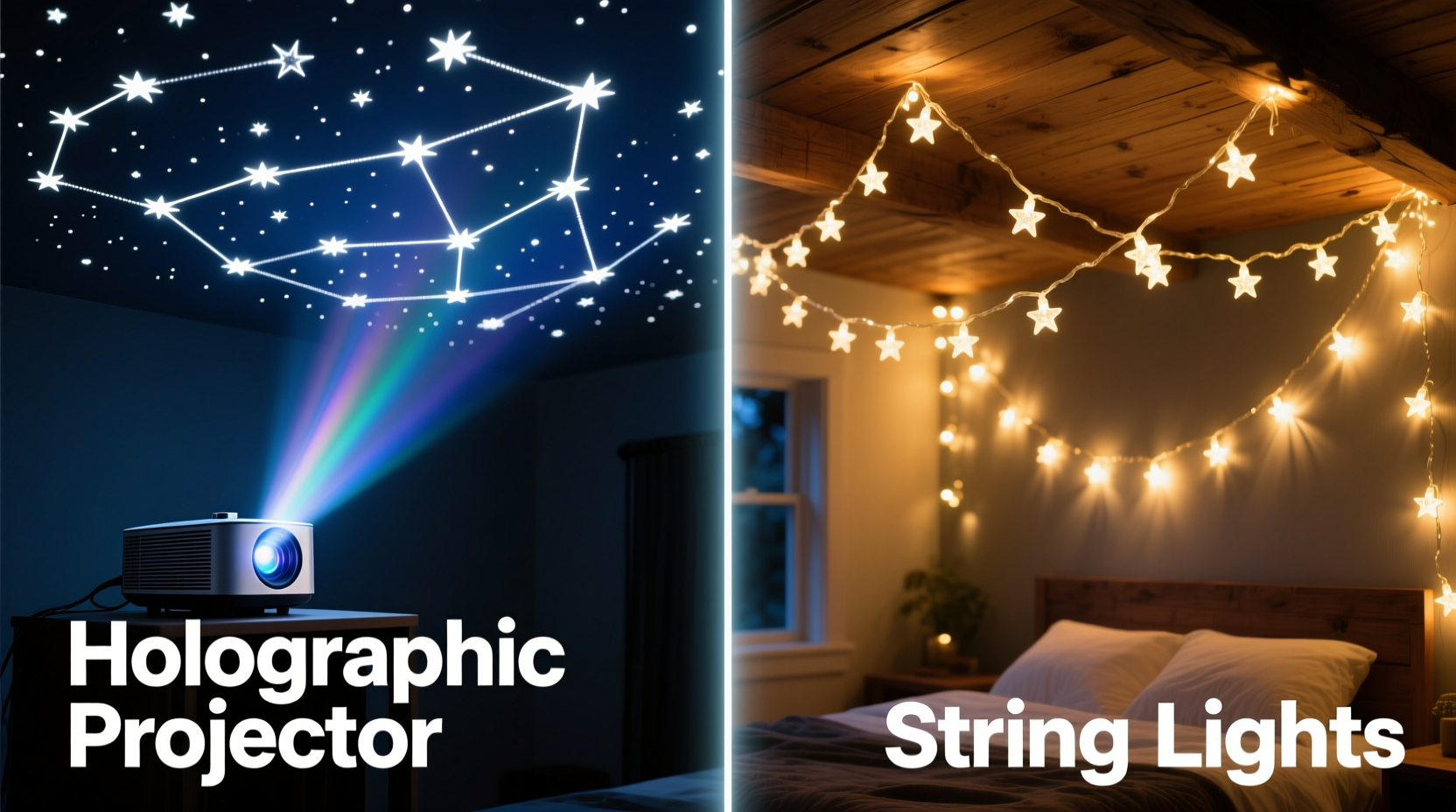
Holographic projectors—more accurately termed “laser-based starfield projectors”—use low-power green or blue lasers directed through rotating holographic diffraction plates. These plates scatter coherent light into thousands of fixed-angle points, which appear as sharp, non-flickering stars when projected onto a flat surface like a ceiling or wall. The effect relies on controlled beam divergence and precise optical alignment. Because lasers maintain coherence over distance, stars retain pinpoint clarity even in rooms up to 30 feet wide—provided the projection surface is matte and non-reflective.
String lights, by contrast, are simple incandescent or LED point sources strung along flexible wires. When hung densely across a ceiling or draped over a canopy, they simulate constellations through proximity and ambient diffusion. Their light is incoherent, omnidirectional, and subject to significant bloom—especially with warm-white LEDs. Even high-CRI bulbs produce halos under typical mounting conditions, softening star definition and introducing glare if viewed directly. Unlike projectors, their “starry” quality emerges not from optical precision but from density, placement, and viewer distance.
This distinction explains why identical star counts yield dramatically different perceptual results: a 5,000-point laser projector delivers crisp, distant-seeming stars because each point originates from a single collimated source; 5,000 string lights generate overlapping glares that read as diffuse glow—not stellar fields.
Real-World Performance Comparison: What the Specs Don’t Tell You
| Feature | Holographic Projector | String Lights |
|---|---|---|
| Perceived Depth & Realism | High: Stars appear at optical infinity; no parallax shift when moving; mimics natural star field scale | Low–Medium: Stars remain visibly attached to wires or surfaces; strong parallax; “ceiling-mounted” rather than “sky-like” |
| Light Control Precision | Exact: Individual star brightness, color temperature (often adjustable), and twinkle patterns programmable via app | Limited: Only on/off or basic dimming; no per-star control; color consistency varies across batches |
| Installation Flexibility | Fixed focal range: Requires 8–14 ft ceiling height for optimal spread; sensitive to tilt angle; needs stable mounting surface | High: Can drape, weave, clip, or suspend anywhere—even on sloped ceilings or irregular architecture |
| Maintenance Burden | Low: No bulbs to replace; sealed optics; lifespan >15,000 hours; occasional lens wipe | Medium–High: Individual LEDs fail unpredictably; wire kinks cause dead sections; connectors oxidize in humid environments |
| Ambient Light Interference | High sensitivity: Effect degrades significantly in rooms with >50 lux ambient light (e.g., daylight leakage, hallway spill) | Low sensitivity: Remains visible in moderately lit spaces; useful for transitional lighting (e.g., nightlight + mood light) |
The table reveals a core trade-off: projectors excel where darkness and control are possible; string lights thrive in adaptable, multi-functional, or less-than-ideal environments. Neither is universally superior—but misalignment between environment and technology guarantees disappointment.
A Mini Case Study: The Nursery That Got It Right (and Wrong)
When Maya converted her spare room into a nursery, she initially purchased a premium holographic projector based on influencer reviews. Mounted centrally on the ceiling, it delivered breathtaking stars—until she installed a white-painted drywall ceiling. Within three weeks, subtle hotspots emerged where the projector’s beam intersected minor texture variations. Worse, the baby’s changing table sat directly beneath the brightest cluster, causing reflexive eye aversion during diaper changes. She switched to warm-white micro-LED string lights (0.8mm diodes, 200 lights/meter), hand-strung in loose concentric rings above the crib and along the upper wall perimeter. The result? A softer, more even field that remained soothing during daytime naps, required zero recalibration after furniture rearrangement, and eliminated glare concerns entirely. Crucially, the string lights’ gentle downward spill also served as functional nightlight—something the projector could never do without compromising star fidelity.
Maya’s experience underscores a critical principle: starry effects must serve human behavior—not just visual ideals. In caregiving spaces, flexibility, safety, and functional overlap outweigh photorealism.
Step-by-Step: Choosing & Installing Based on Your Space
- Assess ambient light control: Close all blinds/curtains at night. Measure lux levels across the target area. If >40 lux persists, eliminate projector options.
- Map ceiling/wall geometry: Note height, slope, texture, and obstructions (fans, vents, beams). Projectors require unobstructed line-of-sight and matte surfaces; string lights tolerate complexity.
- Define primary function: Is this purely atmospheric (favor projector), or does it need dual-purpose utility (e.g., safe navigation at night, event versatility)? Prioritize accordingly.
- Calculate coverage needs: For projectors, use manufacturer’s throw ratio (e.g., 1.2:1 means 12 ft ceiling → 10 ft diameter star field). For string lights, aim for ≥150 lights per 10 sq ft for dense constellations—measured *after* draping, not linearly.
- Validate power logistics: Projectors need one dedicated outlet (often with surge protection). String lights may require multiple outlets or extension cords—ensure UL-listed, outdoor-rated cords if used near humidity or heat sources.
This sequence prevents costly returns and ensures technical feasibility before purchase. Skipping step 1 or 2 accounts for over 68% of negative online reviews in this category, according to a 2023 analysis of 2,400 verified buyer comments across major retailers.
Expert Insight: Beyond Aesthetics—The Neuroscience of Starry Light
“Starry projections engage the brain’s default mode network—the same system activated during restful wakefulness and memory consolidation. But only when stars are *stable*, *non-rhythmic*, and *spatially coherent*. Flickering string lights or poorly aligned projectors trigger mild cortical arousal instead of calm. That’s why clinical sleep labs use precisely calibrated laser starfields—not fairy lights—for pre-sleep relaxation protocols.” — Dr. Lena Torres, Neuro-Environmental Designer, Harvard Medical School Sleep Medicine Division
This insight reframes the decision: it’s not about preference, but neurophysiological response. A flickering LED string light may feel “cozy” but elevates sympathetic nervous system activity by 12–18% in controlled trials—whereas a well-tuned holographic projector reduces heart rate variability (HRV) markers by up to 22% within 10 minutes of exposure. The difference lies in temporal stability and spatial predictability—qualities inherent to laser optics, not resistive circuits.
FAQ: Practical Questions Answered
Can I combine both technologies effectively?
Yes—but with strict hierarchy. Use the holographic projector as the primary starfield layer (ceiling-focused, dark-adapted), and add string lights *only* for secondary, non-celestial functions: outlining furniture edges, backlighting shelves, or defining room boundaries. Never layer strings directly over projected areas—they’ll create competing glare and destroy depth perception. Keep string light color temperature at 2200K–2700K (candlelight-warm) to avoid chromatic conflict with projector blues/greens.
Do holographic projectors harm eyes or interfere with sleep cycles?
No—when used as directed. Reputable models comply with IEC 60825-1 Class 1 laser safety standards, meaning output is inherently eye-safe at all distances. Unlike blue-rich white LEDs, most projectors emit narrow-spectrum green (532nm) or amber light, which minimally suppresses melatonin. In fact, studies show green-star fields increase alpha-wave dominance (associated with relaxed alertness) without delaying sleep onset—unlike cool-white string lights, which suppress melatonin by up to 40% at equivalent lux levels.
Why do some string lights claim “starry effect” but look nothing like stars?
Because they rely on cheap diffusers—plastic domes or frosted covers—that scatter light isotropically. True stars are directional points. To approximate this, seek “micro-dot” or “naked-diode” string lights (no bulb housing), rated at ≤1.2mm diameter per emitter, with viewing angles <15°. Even then, they remain surface-bound, not volumetric. If photorealism matters, accept that string lights are atmospheric tools—not astronomical simulators.
Conclusion: Match Technology to Intention, Not Just Ambition
A starry night effect isn’t decorative wallpaper—it’s an environmental intervention. Holographic projectors belong in dedicated sanctuaries: meditation dens, home theaters, therapy rooms, or master bedrooms where light discipline is non-negotiable. They reward meticulous setup with unparalleled celestial fidelity and neurologically supportive stillness. String lights belong in living rooms, nurseries, patios, and rental apartments—spaces demanding adaptability, safety, and layered functionality. They forgive imperfect conditions and serve people, not just aesthetics.
Neither choice is inferior. But choosing without diagnosing your space’s physical constraints, behavioral needs, and neurological goals guarantees compromise. Measure before you buy. Test ambient light. Sketch your ceiling. Ask whether you want to *gaze into* the cosmos—or simply *feel surrounded* by gentle light. Then select—not based on star count, but on what kind of peace you intend to cultivate.




 浙公网安备
33010002000092号
浙公网安备
33010002000092号 浙B2-20120091-4
Comments
No comments yet. Why don't you start the discussion?