
Procrastination isn’t just about laziness—it’s a complex cycle of avoidance, distraction, and self-sabotage that traps even the most motivated individuals. When you find yourself repeatedly putting off tasks, switching between unfinished projects, or scrolling mindlessly instead of working, you’re likely caught in a procrastination loop. These cycles erode focus, increase stress, and damage long-term progress. The good news: they can be broken. With targeted strategies grounded in behavioral psychology and neuroscience, it’s possible to interrupt these patterns, restore clarity, and build sustainable focus.
The Psychology Behind Procrastination Loops
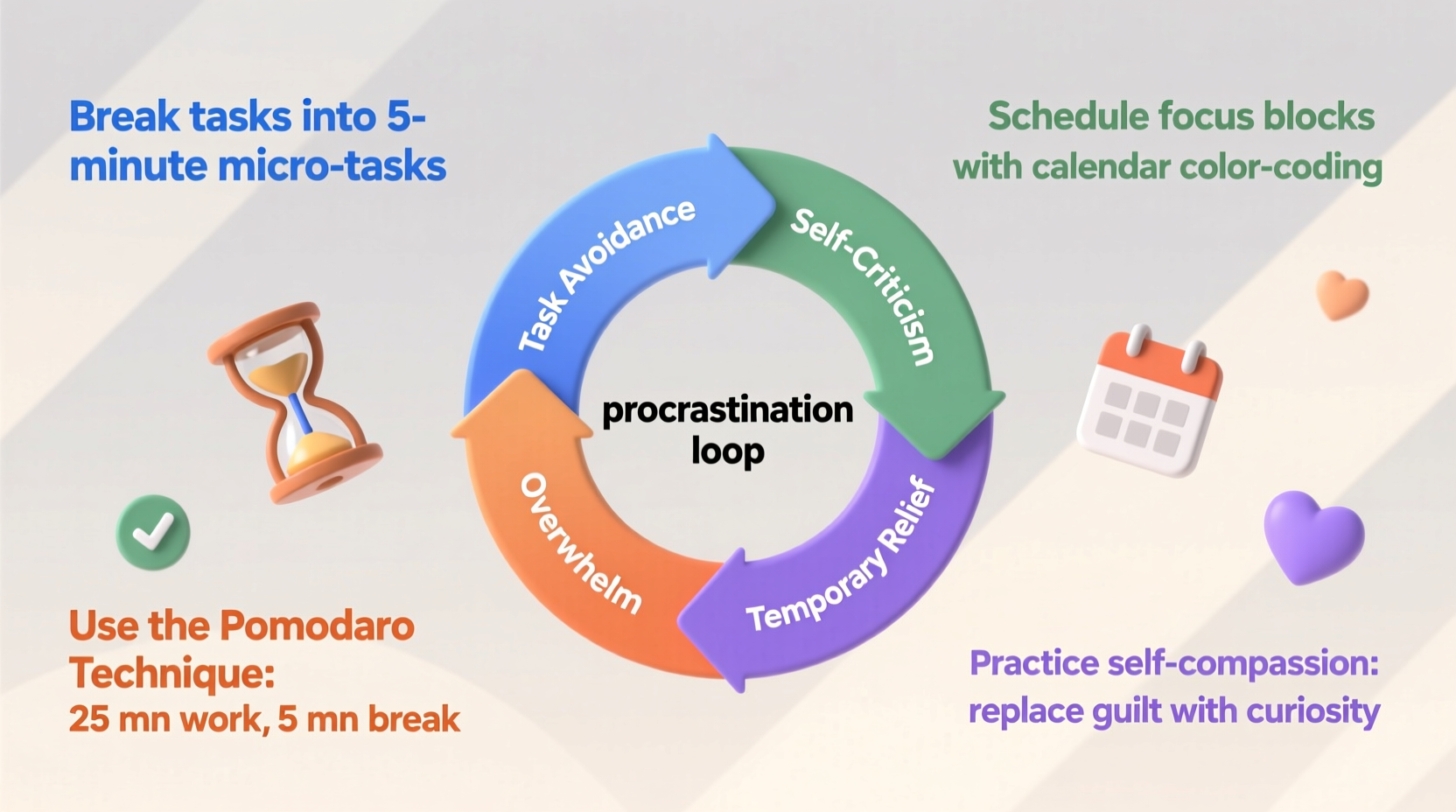
At its core, procrastination is not a time management issue—it’s an emotional regulation problem. When a task triggers discomfort—whether due to fear of failure, perfectionism, ambiguity, or overwhelm—the brain instinctively seeks relief through distraction. This temporary escape reinforces a feedback loop: avoid → feel better briefly → return to task with increased anxiety → avoid again. Over time, this becomes habitual, creating what psychologists call a \"procrastination loop.\"
Dr. Tim Pychyl, a leading researcher on procrastination at Carleton University, explains:
“Procrastination is about giving in to short-term mood repair, not about being lazy. We delay tasks to feel better now, even though we pay a price later.” — Dr. Tim Pychyl, Procrastination Researcher
This insight shifts the solution from willpower to emotional awareness. Instead of asking, “How can I force myself to work?”, the more effective question is: “What emotion am I trying to avoid?” Recognizing this allows you to address the root cause rather than fight symptoms.
Step-by-Step Guide to Break the Loop
Escaping a procrastination loop requires intentional intervention. Here’s a five-step process to disrupt the cycle and regain control of your attention:
- Pause and Name the Emotion: When you notice yourself avoiding a task, stop. Ask: “What am I feeling right now?” Is it anxiety? Boredom? Fear of judgment? Naming the emotion reduces its intensity and creates psychological distance.
- Reframe the Task: Break the task into its smallest possible action. Instead of “write report,” try “open document and write one sentence.” Reducing perceived effort lowers resistance.
- Set a 5-Minute Timer: Commit to working for just five minutes. Often, starting is the hardest part. Once begun, momentum usually carries you forward.
- Remove Decision Fatigue: Pre-decide when and where you’ll work. Example: “After breakfast, I’ll sit at my desk and draft three bullet points.” Eliminating choices conserves mental energy.
- Reflect Without Judgment: At day’s end, review: What triggered avoidance? What helped you start? Use insights to adjust your approach—not to self-criticize.
Effective Focus Strategies Backed by Science
Sustained focus doesn’t come from sheer willpower—it’s cultivated through environment, routine, and cognitive design. Below are evidence-based methods to strengthen attention and reduce susceptibility to loops.
Use the “10-3-2-1-0” Morning Routine
Your first hour sets the tone for the day. A structured morning reduces decision fatigue and primes focus:
- 10 minutes of movement: Walk, stretch, or do light exercise to increase blood flow to the brain.
- 3 minutes of intention setting: Write down your top priority for the day.
- 2 minutes of gratitude: List two things you appreciate. This reduces anxiety and improves emotional resilience.
- 1 minute of breathwork: Inhale for four counts, hold for four, exhale for six. Calms the nervous system.
- 0 screens before work starts: Avoid email and social media until after beginning your first task.
Design Your Environment for Deep Work
Distractions aren’t personal failures—they’re environmental defaults. To support focus:
- Use website blockers (e.g., Freedom, Cold Turkey) during work blocks.
- Keep your phone in another room or in grayscale mode to reduce allure.
- Create a “focus zone”: a clean, clutter-free space with only tools needed for the task.
- Use noise-canceling headphones with ambient sound (e.g., rain, white noise).
Leverage Ultradian Rhythms
The brain operates in natural 90- to 120-minute energy cycles. Working in alignment with these rhythms increases output and reduces burnout. Try the following schedule:
| Time Block | Activity | Purpose |
|---|---|---|
| 90 minutes | Focused work (no interruptions) | Aligns with peak concentration window |
| 20–30 minutes | Full break (walk, hydrate, stretch) | Restores mental energy |
| Repeat 2–3x | Cycle structure | Prevents decision fatigue and maintains quality |
“The best performers don’t work longer—they recover smarter.” — Alex Soojung-Kim Pang, Author of *Rest: Why You Get More Done When You Work Less*
Common Traps and How to Avoid Them
Even with good intentions, certain habits perpetuate procrastination loops. Recognizing these pitfalls helps you sidestep them.
Perfectionism Paralysis
Waiting for ideal conditions or flawless execution ensures nothing gets started. Progress, not perfection, builds momentum. Adopt a “draft-first” mindset: prioritize completion over quality in early stages.
Task Ambiguity
Vague goals like “work on project” create mental friction. Break objectives into concrete actions: “Email client for feedback,” “Sketch wireframe for homepage.” Specificity reduces anxiety.
Digital Clutter
An overflowing inbox or chaotic desktop drains cognitive resources. Dedicate 15 minutes daily to clear digital noise. A clean interface supports a clear mind.
Over-Scheduling
Jamming your calendar with back-to-back tasks ignores human limits. Leave buffer time between activities to reset and reflect. Unscheduled moments foster creativity and prevent burnout.
Mini Case Study: From Chronic Delay to Consistent Output
Sarah, a freelance graphic designer, struggled with missed deadlines and constant guilt. She’d open her design software, then switch to social media, watch tutorials “for inspiration,” or reorganize her files—all while the client project sat untouched. After tracking her behavior, she realized her trigger was fear of negative feedback. Starting felt risky because it meant exposing her work.
Using the 5-minute rule, she committed to opening her file and sketching one rough idea. That small step often led to 45 minutes of productive work. She also began sharing low-fidelity drafts early, normalizing imperfection. Within six weeks, her turnaround time improved by 60%, and client satisfaction rose. The key wasn’t working harder—it was reducing the emotional cost of starting.
Checklist: Daily Anti-Procrastination Routine
Implement this checklist each day to prevent loops before they begin:
- ✅ Identify your Most Important Task (MIT) the night before.
- ✅ Schedule your first focus block within 90 minutes of waking.
- ✅ Turn off non-essential notifications for at least 90 minutes.
- ✅ Begin with a 5-minute warm-up task (review notes, organize workspace).
- ✅ After each session, note one thing you completed—no matter how small.
- ✅ End the day with a 5-minute shutdown ritual: review progress and set tomorrow’s MIT.
FAQ
Why do I procrastinate even when I know it causes stress?
Because the brain prioritizes immediate emotional relief over future consequences. The anxiety of starting feels worse in the moment than the distant pain of delay. Breaking the habit requires rewiring this automatic response through consistent, low-pressure action.
Is multitasking making my procrastination worse?
Yes. Switching between tasks creates “attention residue,” where part of your mind remains stuck on the previous activity. This slows progress and increases mental fatigue. Single-tasking with full attention reduces perceived effort and improves completion rates.
Can medication help with chronic procrastination?
Not directly. However, if procrastination stems from ADHD, anxiety, or depression, treating the underlying condition with professional support (including medication if appropriate) can significantly improve executive function and task initiation.
Conclusion: Reclaim Your Focus, One Step at a Time
Procrastination loops are not a life sentence. They are learned patterns—and like any habit, they can be unlearned. The strategies outlined here don’t promise instant transformation, but they do offer a reliable path forward. By addressing the emotional roots of delay, designing supportive routines, and acting with self-compassion, you gradually weaken the grip of avoidance. Focus isn’t something you either have or don’t—it’s a skill refined through practice. Start small. Stay consistent. Celebrate progress, not perfection.




 浙公网安备
33010002000092号
浙公网安备
33010002000092号 浙B2-20120091-4
Comments
No comments yet. Why don't you start the discussion?