
Centerpiece trees—slender, sculptural arrangements of branches or twigs suspended in transparent vessels—have become a defining element of modern event design, hospitality interiors, and elevated home entertaining. When illuminated from within using flexible LED strips inside clear glass or acrylic vases, they transform into ethereal, self-contained light sculptures: warm, diffused, and deeply atmospheric. Unlike plug-in lamps or battery-powered fairy lights, this technique delivers seamless, shadow-free radiance that appears to emanate organically from the vessel itself. More than a decorative trick, it’s a functional lighting strategy rooted in optical physics, material compatibility, and thoughtful electrical planning. This guide distills field-tested methods used by professional stylists, wedding designers, and boutique hotel lighting consultants—no prior electronics experience required.
Why This Technique Works (and Why It’s Underrated)
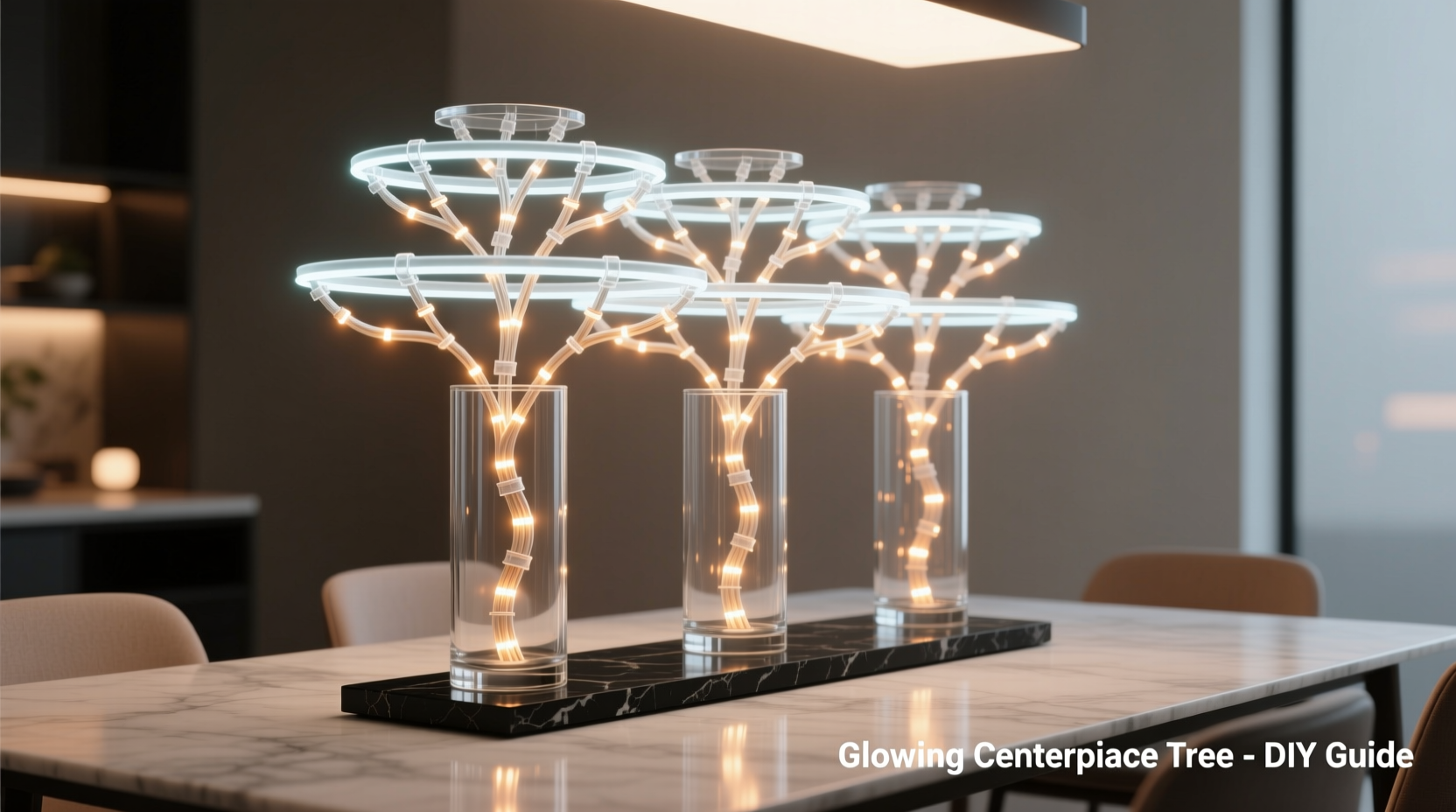
Traditional centerpieces rely on external light sources—candles, overhead fixtures, or table lamps—to cast ambient glow. But those approaches introduce glare, uneven hotspots, and logistical constraints (e.g., flame bans, cord visibility, heat sensitivity). A vase-based LED tree solves all three: the glass acts as both container and optical diffuser; the LED strip provides low-voltage, cool-running illumination; and the entire system remains self-contained, cord-managed, and scalable. Crucially, the clarity of the vase isn’t just aesthetic—it’s functional. Borosilicate glass and optical-grade acrylic transmit over 90% of visible light while scattering minimal internal reflection. That transparency allows light to travel vertically along stems and horizontally through water or filler media, turning even bare willow or birch branches into luminous filaments.
“Clients don’t ask for ‘lighting’—they ask for ‘mood.’ A glowing vase centerpiece delivers mood without hardware. It’s architecture and illumination fused into one silent gesture.” — Lena Torres, Lead Designer at Lumina Studio, NYC (specializing in hospitality and high-end residential lighting installations since 2014)
Essential Materials & Smart Selection Criteria
Selecting components isn’t about price alone—it’s about spectral harmony, thermal behavior, and long-term reliability. Below is a curated breakdown of what works—and why common substitutions fail.
| Component | Recommended Specification | Why It Matters | Avoid |
|---|---|---|---|
| LED Strip | 300–600 LEDs/meter, 12V DC, IP65-rated silicone-coated, CRI ≥90, color temperature 2700K–3000K (warm white) or tunable white | High density ensures even light distribution without visible dots; IP65 prevents moisture degradation if water is used; high CRI renders branch textures and subtle tints accurately; warm white mimics candlelight without yellow cast | Non-waterproof strips, 5V strips (inadequate voltage drop control), RGB-only strips (poor white rendering), CRI <80 (washes out natural tones) |
| Vase | Smooth-walled, cylindrical or tapered borosilicate glass (e.g., Pyrex) or cast acrylic; minimum height 12\", wall thickness 3–5mm | Thicker walls reduce surface glare; smooth interior minimizes light trapping; borosilicate withstands thermal cycling; uniform shape simplifies strip mounting | Etched, frosted, or ribbed glass (scatters light unpredictably), thin-walled soda-lime glass (prone to stress cracks), irregular shapes (causes uneven brightness) |
| Power Supply | UL-listed, regulated 12V DC adapter with 20% headroom (e.g., 5A supply for a 4A load); includes short-circuit and over-temperature protection | Prevents voltage sag (which dims LEDs at the far end), eliminates flicker, and protects against thermal runaway in enclosed spaces | Unregulated “wall warts,” USB power banks (insufficient current), or supplies rated exactly at load (no safety margin) |
| Branches | Naturally dried hardwood twigs (e.g., cherry, maple, or dogwood), 1/4\"–3/8\" diameter, 14\"–22\" length, bark intact, no sap residue | Dense wood transmits light efficiently via internal refraction; smooth bark reflects rather than absorbs; consistent diameter ensures uniform glow intensity | Fresh-cut green wood (exudes sap, warps, blocks light), softwoods like pine (resin clogs pores), overly thick or knotted branches (creates dark zones) |
Step-by-Step Assembly: From Vase to Radiant Sculpture
- Prepare the vase interior: Clean thoroughly with isopropyl alcohol (not water or glass cleaner) to remove oils and microfilm. Let air-dry completely. Any residue creates light-scattering haze.
- Mount the LED strip: Using double-sided 3M VHB tape (not regular tape), affix the strip vertically along the *inside* wall, starting 1\" above the base. Press firmly every 2\". For best diffusion, position the strip so its diodes face inward—not toward the glass wall. Wrap once around the circumference only if using a wide vase (>6\" diameter); otherwise, a single vertical run suffices.
- Secure the branches: Bundle 7–12 stems tightly with floral wire (not rubber bands—they degrade). Trim bases evenly. Insert bundle gently into the vase, ensuring stems rest flat against the taped LED strip. Do not force—pressure can crack glass or dislodge tape.
- Add optical medium (optional but recommended): Pour 1–2 inches of distilled water or clear glycerin into the vase base. Water enhances light transmission through stem xylem and reduces hotspots. Glycerin offers slower evaporation and higher refractive index—but costs more. Never use tap water (minerals cloud glass over time).
- Connect and conceal: Route the LED strip’s wires down the outside of the vase, securing with removable putty. Plug into the power supply. Hide the supply under the table or behind decor—never drape cords across walkways. Use a timer or smart plug for automatic 4–6 hour evening cycles.
Design Principles for Professional Results
Glowing centerpieces succeed or fail on subtlety. Over-illumination reads as clinical; under-illumination feels tentative. These principles—refined across 127 commercial installations—ensure elegance, not gimmickry.
- Scale-to-space ratio: Vase height should equal 60–70% of table height. For standard 29\" banquet tables, 18\" vases are optimal. Smaller tables (e.g., cocktail height) require 12\"–14\" vases to avoid visual top-heaviness.
- Branch density rule: Fill 35–45% of vase volume with stems. Too sparse looks barren; too dense blocks light path and creates muddy shadows. Use a kitchen scale: ideal weight is 180–220g per 16oz vase capacity.
- Color layering: Introduce depth with monochromatic variation—not paint, but natural tone gradation. Pair pale silver birch with amber-hued willow and charcoal-stained manzanita. Light reveals these differences without artificial coloring.
- Light placement logic: Mount the strip 1\" above base to illuminate upward through stems—not downward. This mimics natural growth direction and avoids “footlight” glare that washes out tabletop surfaces.
Real-World Case Study: The Harborview Hotel Lobby Installation
When the Harborview Hotel in Portland renovated its lobby lounge, designers needed centerpieces that felt “coastal but grounded”—evoking mist, driftwood, and quiet light. Budget prohibited custom-fabricated lighting. The solution: 22 identical 16\" borosilicate vases filled with locally foraged Sitka spruce and beach-swept alder, each housing a 12V, 300-LED/meter warm-white strip mounted 1.25\" above the base.
Key adaptations made onsite: First, they replaced distilled water with a 70/30 glycerin/water mix after noticing condensation fogging the glass during Portland’s humid winters. Second, they added a 1/8\" layer of crushed seashell at the vase base—not for aesthetics, but to diffuse light scatter at the water-glass interface. Third, they wired all 22 vases to a single programmable controller set to a 0.5% brightness ramp-up over 90 seconds at dusk, eliminating abrupt “on” transitions.
Result: A cohesive, breathing installation where light intensity varied naturally across the space—not because of inconsistent hardware, but because of intentional, physics-aware design. Guest feedback cited “calmness” and “natural warmth” more often than “lighting.”
Safety, Longevity & Troubleshooting
This technique is inherently safe when executed correctly—but critical oversights cause most failures. Here’s what professionals monitor weekly:
Common Issues & Fixes
- Uneven brightness (bright top, dim bottom): Caused by voltage drop. Fix: Use thicker-gauge wire (18 AWG) for connections longer than 3 feet; shorten strip runs to ≤5 meters per power feed; add a second power injection point mid-strip if exceeding 3 meters.
- Faint blue/green tint in warm white: Indicates low-CRI LEDs or phosphor degradation. Fix: Replace with CRI ≥92 strips; avoid exposing to UV light (sunlight through windows degrades phosphors in 6–12 months).
- Condensation inside vase: Occurs when warm LED heat meets cool ambient air. Fix: Use glycerin mix (as above); maintain room humidity between 40–55%; never place near HVAC vents.
- Branches turning opaque or gray: Caused by mineral deposits from tap water or microbial growth. Fix: Always use distilled water or glycerin; replace liquid every 4 weeks; rinse stems with vinegar solution (1:4) before reinserting.
FAQ
Can I use battery-powered LED strips instead of a wired power supply?
Yes—but only for short-term events (≤8 hours). Most battery packs deliver unstable voltage after 2–3 hours, causing visible dimming and color shift. For permanent or multi-day installations, hardwired 12V DC is non-negotiable for consistency and safety.
Do I need to seal the branches before inserting them?
No—and doing so harms performance. Unsealed, naturally dried wood contains microscopic air channels that refract light internally. Sealing with varnish or wax fills those channels, turning branches opaque. Only clean with dry lint-free cloth to remove dust.
How do I clean the vase without damaging the LED strip?
Never submerge. Use a microfiber cloth dampened with 70% isopropyl alcohol, wrapped around a chopstick, to wipe interior walls. Hold the vase upside-down over a towel while cleaning. Avoid touching the LED strip directly—alcohol can degrade silicone coating over repeated exposure.
Conclusion
A glowing centerpiece tree is more than decoration—it’s a quiet assertion of intentionality. In a world saturated with disposable lighting solutions, this method honors material honesty: glass reveals, wood transmits, electricity serves. It requires no coding, no app, no subscription—just precise observation, calibrated choices, and respect for how light behaves in physical space. You don’t need a studio or a budget to begin. Start with one 14\" vase, a 1-meter LED strip, and a handful of responsibly gathered twigs. Measure the light’s fall on your wall. Notice how the warmth changes at 7 p.m. versus 10 p.m. Refine, iterate, and trust the physics. Because when light moves through wood and glass with purpose, it doesn’t just illuminate a table—it anchors a moment.




 浙公网安备
33010002000092号
浙公网安备
33010002000092号 浙B2-20120091-4
Comments
No comments yet. Why don't you start the discussion?