
String lights have long defined indoor ambiance: warm, nostalgic, and effortlessly festive. But they’re limited—static in pattern, fixed in placement, and often underwhelming in visual impact. Projector lights offer a compelling evolution: not just illumination, but intentional light design. When used thoughtfully, they transform walls, ceilings, and floors into living canvases—projecting stars, geometric motifs, seasonal scenes, or even custom monograms. Unlike string lights, which scatter light uniformly (and often inefficiently), projectors deliver focused, controllable, and highly adaptable illumination that enhances architecture, supports mood, and adapts to function—from dinner parties to meditation spaces. This isn’t about replacing twinkle lights with tech for tech’s sake. It’s about elevating interior lighting from decoration to deliberate environmental storytelling.
Why projector lights outperform string lights in key indoor scenarios
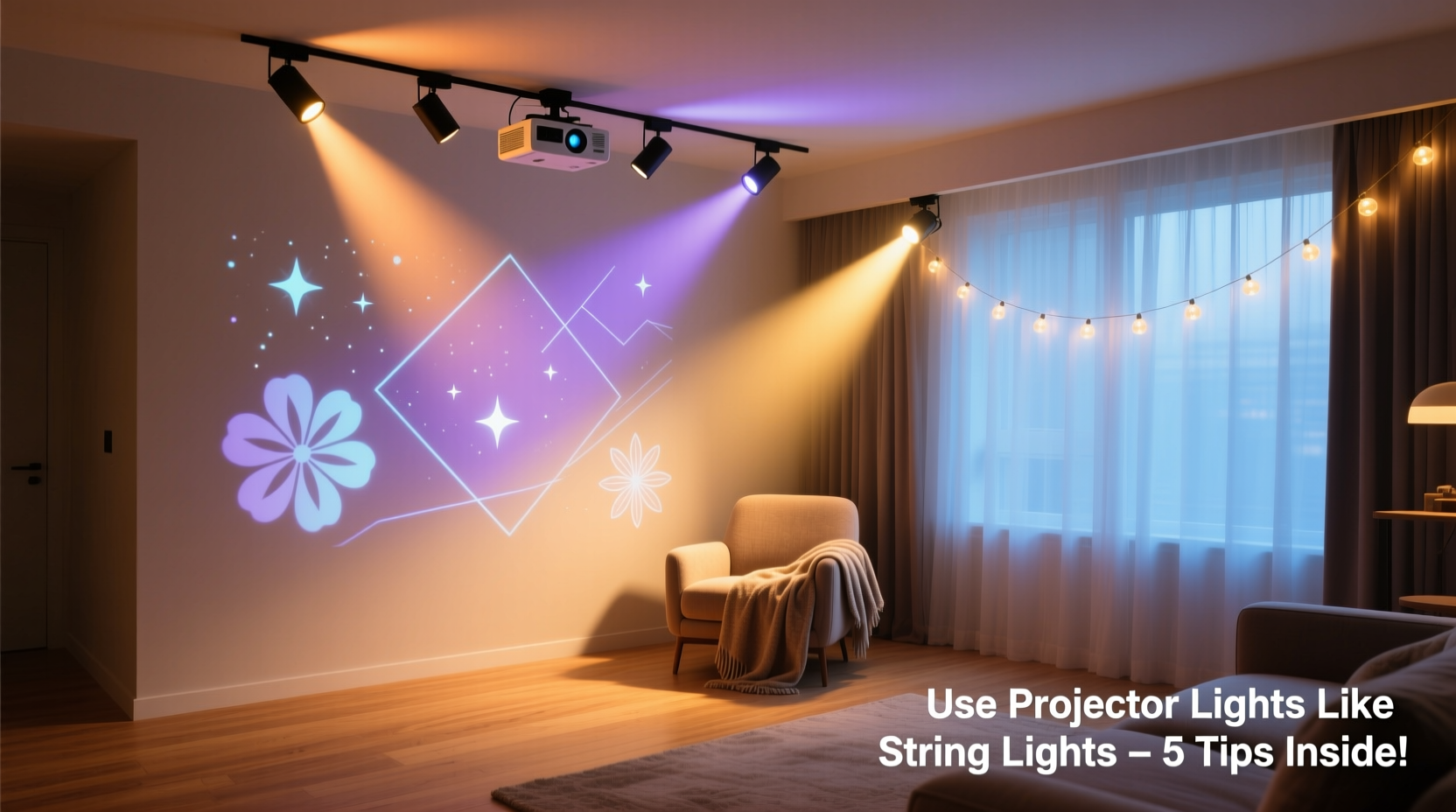
String lights excel at soft, ambient glow—but they lack precision, scalability, and adaptability. Projector lights address four fundamental limitations:
- Directional control: String lights emit omnidirectionally, causing glare, uneven washes, and wasted lumens. Projectors direct light only where needed—onto a wall, along a ceiling cove, or across a textured surface—minimizing spill and maximizing effect.
- Pattern versatility: A single projector can cycle through dozens of interchangeable gobo patterns (e.g., leaves, snowflakes, abstract lines) or display animated sequences. String lights require physical replacement or layered installations for variation.
- Scale independence: One 15-watt LED projector can cover a 10 ft × 12 ft wall with crisp detail. Achieving comparable coverage with string lights demands 20+ feet of wiring, multiple outlets, and complex mounting—often resulting in visible cords and cluttered aesthetics.
- Functional integration: Many modern projectors sync with smart home systems (via Bluetooth or Wi-Fi), respond to music, dim on schedule, or shift color temperature with circadian rhythms. String lights rarely offer this level of responsive intelligence without costly add-ons.
This isn’t theoretical. Lighting designers increasingly specify projectors in hospitality and residential projects where atmosphere must shift dynamically—such as a home office that transitions from focused daylight-mode to relaxed evening ambiance with a single tap.
Essential equipment and what to avoid
Not all projector lights are suitable for indoor ambient use. Performance hinges on three core components: the light engine, optical quality, and thermal management. Below is a comparison of critical specifications for residential use:
| Feature | Ideal for Indoor Ambient Use | Avoid |
|---|---|---|
| Lumens | 300–800 ANSI lumens (sufficient for dark-to-dim rooms; higher causes glare) | Over 1,200 lumens (designed for large venues; harsh in bedrooms or living rooms) |
| Light Source | High-CRI (≥90) LED with adjustable CCT (2700K–4000K) | Low-CRI LEDs (<80) or unfiltered blue-rich white LEDs (causes eye strain and disrupts melatonin) |
| Optics | Glass lenses + adjustable focus + built-in gobo wheel | Plastic lenses, fixed focus, or “one-size-fits-all” beam angles (no wall-size adjustment) |
| Cooling | Passive heat sinks or silent fan (under 25 dB) | Noisy fans (>35 dB) or no thermal regulation (shortens LED life, risks overheating near curtains) |
| Mounting | 360° tilt, 180° swivel, and optional ceiling mount kit | Rigid base-only units (no angle flexibility for wall projection) |
Also avoid “party projectors” marketed for kids’ rooms—these typically use low-power LEDs, plastic optics, and fixed patterns with poor edge definition. For sustained, high-fidelity ambiance, invest in purpose-built architectural-grade projectors like those from brands such as Bega, Erco, or even mid-tier residential models from Philips Hue Play or Nanoleaf Skylight (when used with projection accessories).
A step-by-step setup for ambient wall and ceiling projection
Effective projection isn’t about pointing and hoping—it’s about calibration. Follow this sequence for consistent, glare-free results:
- Select your surface: Choose matte, light-colored walls or ceilings. Avoid glossy paint, mirrored tiles, or deep textures—they scatter light, blur edges, and create hotspots. Light gray or off-white works best for neutral tone fidelity.
- Measure throw distance: Use the projector’s throw ratio (e.g., 1.2:1 means 1.2 ft of distance yields 1 ft of image width). For a 6-ft-wide starfield on your bedroom wall, you’ll need ~7.2 ft of clearance from the projector lens to the wall.
- Mount securely: Use a tripod mount or low-profile ceiling bracket—not adhesive pads or unstable shelves. Vibration from footsteps or HVAC can cause subtle image shimmer.
- Focus and align: Power on in a dark room. Adjust focus until pattern edges are razor-sharp. Then fine-tune vertical/horizontal keystone correction (if available) to prevent trapezoidal distortion—never rely solely on digital correction, as it degrades resolution.
- Dim and diffuse: Lower brightness to 30–50% of max. Add a layer of diffusion gel (e.g., Lee Filters 216) over the lens if the pattern feels too sharp or clinical. This softens edges and mimics the organic diffusion of string-light filaments.
- Integrate with environment: Turn off overhead lights and close blinds. Observe how the projection interacts with existing furniture shadows and architectural lines. Adjust rotation or pattern speed to complement—not compete with—the room’s natural rhythm.
This process takes 15–25 minutes but eliminates rework. Once calibrated, save your settings—many projectors allow memory presets for different scenes (e.g., “Dinner,” “Movie Night,” “Wind-Down”).
Real-world application: Transforming a compact urban apartment
Maya, a graphic designer in Brooklyn, lived in a 550-sq-ft studio with zero outdoor access and uninspiring beige walls. Her string lights had failed her twice: first, tangled behind her bookshelf and dimmed by dust; second, mounted above her bed but casting harsh, uneven pools on the ceiling that disrupted sleep. She replaced them with two compact 400-lumen LED projectors—one ceiling-mounted above her reading nook, the other wall-mounted behind her sofa.
She chose a slow-pulsing leaf motif for the ceiling (CCT set to 2700K, brightness at 35%) and a subtle, rotating hexagonal grid for the accent wall (CCT at 3000K, brightness at 40%). Both synced via Bluetooth to her smart hub and dimmed automatically after 10 p.m. Within a week, she reported measurable improvements: guests consistently commented on the “calm depth” of her space; her evening screen time decreased because the ambient light reduced eye fatigue; and her therapist noted improved sleep onset latency—attributed to the absence of blue-rich overheads and the rhythmic, non-stimulating motion of the projections.
Crucially, Maya didn’t treat the projectors as novelty gadgets. She treated them as architectural elements—adjusting their timing, intensity, and pattern seasonally (snowflakes in December, cherry blossoms in April) and always ensuring the light served human needs first: comfort, circadian alignment, and spatial coherence.
Expert insight: The psychology of projected light
“Static light sources like string lights trigger passive visual processing—our brains register them as background. Projected light, especially with gentle motion or organic patterns, engages the parasympathetic nervous system. It’s not the brightness that relaxes us—it’s the predictability of rhythm, the softness of edge, and the sense of envelopment. That’s why a slow-drifting constellation projection lowers heart rate more effectively than 50 evenly spaced bulbs.” — Dr. Lena Torres, Environmental Psychologist and Lighting Research Lead at the Human Spaces Institute
This explains why projectors succeed where strings plateau: they work *with* neurobiology, not against it. The key is restraint—motion under 0.3 cycles per second, contrast ratios below 4:1, and patterns that echo natural forms (fractals, radial symmetry, fluid gradients). Overly fast spins, jagged geometries, or high-contrast silhouettes activate alertness circuits—defeating the very calm they’re meant to evoke.
Do’s and don’ts for safe, sustainable use
Projector lights are energy-efficient, but misuse compromises safety and longevity. Here’s what experienced users follow:
- DO place projectors at least 3 ft from curtains, bedding, or upholstered furniture—even low-heat LEDs can degrade fabrics over months of continuous exposure.
- DO clean the lens monthly with microfiber cloth and lens-safe solution. Dust buildup reduces output by up to 22% and creates halo artifacts.
- DO run projectors on a timer or smart plug—never leave them unattended overnight unless explicitly rated for 24/7 operation (check manufacturer specs).
- DON’T use projectors in humid areas (bathrooms, laundry rooms) unless IP65-rated. Condensation inside optics causes permanent fogging.
- DON’T stack multiple projectors aiming at the same surface without color-matching calibration. Mismatched CCTs create visual dissonance (e.g., one 2700K and one 3500K projector side-by-side will read as “warm vs. cold,” not “layered”)
- DON’T ignore firmware updates. Modern projectors receive enhancements for color accuracy, motion smoothing, and thermal algorithms—updates that extend usable life by 2–3 years.
FAQ
Can I use a regular video projector instead of a dedicated ambient projector?
No. Video projectors prioritize resolution and contrast for images—not uniform washes or soft-edge patterns. They overheat quickly in static mode, lack gobo wheels or ambient color profiles, and produce distracting fan noise. Their lenses aren’t optimized for wide-angle wall coverage at short throws. Dedicated ambient projectors are engineered for silent, stable, long-duration operation with optics designed for diffusion and pattern fidelity.
How long do LED projector lights last, and when should I replace them?
Quality ambient projectors use LEDs rated for 25,000–50,000 hours at 50% brightness. At 3 hours/day, that’s 22–45 years. Real-world replacement is driven by performance decay—not failure. Replace when output drops below 70% (measured with a lux meter), color shifts noticeably (especially green/magenta tint), or focus consistency degrades despite cleaning. Most users upgrade before then for new features—not diminished function.
Are projector lights safe around children and pets?
Yes—if used responsibly. Choose models with lens guards (no exposed glass edges), surface temperatures under 45°C (113°F) during operation, and automatic shut-off if tipped. Never mount where curious fingers or paws can reach the lens or ventilation slots. Avoid laser-based projectors entirely for ambient use—only LED-based units meet IEC 62471 safety standards for Class 1 (eye-safe) operation in homes.
Conclusion
Projector lights aren’t a gimmick—they’re the next evolution of intentional interior lighting. When selected with attention to optics, calibrated with patience, and deployed with psychological awareness, they offer something string lights never could: responsive atmosphere. They turn blank walls into breathing surfaces, ceilings into open skies, and corners into zones of quiet resonance. They reduce visual clutter while increasing emotional depth. And they do so with less energy, fewer cords, and greater longevity than legacy alternatives. The barrier isn’t cost or complexity—it’s mindset. Shift from thinking “How do I hang lights?” to “How do I shape light to serve how people live, rest, gather, and breathe in this space?” Start small: choose one wall, one projector, one pattern. Calibrate it. Live with it for a week. Notice how your mood shifts, how guests pause longer in the doorway, how shadows fall more kindly at dusk. Then expand—not with more hardware, but with deeper intention. Your home doesn’t need more light. It needs better light.




 浙公网安备
33010002000092号
浙公网安备
33010002000092号 浙B2-20120091-4
Comments
No comments yet. Why don't you start the discussion?