
In 2024, smartphone photography continues to dominate public conversation. With computational photography advancing at a breakneck pace, many consumers wonder: has the iPhone 11—or smartphones in general—finally caught up to mirrorless cameras? The iPhone 11, released in 2019, was once a flagship device with impressive camera capabilities for its time. But now, four years later, how does it stand against modern mirrorless systems like the Sony Alpha series, Canon EOS R, or Fujifilm X-T5?
The answer isn't a simple yes or no. While smartphones have made extraordinary strides in convenience, AI processing, and point-and-shoot usability, mirrorless cameras still hold decisive advantages in dynamic range, low-light performance, depth control, and creative flexibility. This article breaks down the real differences between the iPhone 11 and contemporary mirrorless cameras, evaluating where phones excel—and where they still fall short.
Image Quality: Sensor Size and Light Capture
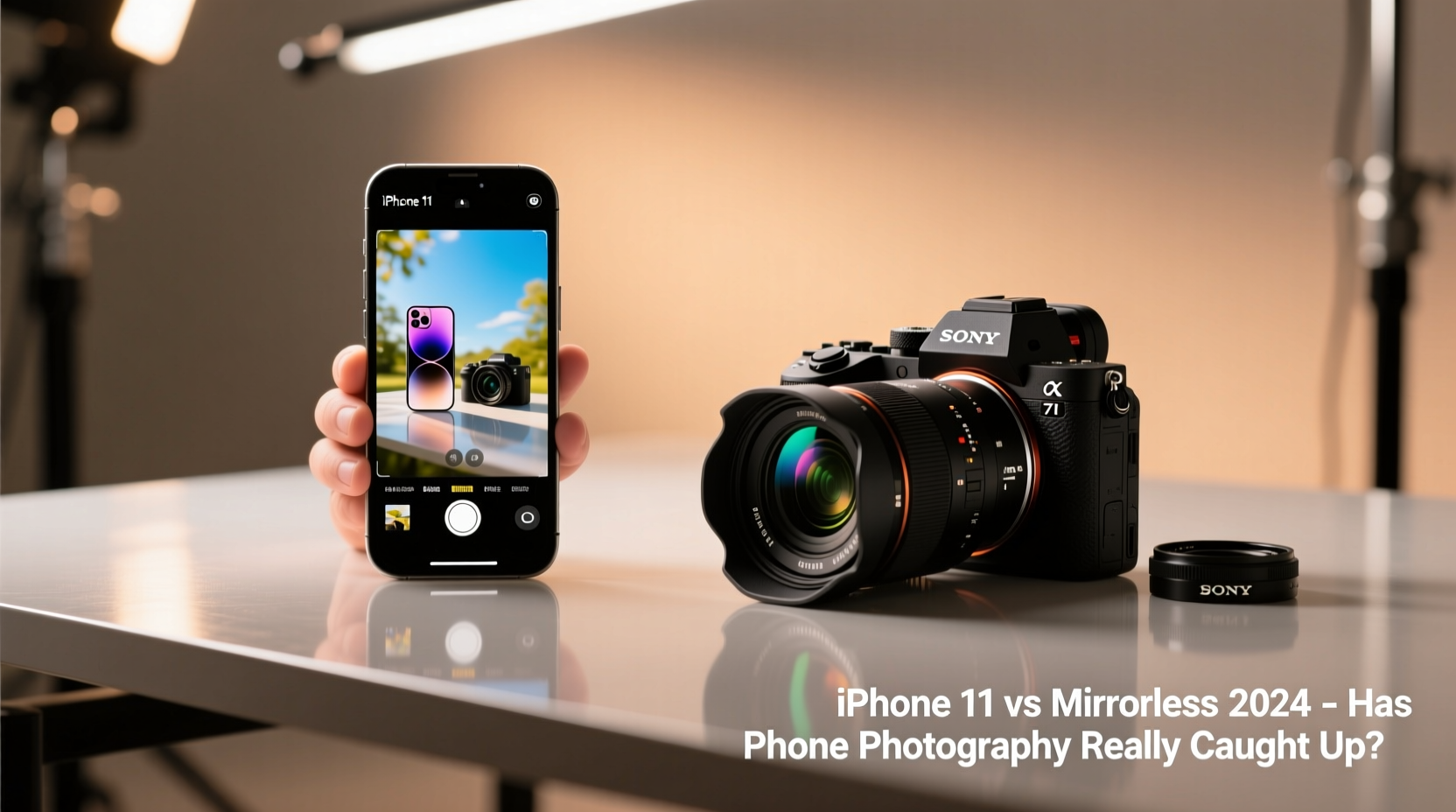
The most fundamental difference lies in hardware. The iPhone 11 features a 12MP main sensor measuring approximately 1/2.55 inches. In contrast, even entry-level mirrorless cameras use APS-C or full-frame sensors—up to 7–10 times larger in surface area. Larger sensors capture more light, which directly translates to better dynamic range, reduced noise, and superior performance in low-light environments.
Take night photography as an example. The iPhone 11 relies on Night Mode, a software-based solution that stacks multiple exposures over one to three seconds. While effective for casual shots, it struggles with moving subjects and lacks the natural tonal gradation of a single long exposure from a mirrorless camera. Mirrorless systems, equipped with high ISO performance (often up to ISO 51200 or higher), can capture clean images in near darkness without relying on artificial brightening.
Optical Versus Computational Photography
Smartphones like the iPhone 11 depend heavily on computational photography. Features such as Smart HDR, Deep Fusion, and Portrait Mode use machine learning to enhance contrast, sharpen details, and simulate depth-of-field effects. These tools produce visually appealing results straight out of the camera—ideal for social media—but often sacrifice authenticity.
Mirrorless cameras, by contrast, prioritize optical accuracy. They rely on physical lens elements, precise focus systems, and minimal post-processing to deliver true-to-life images. Photographers retain full control over exposure, white balance, and focus, enabling consistent results across different lighting conditions. This is especially critical in professional settings such as weddings, product shoots, or photojournalism, where predictability matters.
Moreover, mirrorless cameras support interchangeable lenses. With access to ultra-wide, macro, telephoto, and tilt-shift optics, photographers aren’t limited by fixed focal lengths. The iPhone 11 offers only two rear lenses: a 26mm-equivalent wide and a 52mm-equivalent telephoto (2x zoom). While sufficient for everyday use, this setup pales in comparison to the creative freedom offered by a mirrorless system.
“Computational photography is impressive, but it’s not a substitute for optical excellence. You can’t compute your way out of poor light or shallow depth.” — Daniel Kim, Professional Landscape Photographer
Performance Comparison Table
| Feature | iPhone 11 | Mirrorless (e.g., Sony a6100) |
|---|---|---|
| Sensor Size | 1/2.55\" | APS-C (1.5x crop) |
| Main Lens Aperture | f/1.8 (wide), f/2.0 (tele) | f/1.8 (with compatible lens) |
| Zoom Capability | Digital only beyond 2x | Optical zoom via lens (e.g., 18-135mm) |
| Low-Light Performance | Good with Night Mode | Excellent, native ISO up to 32000+ |
| Dynamic Range | Decent (HDR processed) | Superior (RAW files preserve detail) |
| Video Recording | 4K@60fps, stabilized | 4K@30/60fps, LOG profiles, external mic input |
| Manual Controls | Limited (via third-party apps) | Full manual exposure, focus, white balance |
| File Format | HEIC, JPEG, optional ProRAW* | RAW, JPEG, TIFF, LOG video |
*ProRAW requires iOS 14.3+, available on iPhone 12 Pro and later; not supported on iPhone 11.
Real-World Example: Travel Photography in Kyoto
Consider a traveler visiting Kyoto in spring, capturing cherry blossoms at various times of day. Using an iPhone 11, they can quickly snap vibrant, well-exposed photos during daylight. Portrait mode creates pleasing bokeh around temple lanterns. However, when photographing interiors of dimly lit shrines, the iPhone struggles with noise and motion blur, despite Night Mode.
In contrast, a photographer using a Fujifilm X-T4 with an f/2 lens captures sharp, low-noise images inside the same temples at ISO 3200. They switch to a 10-24mm lens for expansive garden views and use manual focus to ensure precision on wooden carvings. Later, editing RAW files allows recovery of highlight detail in bright sky areas—an option unavailable with standard iPhone HEIC output.
The mirrorless user spends more time setting up shots but achieves consistently higher fidelity. The iPhone user prioritizes speed and shareability. Both approaches are valid, but serve different purposes.
When the iPhone 11 Is Enough
For the average user, the iPhone 11 remains a capable imaging tool in 2024. Its strengths include:
- Instant sharing via cellular networks
- Seamless integration with iCloud and editing apps
- Reliable autofocus and exposure in daylight
- Compact size and always-available design
- Strong video stabilization for vlogging
If your primary goal is documenting daily life, posting to Instagram, or capturing memories during family events, the iPhone 11 delivers excellent results with zero friction. Most viewers won’t notice the difference between a smartphone image and a professionally edited mirrorless shot when viewed on a phone screen.
Where Mirrorless Still Wins
Despite smartphone advances, mirrorless cameras maintain clear superiority in several key areas:
- Creative Control: Full manual settings allow photographers to experiment with shutter speed, aperture, and focus creatively.
- Professional Output: High-resolution RAW files are essential for large prints, commercial work, or editorial use.
- Low-Light Fidelity: Mirrorless cameras produce cleaner, more natural-looking images in darkness.
- Telephoto Reach: Dedicated telephoto lenses offer 10x+ optical zoom without quality loss.
- Focusing Systems: Advanced subject tracking (human, animal, vehicle) outperforms smartphone AF in complex scenes.
FAQ
Can I shoot professional photos with an iPhone 11 in 2024?
You can produce publishable images in good light, especially for digital platforms. However, limitations in dynamic range, lack of RAW by default, and fixed lenses make it challenging for demanding assignments. Newer iPhones with ProRAW are better suited for prosumer work.
Is it worth buying a mirrorless camera if I already have a smartphone?
If you’re passionate about photography, value image quality over convenience, or need gear for paid work, yes. Mirrorless systems offer growth potential, creative freedom, and long-term investment value that smartphones cannot match.
Does the iPhone 11 support RAW photography?
No. The iPhone 11 does not support Apple ProRAW, which was introduced with the iPhone 12 Pro. Third-party apps can export DNG files, but these lack the full sensor data and processing pipeline of true ProRAW.
Conclusion: Complements, Not Replacements
In 2024, smartphone photography has come remarkably close to matching mirrorless cameras—in certain contexts. The iPhone 11 exemplifies how far computational imaging has come, delivering strong results for casual and social photography. Yet, when examined critically, it still operates within tight hardware constraints that prevent it from truly replacing a dedicated camera.
Mirrorless systems remain unmatched in optical quality, adaptability, and professional reliability. Rather than seeing smartphones and mirrorless cameras as competitors, think of them as complementary tools. Use your iPhone 11 for spontaneity and connectivity. Turn to a mirrorless camera when image integrity, creative control, and technical excellence matter most.




 浙公网安备
33010002000092号
浙公网安备
33010002000092号 浙B2-20120091-4
Comments
No comments yet. Why don't you start the discussion?