
In academic writing, journalism, research, and even digital content creation, citing sources correctly is not just a formality—it's foundational. Accurate referencing builds credibility, avoids plagiarism, and allows readers to verify claims and explore further. Yet, many struggle with the nuances of citation: which style to use, how to format entries, or when a source truly needs attribution. This guide breaks down the essentials of referencing with clarity and precision, offering practical tools for confident, ethical information use.
Why Citation Matters Beyond Avoiding Plagiarism
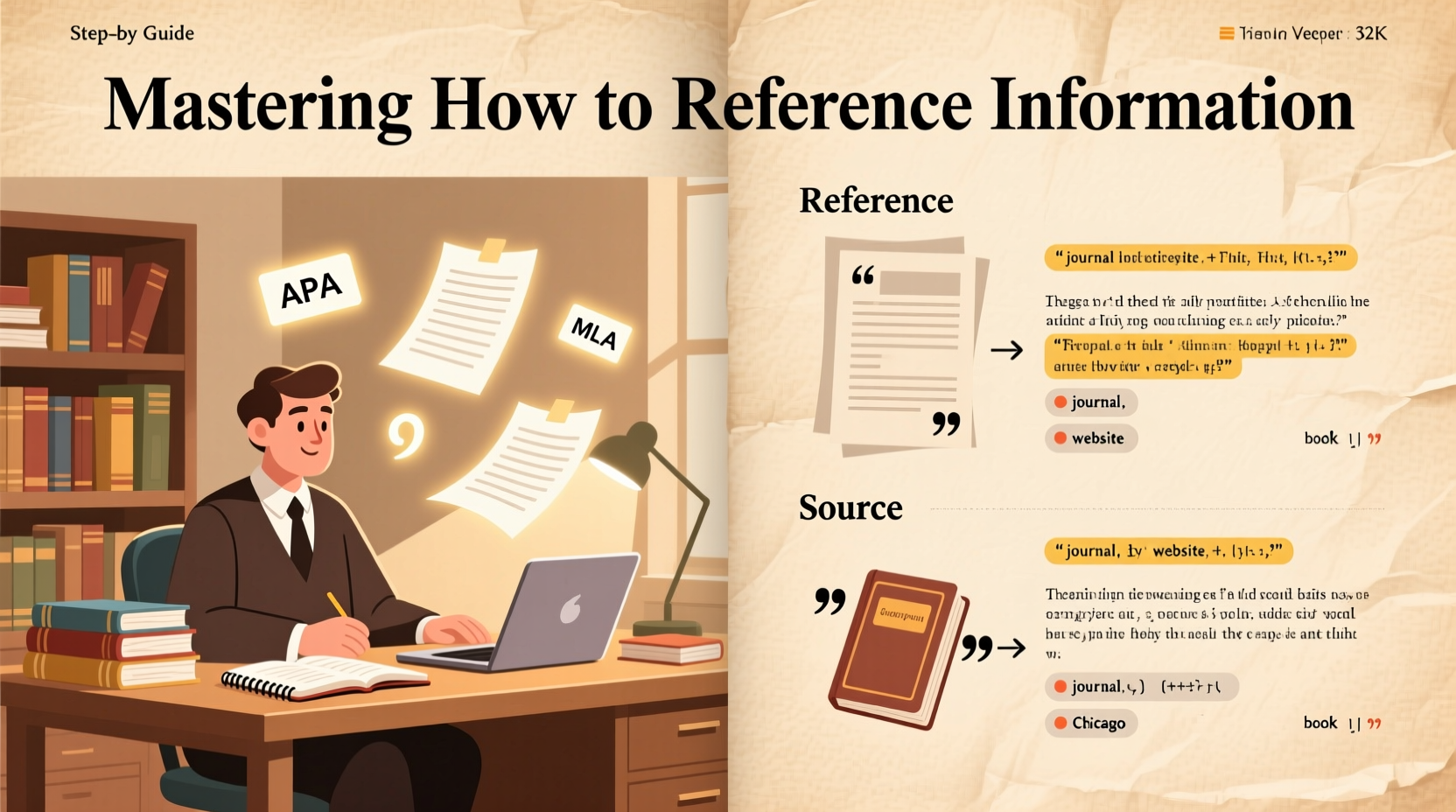
Citation is often taught as a defensive tool—something done to avoid penalties. In reality, it’s an intellectual act of respect and transparency. When you cite a source, you acknowledge the work of others, position your argument within existing discourse, and contribute to the traceability of knowledge. A well-cited piece invites dialogue rather than asserting isolated opinion.
Consider a researcher building on a 2018 study about climate change impacts on coastal agriculture. By citing the original work, they allow peers to assess the data’s relevance, replicate findings, or challenge assumptions. Without proper citation, the connection is lost, weakening both accountability and scholarly progress.
“Citation is the skeleton of academic integrity. It shows where ideas begin and end—and who deserves credit.” — Dr. Lena Patel, Professor of Research Ethics, University of Edinburgh
Major Citation Styles: Choosing the Right Format
Different disciplines favor different citation systems. Understanding the purpose and structure of each helps ensure consistency and professionalism in your work.
| Style | Common Fields | Key Features | Example (Book) |
|---|---|---|---|
| APA (American Psychological Association) | Social sciences, education, psychology | Author-date in-text citations; reference list at end | Smith, J. (2020). The Cognitive Edge. Oxford Press. |
| MLA (Modern Language Association) | Humanities, literature, arts | Author-page in-text; Works Cited list | Smith, John. The Cognitive Edge. Oxford Press, 2020. |
| Chicago Manual of Style | History, publishing, some social sciences | Footnotes or author-date; bibliography | John Smith, The Cognitive Edge (Oxford: Oxford Press, 2020), 45. |
| IEEE (Institute of Electrical and Electronics Engineers) | Engineering, computer science, technology | Numbered brackets in text; numbered reference list | [1] J. Smith, The Cognitive Edge. Oxford: Oxford Press, 2020. |
Selecting the correct style depends on your audience or institutional guidelines. Always confirm expectations before finalizing your document.
A Step-by-Step Guide to Building Accurate Citations
Whether you're quoting a journal article or paraphrasing a blog post, follow this sequence to create reliable references:
- Identify the source type: Is it a book, journal, website, video, or interview? Each has distinct formatting rules.
- Gather core elements: Author(s), publication year, title, publisher, URL (if online), page numbers, DOI (for journals).
- Choose your citation style: Match it to your field or assignment requirements.
- Structure the entry: Follow the exact punctuation, order, and formatting rules of the style.
- Insert in-text citations: Place them immediately after borrowed ideas, quotes, or data.
- Create a complete reference list: Alphabetize entries and apply consistent formatting.
- Double-check accuracy: Verify spelling, dates, URLs, and italics.
Real Example: From Source to Citation
Lena, a sociology student, writes a paper on urban inequality. She reads a 2022 journal article titled “Housing Disparities in Post-Pandemic Cities” by Dr. Amir Chen, published in Urban Studies Quarterly. She wants to include Chen’s finding that rent prices rose 34% faster in low-income neighborhoods.
Using APA style, her in-text citation reads:
“Post-pandemic rent increases disproportionately affected marginalized communities (Chen, 2022).”
In her reference list, she includes:
Chen, A. (2022). Housing disparities in post-pandemic cities. Urban Studies Quarterly, 47(3), 112–130. https://doi.org/10.1234/usq.2022.04703
This process ensures transparency and enables her professor to locate and evaluate the original study.
Common Citation Mistakes and How to Avoid Them
Even experienced writers make errors. The most frequent issues include:
- Mixing citation styles within one document
- Omitting in-text citations when paraphrasing
- Failing to cite common knowledge incorrectly (e.g., citing that water boils at 100°C)
- Incorrect DOI or broken URLs
- Missing authors or using “Anonymous” instead of verifying contributor names
“Paraphrasing doesn’t exempt you from citation. If the idea isn’t yours, credit it.” — Prof. David Liu, Academic Writing Coordinator, Stanford University
Do’s and Don’ts of Effective Referencing
| Do | Don't |
|---|---|
| Cite whenever you quote, summarize, or paraphrase | Assume a source is “common knowledge” without verification |
| Use quotation marks for direct quotes | Copy text without attribution, even if you change a few words |
| Verify all details against the original source | Rely solely on auto-generated citations from websites without checking |
| Include DOIs for scholarly articles when available | Use vague references like “a recent study found…” |
Checklist: Ensuring Your Citations Are Complete and Correct
Before submitting any written work, run through this checklist:
- ✅ Every borrowed idea or fact has a corresponding in-text citation
- ✅ All in-text citations appear in the reference list
- ✅ Reference list is alphabetized by author’s last name
- ✅ Punctuation, italics, and capitalization follow style guidelines
- ✅ URLs are functional and DOIs are included where applicable
- ✅ No citation style inconsistencies (e.g., mixing APA and MLA)
- ✅ Quoted material is enclosed in quotation marks or formatted as block quotes
FAQ: Frequently Asked Questions About Citation
Do I need to cite information I already knew?
If the information is widely recognized as common knowledge (e.g., “Paris is the capital of France”), citation isn’t required. However, if the fact is debated, specific, or data-driven (e.g., “Paris population reached 2.1 million in 2023”), always cite the source.
How do I cite a source I found in another source (secondary citation)?
In APA, for example, you would write: (Original Author, as cited in Secondary Author, Year). While acceptable, try to access the original source whenever possible for accuracy and depth.
Can I use AI-generated content as a source?
Most academic institutions currently advise against citing AI tools like chatbots as authoritative sources. Instead, use AI to help draft or clarify ideas, but ground your arguments in peer-reviewed, verifiable materials. If you must reference AI output, describe the prompt and tool used in an appendix or footnote, following institutional guidelines.
Conclusion: Build Trust Through Transparent Scholarship
Mastering how to reference information is more than a technical skill—it’s a commitment to intellectual honesty. Whether you’re writing a thesis, a blog post, or a policy brief, accurate citations demonstrate respect for knowledge, empower your audience, and strengthen your voice. By applying consistent standards, double-checking details, and understanding the logic behind citation formats, you turn referencing from a chore into a powerful tool of clarity and credibility.




 浙公网安备
33010002000092号
浙公网安备
33010002000092号 浙B2-20120091-4
Comments
No comments yet. Why don't you start the discussion?