
The abbreviation \"etc.\"—short for the Latin phrase *et cetera*, meaning \"and other things\" or \"and so forth\"—is one of the most commonly used yet frequently misused terms in English writing. When applied correctly, it streamlines lists and prevents redundancy. But when overused or poorly placed, it can introduce vagueness, weaken precision, and undermine credibility. Whether you're drafting an email, composing a report, or editing an article, mastering the use of \"etc.\" is essential for clear, professional communication.
This guide explores how to use \"etc.\" effectively, offering actionable strategies to maintain clarity while avoiding common pitfalls. By understanding its proper context, recognizing alternatives, and applying best practices, you can ensure your writing remains concise without sacrificing specificity.
Understanding the Meaning and Origin of “Etc.”
\"Etc.\" derives from the Latin expression *et cetera*, which literally translates to \"and the rest\" or \"and other things of the same kind.\" It's used to indicate that a list is incomplete but representative of a broader category. For example:
Vegetables like carrots, broccoli, spinach, etc., are rich in nutrients.
In this case, \"etc.\" signals that additional vegetables could be named, but they belong to the same general group. The key assumption is that the reader can infer what follows based on the items already listed.
However, because \"etc.\" is rooted in Latin, it carries formal undertones. In academic, technical, or professional writing, it should be used sparingly and only when the omitted items are clearly implied by the preceding examples.
When (and When Not) to Use “Etc.”
While convenient, \"etc.\" is not appropriate in all contexts. Its misuse often leads to ambiguity or lazy writing. Consider the following guidelines:
- Use it after two or more specific examples – A single item followed by \"etc.\" provides no meaningful context (e.g., \"apples, etc.\" tells us nothing about the category).
- Avoid using it with vague or unrelated items – Lists should be logically consistent. Saying \"laptops, coffee mugs, shoes, etc.\" fails to establish a coherent category.
- Never combine with phrases like “and so on” or “and others” – This is redundant. Choose one: either \"etc.\" or \"and so on,\" not both.
- Don’t use it in formal enumerations where completeness matters – Legal documents, scientific reports, and policy briefs typically require full disclosure.
Common Misuses of “Etc.”
| Mistake | Why It’s Problematic | Better Alternative |
|---|---|---|
| I need pens, paper, etc. | Only one item before \"etc.\"; unclear scope | I need stationery such as pens, paper, notebooks, and other supplies. |
| We discussed strategy, leadership, innovation, etc., and moved on. | Implies open-endedness in a serious discussion | We discussed several topics, including strategy, leadership, and innovation. |
| Bring snacks, drinks, plates, forks, spoons, napkins, etc. | Overuse in detailed planning; better to be explicit | Bring all necessary serving items—plates, utensils, napkins, and beverages. |
Alternatives to “Etc.” for Clearer Writing
Modern writing favors precision over implication. Instead of relying on \"etc.\", consider stronger, more transparent alternatives:
- Use phrases like “such as,” “including,” or “for example” – These signal incompleteness without vagueness.
- Reword to generalize the category – Replace a partial list with a broader term (e.g., “various fruits” instead of “apples, bananas, etc.”).
- List all relevant items if short enough – Clarity often trumps brevity.
- Use ellipsis (...) sparingly in informal contexts – Only when tone permits and meaning is clear.
For instance:
- Weak: We offer yoga, pilates, Zumba, etc.
- Stronger: We offer a range of fitness classes, including yoga, pilates, and Zumba.
Real-World Example: Improving a Business Email
Consider this poorly written message:
Hi team,
Please bring your laptops, chargers, notebooks, pens, water bottles, snacks, etc. to the offsite. Also, wear comfortable clothes, shoes, hats, sunscreen, etc. See you there!
The overuse of \"etc.\" creates uncertainty. What exactly should attendees prepare? Are jackets included? Is lunch provided?
Here’s a revised version with improved clarity:
Hi team,
Please bring your laptop, charger, notebook, and any personal items you typically use during long meetings. Pack water, a snack, and sun protection, as part of the session will be outdoors. Wear business-casual attire with comfortable footwear. Lunch will be provided.
This rewrite eliminates ambiguity, removes unnecessary reliance on \"etc.\", and enhances professionalism—all while conveying the same core information.
Expert Insight on Precision in Communication
“Vague language like ‘etc.’ may save time in writing, but it costs clarity in understanding. In professional settings, every word should serve a purpose.” — Dr. Rebecca Lang, Communication Specialist, University of Toronto
Dr. Lang emphasizes that readers interpret omissions differently. What seems obvious to the writer may be entirely unclear to the audience. Effective writing anticipates these gaps and closes them proactively.
Step-by-Step Guide to Using “Etc.” Correctly
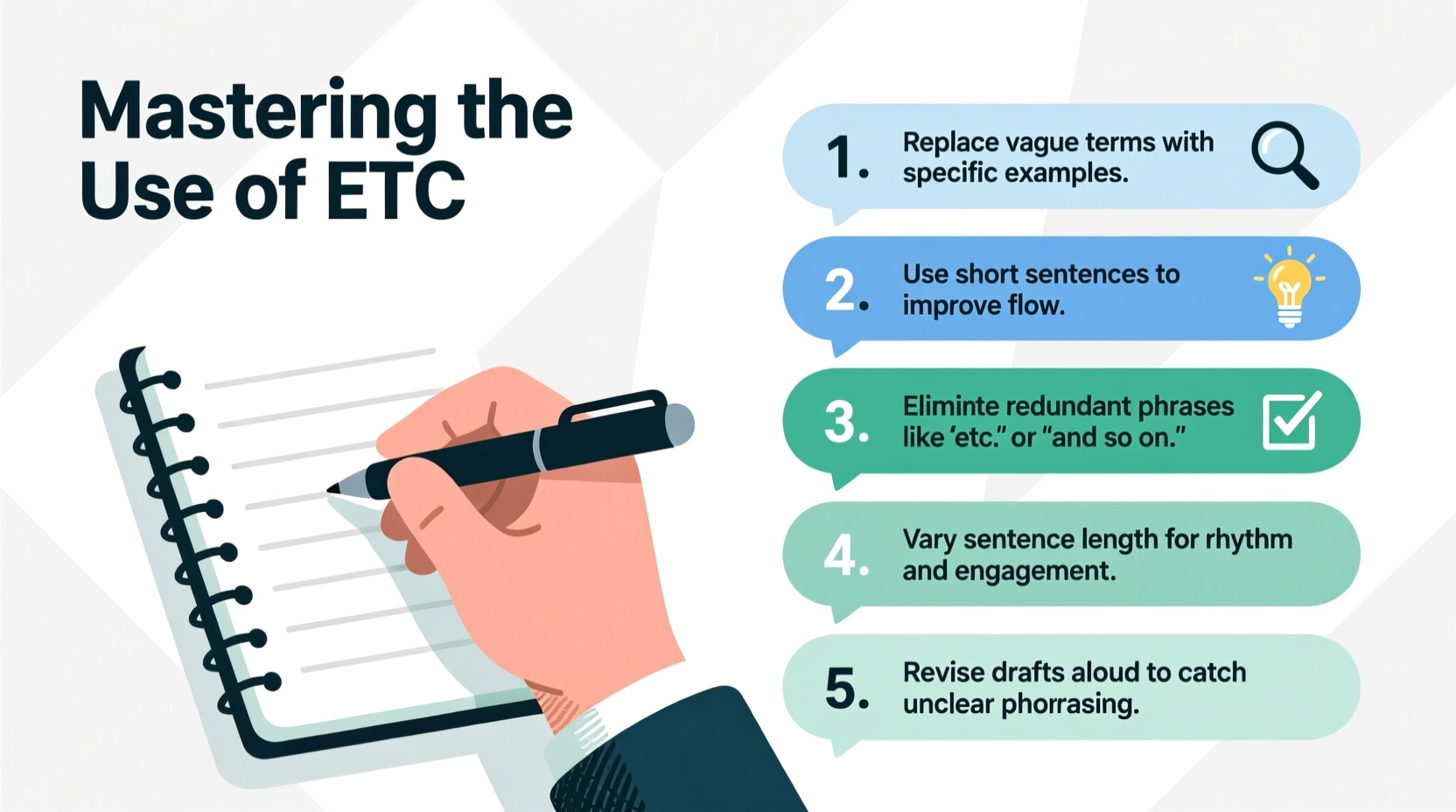
Follow this five-step process to determine whether \"etc.\" is appropriate in your sentence:
- Identify the list – Are you naming multiple items of the same type?
- Check for at least two concrete examples – One item isn’t enough to establish a pattern.
- Ask: Can the reader predict what’s missing? – If not, expand the list or rephrase.
- Avoid combining with similar terms – Don’t write “and so on, etc.” or “including, etc.”
- Consider tone and formality – In formal writing, prefer rewording over abbreviation.
Checklist: Using “Etc.” Like a Pro
- ☑ Used after two or more specific examples
- ☑ Items in the list are of the same category
- ☑ No redundancy (e.g., avoided “etc., and so forth”)
- ☑ Not used in formal, legal, or technical documentation unless absolutely necessary
- ☑ Replaced with clearer phrasing when ambiguity is possible
Frequently Asked Questions
Can I use “etc.” at the end of a sentence?
Yes, but only if it follows a list and a comma is not required after it in standard punctuation. Example: “We stocked apples, oranges, bananas, etc.” Note: Always place a period after “etc.” since it’s an abbreviation.
Is “etc.” acceptable in academic writing?
Rarely. Most academic style guides (APA, MLA, Chicago) discourage its use because scholarly writing demands precision. Instead, use phrases like “among others” or explicitly state that the list is illustrative.
Can “etc.” be used in presentations or speeches?
In spoken language, saying “etc.” can sound dismissive or lazy. It’s better to say “and more,” “and so on,” or simply pause to imply continuation. In slides, avoid \"etc.\" unless the context is casual and the list is clearly representative.
Final Thoughts: Clarity Over Convenience
\"Etc.\" is not inherently wrong—but it is a crutch. Relying on it too often suggests a lack of intentionality in writing. Masterful communication doesn’t just convey information; it anticipates questions, reduces confusion, and respects the reader’s time.
By reserving \"etc.\" for cases where meaning is unmistakable and opting for clearer alternatives otherwise, you elevate the quality of your writing across emails, reports, articles, and everyday correspondence. The goal isn’t to eliminate the term entirely, but to wield it with purpose.




 浙公网安备
33010002000092号
浙公网安备
33010002000092号 浙B2-20120091-4
Comments
No comments yet. Why don't you start the discussion?