
As Minecraft enters 2025, the debate between Java and Bedrock Editions continues to evolve—especially when it comes to modding. While both versions offer unique experiences, the depth and flexibility of modifications remain a key factor for players who want to reshape their gameplay. Whether you're building elaborate fantasy worlds, automating complex systems, or adding new dimensions, the version you choose can significantly affect what's possible. Understanding the differences in mod support, tools, community size, and technical limitations is essential for making an informed decision.
The State of Modding in 2025
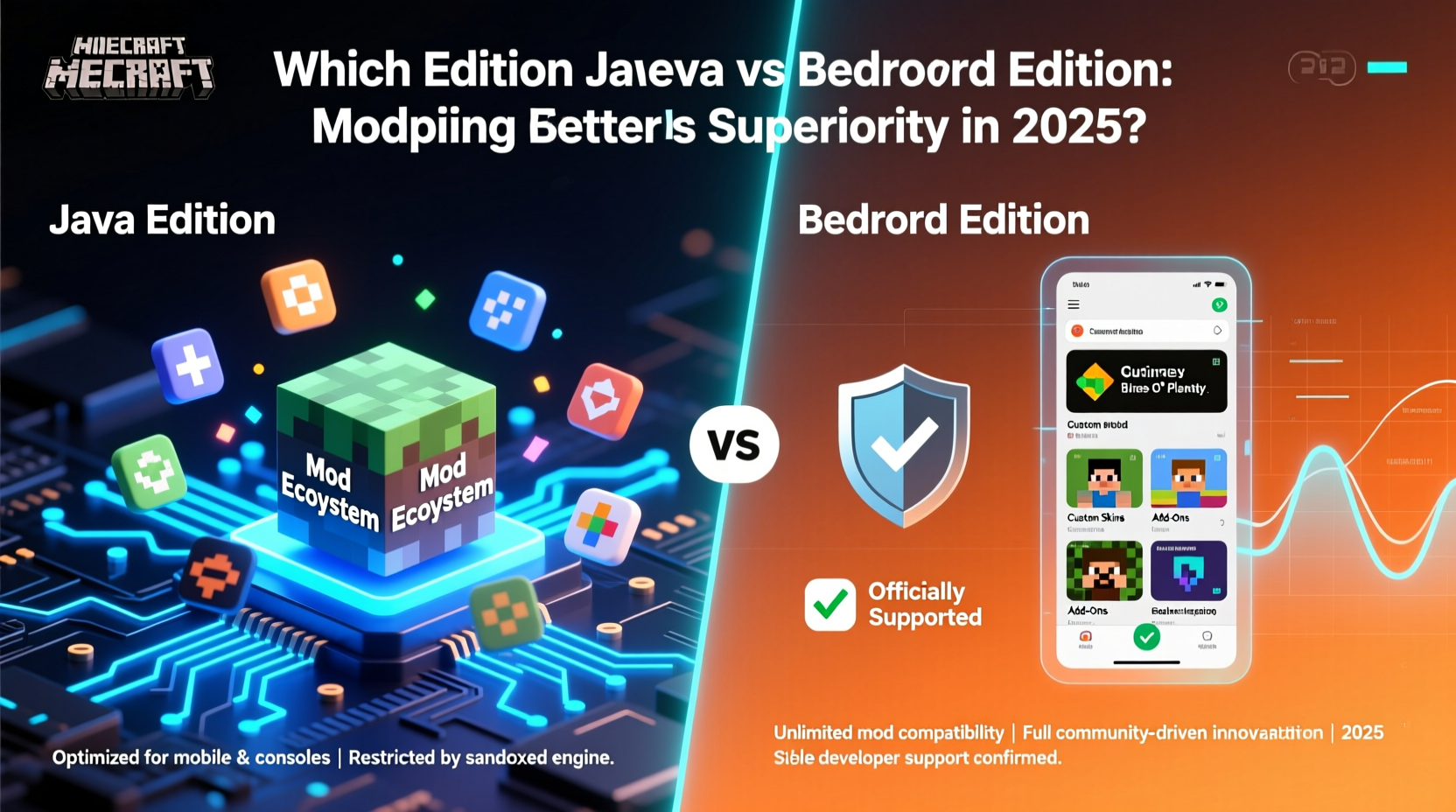
By 2025, Minecraft’s modding ecosystem has matured into two distinct branches. Java Edition, available on PC, remains the traditional hub for deep, code-level modifications. It supports full access to the game’s source via decompiled classes, enabling developers to alter core mechanics, introduce new programming interfaces, and integrate with third-party tools. This level of control has allowed for decades of innovation—from simple texture tweaks to complete overhauls like the popular \"SkyFactory\" or \"RLCraft\" packs.
In contrast, Bedrock Edition—available on Windows 10/11, consoles, and mobile devices—has taken a more curated approach. Instead of traditional mods, Bedrock uses \"add-ons,\" which are limited scripts and JSON-based configurations that modify behaviors, textures, and UI elements without touching the underlying engine. While this makes add-ons safer and more stable across platforms, it also restricts their scope. True machine-level automation, physics manipulation, or AI-driven mobs aren’t feasible under this model.
Technical Foundations: Why Java Leads in Mod Depth
The fundamental difference lies in architecture. Java Edition runs on the Java Virtual Machine (JVM), allowing direct memory access, reflection, and runtime class modification. Tools like Forge, Fabric, and Rift provide structured environments where developers can hook into game events, override methods, and inject custom logic. These frameworks have been refined over more than a decade, resulting in robust ecosystems with dependency management, version control, and debugging support.
Bedrock, built on C++ and optimized for cross-platform consistency, operates within a sandboxed environment. Its scripting API, while improved since its 2017 debut, still lacks low-level access. You cannot change how redstone calculates signal strength or how pathfinding works for mobs. Add-ons are confined to predefined parameters set by Mojang, meaning even skilled developers face hard limits.
This architectural gap translates directly to functionality. In Java, mods exist that simulate real-world electricity (like RedLogic), implement fully functional computers inside the game (OpenComputers), or generate entire biomes with dynamic weather systems (Biomes O' Plenty). None of these would be possible—or even close to replicable—on Bedrock.
“Java Edition isn’t just more moddable—it’s fundamentally designed to be extended. The community didn’t create that openness; they exploited it because the language and platform allowed them to.” — Daniel Park, Senior Game Developer at BlockWorks Studios
Comparison Table: Java vs Bedrock Modding Capabilities (2025)
| Feature | Java Edition | Bedrock Edition |
|---|---|---|
| Mod Type | Full-code mods via Forge/Fabric | Add-ons (JSON + scripts) |
| Access Level | Deep engine access (memory, classes, threads) | Limited behavioral scripting only |
| Custom Blocks/Mobs | Yes, with full AI and rendering control | Yes, but behavior trees are restricted |
| Performance Impact | High (depends on mod complexity) | Low to moderate |
| Cross-Platform Sharing | No (PC-only) | Yes (across all Bedrock platforms) |
| Ease of Installation | Moderate (requires mod loader setup) | Easy (via Marketplace or file import) |
| Community Size | ~70% of mod creators active here | Growing, but mostly beginner-focused |
| Update Stability | Frequent breakage after updates | More stable due to official APIs |
Real-World Example: Building a Fully Automated Factory
Consider a player aiming to build a self-sustaining industrial complex with automated mining, smelting, sorting, power generation, and item transport. On Java Edition, this is achievable through a combination of mods like Thermal Expansion, Ender IO, Applied Energistics 2, and ComputerCraft. Each adds machines, energy networks, storage systems, and programmable logic—all interoperable thanks to standardized APIs like Capability System and Energy Networks.
In Bedrock, similar results require workarounds. Players might use command blocks and Redstone contraptions, or rely on pre-made add-ons from the Marketplace. However, there’s no equivalent to modded cables, quantum storage, or Lua-controlled drones. Automation is limited to what vanilla mechanics allow, extended slightly by script-based tweaks. The result is a less flexible, less scalable system that demands more manual input and creative compromise.
This disparity highlights a broader trend: Java empowers creators to transcend the original game design, while Bedrock enhances but rarely reinvents it.
Community and Ecosystem Momentum
The modding community around Java Edition remains vast and technically sophisticated. Platforms like CurseForge, PlanetMinecraft, and GitHub host thousands of open-source projects, tutorials, and collaborative development efforts. Major modpacks such as FTB Infinity Evolved, All the Mods, and Enigmatica continue releasing updated versions annually, often featuring 200+ interdependent mods working in harmony.
Bedrock’s community, while growing, focuses more on accessibility than innovation. Add-on creators often target younger audiences or console players seeking cosmetic changes—new skins, pet behaviors, or mini-games. The absence of a centralized repository comparable to CurseForge also hinders discoverability and trust. Most high-quality add-ons appear in the official Marketplace, where monetization is possible, but technical ambition is capped by platform constraints.
Moreover, the skill barrier differs significantly. Creating a Java mod typically requires knowledge of Java programming, Gradle builds, and Minecraft’s internal event system. Bedrock add-ons use JavaScript and JSON, lowering entry barriers—but also limiting output. As one developer put it: “You can teach someone to make a Bedrock add-on in a weekend. Teaching them to make a useful Java mod takes months.”
Future Outlook: Will Bedrock Catch Up?
Despite current limitations, Bedrock has made strides. Mojang has expanded its scripting API with better entity event handling, UI customization, and multiplayer synchronization tools. The introduction of “Scripting Engine v2” in late 2024 improved performance and stability for complex add-ons. Some developers have even created lightweight frameworks mimicking mod loaders, though they still operate within strict boundaries.
However, structural challenges remain. Because Bedrock prioritizes uniformity across devices—including Xbox, PlayStation, and mobile—the risk of instability from unrestricted mods is too high. Sony and Microsoft enforce stricter certification standards than PC allows, preventing deep system access. Unless these policies shift dramatically, Bedrock will likely remain a platform for enhancements rather than transformations.
Java, meanwhile, benefits from Microsoft’s continued investment in the PC gaming space. With the Windows Store now hosting Java Edition and integration with Xbox Cloud Gaming improving, Microsoft appears committed to maintaining both editions separately—preserving Java’s mod-friendly nature while expanding Bedrock’s reach.
Step-by-Step Guide: Choosing the Right Version for Your Modding Goals
- Define your goal: Are you looking for visual upgrades, new items, or complete gameplay overhauls?
- Assess your platform: Do you play primarily on PC, or do you need cross-device sync (e.g., playing on iPad then continuing on Xbox)?
- Evaluate technical comfort: Are you willing to manage JAR files, resolve dependency conflicts, and troubleshoot crashes?
- Research available mods: Check CurseForge for Java mods or the Marketplace for Bedrock add-ons related to your interests.
- Test both versions: Try a small mod pack on Java (e.g., ATM9 Lite) and a feature-rich add-on on Bedrock (like “Tech World”) to compare depth and usability.
- Decide based on priority: Choose Java for maximum mod capability; choose Bedrock for ease of use and multiplatform convenience.
Frequently Asked Questions
Can I transfer mods from Java to Bedrock?
No. The architectures are incompatible. While some content creators manually recreate popular mods as add-ons, the process is not automated and often results in simplified versions.
Is modding safe on either version?
Java mods carry higher risk due to unverified code execution. Always download from trusted sources like CurseForge or Modrinth. Bedrock add-ons are generally safer, especially those from the official Marketplace, as they undergo review.
Will Mojang unify modding between editions?
Unlikely. Despite rumors, Mojang has stated that the technical and policy differences make full parity impossible. They aim to improve both ecosystems independently rather than merge them.
Checklist: Preparing for Serious Modding in 2025
- ✔ Install Java Development Kit (JDK) if planning to create mods
- ✔ Download a mod loader (Forge or Fabric) compatible with your Minecraft version
- ✔ Allocate at least 4GB of RAM for modded gameplay
- ✔ Backup your world saves before installing new mods
- ✔ Join modding communities (Reddit’s r/feedthebeast, Discord servers)
- ✔ Use a launcher like Prism or GDLauncher for easier modpack management
- ✔ Stay updated on patch notes affecting mod compatibility
Conclusion: Java Reigns Supreme—for Now
When it comes to mods in 2025, Minecraft Java Edition remains the undisputed leader. Its open architecture, mature tooling, and vibrant developer community enable experiences far beyond what Bedrock can offer. While Bedrock excels in accessibility, stability, and cross-platform play, it sacrifices depth for safety and uniformity. For players who value creativity, customization, and technical exploration, Java is not just preferable—it’s essential.
That said, Bedrock’s role shouldn’t be dismissed. For casual mod users, families, or mobile gamers, its streamlined add-on system provides meaningful enhancements without complexity. But if you’re asking which version has *better* mods—measured by innovation, functionality, and community impact—the answer is clear.




 浙公网安备
33010002000092号
浙公网安备
33010002000092号 浙B2-20120091-4
Comments
No comments yet. Why don't you start the discussion?