
For years, flagship smartphones have been dominated by a familiar hierarchy: Apple at the top, followed by Samsung, with other manufacturers striving to match their polish, ecosystem integration, and long-term reliability. OnePlus, once known for its “flagship killer” ethos, has spent much of the past decade refining its identity—balancing aggressive pricing with premium hardware. Now, with the launch of the OnePlus 12, the company isn’t just competing on specs; it’s challenging Apple’s dominance head-on. The question is no longer whether OnePlus can deliver raw power, but whether it can truly rival the iPhone 15 Pro Max in real-world experience.
The OnePlus 12 marks a turning point—not just another incremental upgrade, but a statement device. With class-leading display technology, vastly improved cameras, and a refined software experience, OnePlus appears closer than ever to matching Apple’s gold standard. But does it close the gap completely? Or are there still fundamental differences that keep the iPhone 15 Pro Max ahead?
Display and Build: Glass, Steel, and First Impressions
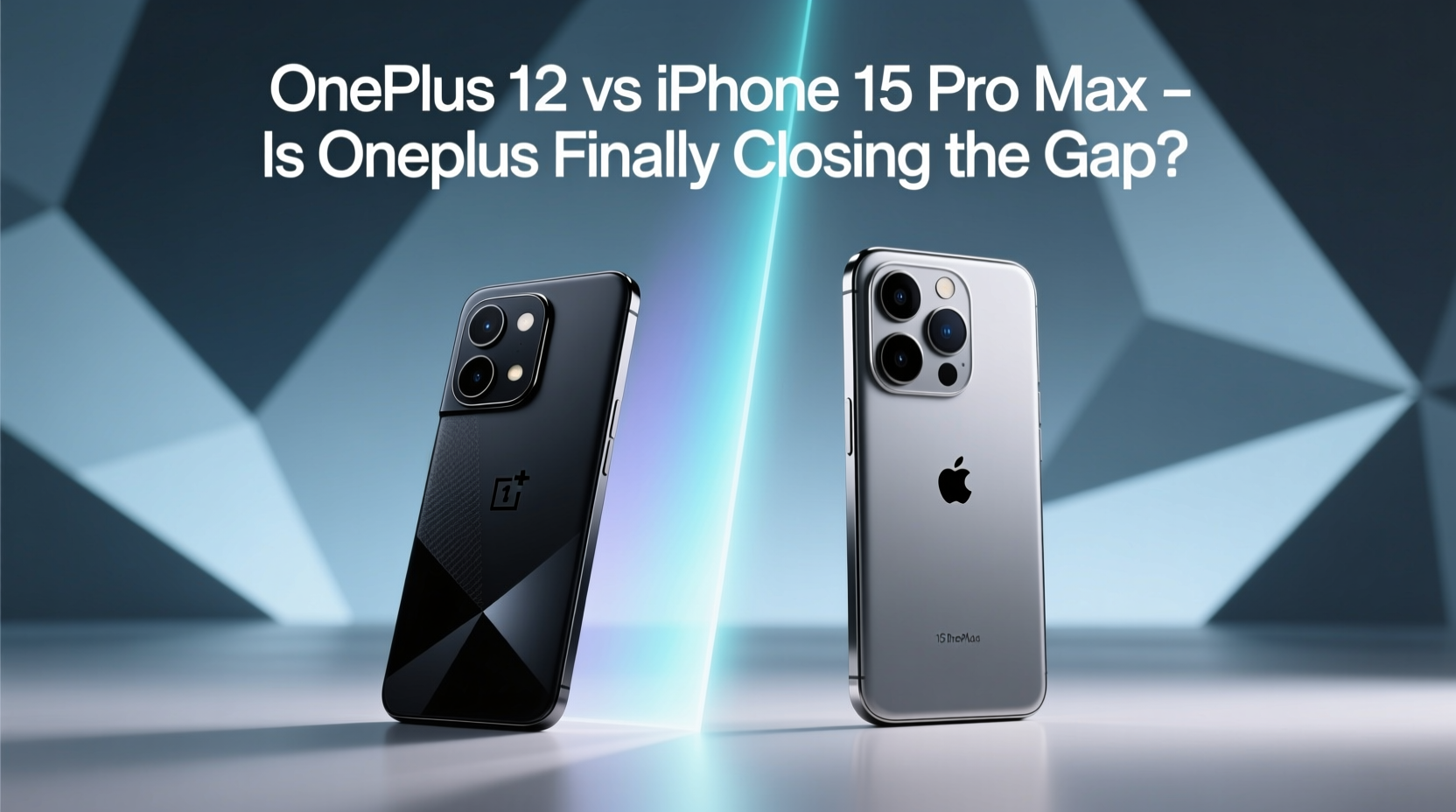
The physical presence of a smartphone shapes user perception from the first touch. Both the OnePlus 12 and iPhone 15 Pro Max use premium materials—titanium frames, curved glass backs, and IP68 ratings—but they achieve different aesthetics.
The iPhone 15 Pro Max features a titanium chassis that reduces weight significantly compared to previous stainless steel models. It feels lighter in hand despite its large 6.7-inch display. Apple’s design philosophy emphasizes minimalism: flush camera bumps, seamless button integration, and tight tolerances. The matte finish resists fingerprints better than ever, and the overall build exudes durability and precision.
In contrast, the OnePlus 12 opts for an aluminum frame with Gorilla Glass Victus 2 on both front and back. While not as light as the iPhone, it carries a satisfying heft that signals solidity. OnePlus offers more color variety, including unique finishes like Jade Green and Volcanic Black, which incorporate textured glass for enhanced grip and visual depth. The display is a 6.82-inch LTPO AMOLED panel with a peak brightness of 4500 nits—the highest of any smartphone released in 2024.
OnePlus also leads in refresh rate flexibility, offering adaptive 1–120Hz modulation based on content, while the iPhone adjusts between 10–120Hz. In daily scrolling and media consumption, the difference is subtle, but OnePlus’s smoother transitions during app launches and animations give a perceptible edge in fluidity.
Performance: Chipsets, Real-World Speed, and Longevity
At the heart of this battle lies two very different approaches to silicon. The iPhone 15 Pro Max runs on Apple’s A17 Pro chip—built on a 3nm process, featuring a 6-core CPU, 6-core GPU, and 16-core Neural Engine. It’s optimized for machine learning, gaming, and video processing, particularly with ProRes workflows and console-level game ports like *Resident Evil Village*.
The OnePlus 12, meanwhile, uses Qualcomm’s Snapdragon 8 Gen 3—an Android industry leader with a 4nm process, 8-core CPU, and Adreno 750 GPU. On paper, Geekbench scores show the A17 Pro edging out in single-core tasks, while multi-core performance is nearly tied. However, synthetic benchmarks don’t tell the full story.
In real-world usage, both devices handle multitasking, 4K video editing, and high-end gaming without hesitation. Where the iPhone excels is thermal efficiency. Even after extended AR sessions or gameplay, the 15 Pro Max rarely exceeds moderate warmth. The OnePlus 12, despite its vapor chamber cooling system, can become noticeably warm during prolonged gaming—especially in poorly ventilated environments.
“Apple’s vertical integration gives them unmatched control over hardware-software synergy. That’s why even older iPhones feel snappy years later.” — David Lin, Mobile Hardware Analyst at TechPulse Insights
Software longevity is where Apple maintains a clear advantage. iPhones typically receive five to six years of iOS updates. There’s strong evidence Apple will support the 15 Pro Max through 2029. OnePlus, while improving, currently guarantees four major OS updates and five years of security patches—a solid commitment, but still trailing Apple.
Camera Comparison: Can OnePlus Match Apple’s Consistency?
This is perhaps the most scrutinized area. Apple has spent years perfecting computational photography—emphasizing natural color science, reliable HDR, and excellent low-light video stabilization. The iPhone 15 Pro Max features a 48MP main sensor (with pixel binning), a 12MP ultrawide, and a 12MP 5x tetraprism telephoto lens—the longest optical zoom in any iPhone to date.
OnePlus 12 introduces a partnership with Hasselblad that goes beyond branding. The triple-camera array includes a 50MP Sony LYT-808 main sensor (1/1.4”), a 48MP ultrawide, and a 64MP periscope telephoto with 3x optical and up to 120x digital zoom. For the first time, OnePlus delivers consistent white balance across lenses and meaningful improvements in dynamic range.
In daylight, both phones produce stunning images. The iPhone leans toward cooler tones and slightly more conservative sharpening, while OnePlus favors warmer hues and higher contrast—appealing to social media audiences seeking punchier visuals. In low light, the OnePlus 12 often captures brighter scenes, but sometimes at the cost of noise grain or overexposed highlights. The iPhone preserves shadow detail more naturally, though it may appear darker out-of-the-box.
Video is where Apple remains untouched. The 15 Pro Max supports 4K Dolby Vision HDR at 120fps, advanced cinematic mode, and ProRes recording—features critical for creators. OnePlus records excellent 4K/60fps video with solid stabilization, but lacks professional-grade codecs or Log profiles. For casual users, the difference may go unnoticed. For filmmakers, it’s decisive.
Photo Quality Summary Table
| Feature | iPhone 15 Pro Max | OnePlus 12 |
|---|---|---|
| Main Sensor | 48MP (1/1.28\") | 50MP (1/1.4\", Sony LYT-808) |
| Telephoto Zoom | 5x Optical | 3x Optical, 15x Hybrid, 120x Digital |
| Low-Light Performance | Natural, balanced exposure | Brighter output, occasional noise |
| Video Capabilities | 4K/120fps Dolby Vision, ProRes | 4K/60fps EIS, no Pro formats |
| Color Science | Neutral, accurate | Warm, vibrant (Hasselblad-tuned) |
Battery Life and Charging: Speed vs Sustainability
The OnePlus 12 packs a 5400mAh battery—the largest in its class—paired with 80W wired charging and 50W wireless. Under typical mixed usage, it lasts well into a second day. A 15-minute charge restores about 50% battery, making it ideal for users who need rapid top-ups.
The iPhone 15 Pro Max, with a smaller 4422mAh battery, relies on extreme efficiency from the A17 Pro and iOS optimization. It consistently delivers 7–9 hours of screen-on time and easily lasts a full day, sometimes stretching to a day and a half. However, its charging speed lags behind: 20W wired (no included charger), 15W MagSafe wireless. Reaching 50% takes around 40 minutes.
While OnePlus wins on convenience, Apple prioritizes long-term battery health. iOS includes Optimized Battery Charging, which learns your routine and delays full charging until needed. OnePlus offers similar AI-based features in OxygenOS 14, but adoption and effectiveness vary.
Ecosystem and Software Experience
No discussion of iPhone vs Android is complete without addressing ecosystem lock-in. The iPhone 15 Pro Max integrates seamlessly with AirPods, Apple Watch, MacBooks, and iCloud. Handoff, Universal Clipboard, and Continuity Camera create a frictionless workflow across devices. Face ID remains one of the fastest and most secure biometric systems available.
OnePlus runs OxygenOS 14, based on Android 14. It’s cleaner than most Android skins, with thoughtful customization options like Zen Mode, customizable alert sliders, and cross-hatch haptics. However, it lacks deep ecosystem integration unless you’re already invested in Google services. Features like Nearby Share and Fast Pair help, but don’t match Apple’s cohesion.
A real-world example illustrates the divide: Sarah, a freelance photographer, uses her iPhone 15 Pro Max to shoot RAW photos, edit them on her iPad Pro using the Apple Pencil, then finalize layouts on her MacBook—all with automatic syncing via iCloud. When she tried switching to the OnePlus 12, she found photo transfers clunky, iCloud replacement solutions unreliable, and no equivalent to AirDrop. Despite loving the camera and speed, she returned to iPhone within three weeks.
Quick Checklist: Choosing Between Them
- Choose iPhone 15 Pro Max if: You value long-term software support, professional video tools, and seamless Apple ecosystem integration.
- Choose OnePlus 12 if: You want faster charging, higher peak brightness, more aggressive pricing (~$999 vs $1,199), and greater customization.
- Consider OnePlus if: You prioritize display size, battery endurance, and Android flexibility.
- Stick with iPhone if: You rely on FaceTime, iMessage, or depend on consistent color grading across devices.
Frequently Asked Questions
Is the OnePlus 12 waterproof like the iPhone 15 Pro Max?
Yes, both phones carry an IP68 rating, meaning they can withstand submersion in up to 6 meters of water for 30 minutes. However, dust resistance and long-term durability may vary due to different sealing techniques.
Can the OnePlus 12 run AAA mobile games smoothly?
Absolutely. Thanks to the Snapdragon 8 Gen 3 and advanced cooling, the OnePlus 12 handles demanding titles like *Genshin Impact* and *Call of Duty: Mobile* at maximum settings. Frame drops occur only during extended play sessions without adequate ventilation.
Does OnePlus offer satellite connectivity like iPhone?
No. The iPhone 15 Pro Max includes Emergency SOS via satellite in supported regions. OnePlus does not currently offer any satellite communication features, limiting its appeal in remote or emergency scenarios.
Conclusion: Closing the Gap, But Not Quite There
The OnePlus 12 is the most complete Android alternative to the iPhone 15 Pro Max to date. It surpasses Apple in display brightness, charging speed, and raw battery capacity. Its camera system, once a weak point, now delivers competitive results in most conditions. OxygenOS has matured into a polished, responsive interface that respects user choice.
Yet, Apple still holds decisive advantages in ecosystem cohesion, software longevity, video capabilities, and biometric security. For users deeply embedded in Apple’s world, switching brings tangible friction. For others—especially those frustrated by slow charging or limited customization—the OnePlus 12 offers a compelling, high-value alternative.
So, is OnePlus finally closing the gap? Yes—but not fully bridging it. They’ve moved from challenger to credible contender. The next step isn’t just about better specs, but building trust in long-term reliability, service networks, and developer partnerships. If OnePlus continues this trajectory, the balance of power in the premium smartphone market may shift sooner than expected.




 浙公网安备
33010002000092号
浙公网安备
33010002000092号 浙B2-20120091-4
Comments
No comments yet. Why don't you start the discussion?