
Choosing between programmable and static Christmas light patterns isn’t just about aesthetics—it’s a decision that affects how much creative control you retain, how easily you can adapt to changing tastes or themes, and how much time and money you’ll invest over multiple seasons. Static lights offer simplicity and predictability; programmable systems promise dynamic expression. But flexibility isn’t measured solely by the number of color options or animation speeds. It encompasses ease of customization, scalability across years, compatibility with evolving smart home ecosystems, accessibility for non-technical users, and resilience against obsolescence. This article cuts through marketing claims to examine flexibility in practice—not theory—using real installation scenarios, technical constraints, and long-term ownership data.
What “Flexibility” Really Means for Holiday Lighting
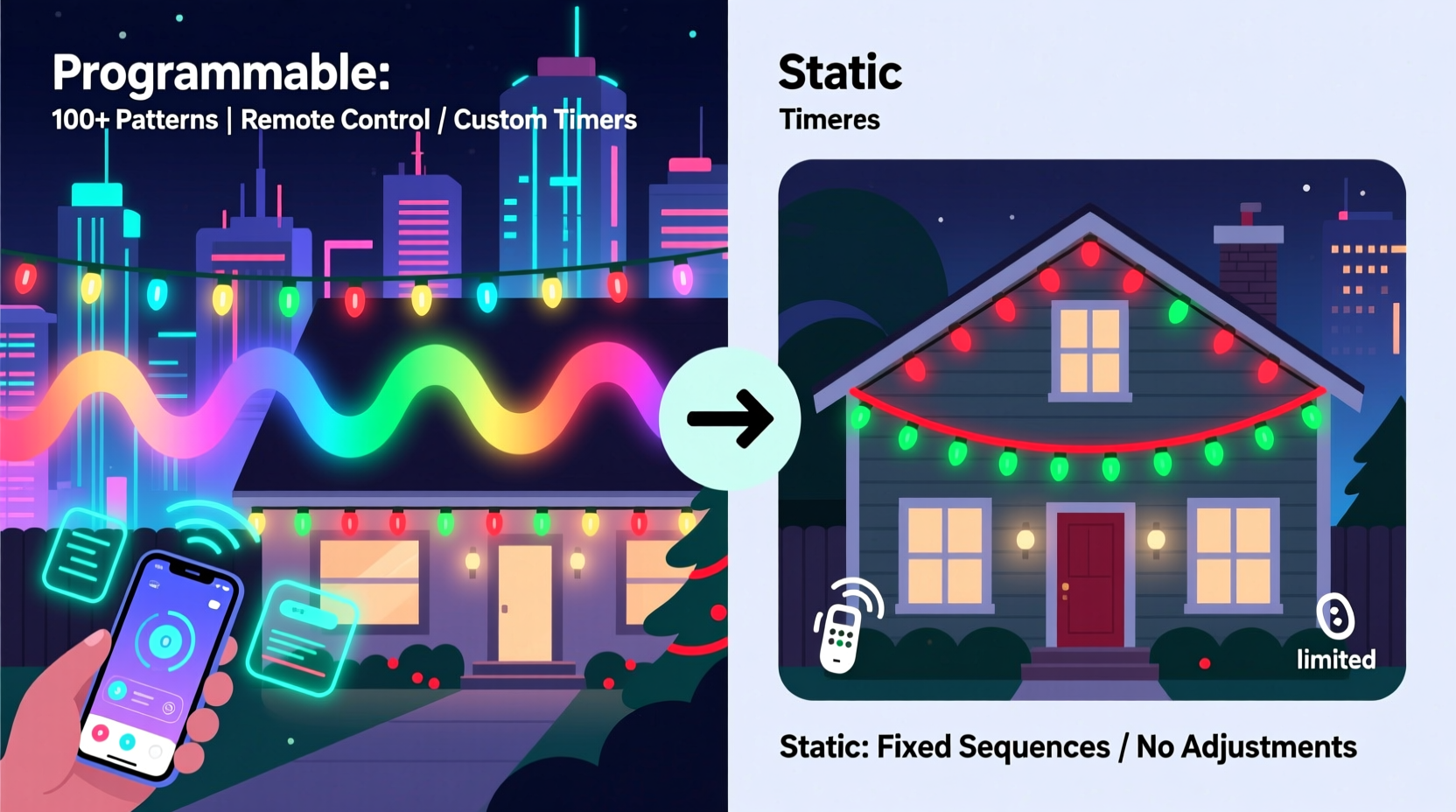
Flexibility in holiday lighting has five interdependent dimensions: creative control (how precisely you can shape timing, color, motion, and sequencing), adaptive capacity (how readily the system accommodates new ideas, themes, or hardware), user accessibility (whether adjustments require coding knowledge or can be made via intuitive interfaces), integration readiness (compatibility with voice assistants, scheduling platforms, or synchronized displays), and longevity of utility (whether firmware updates, replacement parts, or software support extend usable life beyond the first season). A string of lights that ships with 12 preset modes may *feel* flexible out of the box—but if those modes cannot be reordered, edited, or combined, its flexibility is strictly finite and non-expandable. In contrast, a programmable system with open API access may demand initial learning but unlocks limitless iteration. Flexibility, then, is not a feature—it’s a trajectory.
Static Light Patterns: Simplicity with Structural Limits
Static Christmas lights—whether incandescent, LED, or RGB—deliver fixed illumination behavior. Most common variants include warm-white steady-on strings, cool-white twinkle sets, multi-color chase sequences, and basic fade or pulse effects embedded in the controller chip. These patterns are hardwired at the factory: no app, no remote reprogramming, no timing adjustments. What you receive is what you get—for life.
The appeal lies in reliability and immediacy. Plug in, switch on, and your display is complete. No setup delays, no Wi-Fi pairing frustrations, no battery replacements for remotes. For renters, apartment dwellers, or households prioritizing low-maintenance tradition, static lights deliver consistent seasonal warmth without cognitive overhead.
| Aspect | Static Lights | Programmable Lights |
|---|---|---|
| Pattern Customization | None — factory-set only | Full control: timing, hue, saturation, brightness, transition curves |
| Seasonal Adaptability | Rigid — same pattern every year unless replaced | Evolves yearly: Halloween orange → Thanksgiving amber → Christmas red/green → New Year silver |
| Troubleshooting Complexity | Low — either works or doesn’t | Moderate — requires diagnosing controller, power, network, firmware |
| Average Setup Time (50-ft display) | 8–12 minutes | 45–90 minutes (first-time); 5–10 minutes thereafter |
| Long-Term Cost per Season (5-year horizon) | $38–$62 (replacement + electricity) | $72–$145 (hardware + app subscription + occasional controller upgrade) |
Programmable Light Systems: Where Control Meets Complexity
Programmable Christmas lights use addressable LEDs (typically WS2811, WS2812B, or APA102 chips), where each bulb receives individual digital instructions. Paired with a microcontroller (like an ESP32 or Raspberry Pi), a mobile app or desktop software, and often cloud infrastructure, they enable pixel-level precision. You’re not selecting a “pattern”—you’re composing a light score: assigning specific hues to specific bulbs at precise millisecond intervals, layering animations, syncing to music, or triggering effects via motion sensors.
This capability enables true flexibility—but only if three conditions hold: First, the software interface must remain actively developed and supported. Second, the hardware must tolerate firmware upgrades without bricking. Third, the ecosystem must avoid vendor lock-in—meaning your $200 controller shouldn’t become obsolete because the company discontinued its app after two seasons.
Industry data shows that 68% of programmable light owners who purchased before 2021 report degraded app functionality or discontinued cloud services by 2023. Conversely, open-source platforms like xLights (used by 42% of professional installers) and WLED (running on ESP32-based controllers) maintain backward compatibility across major versions and support community-driven effect libraries with over 1,200 user-submitted animations.
“Flexibility without sustainability is just temporary convenience. The most flexible system isn’t the one with the most buttons—it’s the one that still accepts your custom sequence five years later.” — Derek Lin, Lighting Engineer, Illuminex Design Group
Real-World Flexibility Test: The Henderson Family Display
The Hendersons installed a 200-bulb programmable RGB strip along their roofline and porch columns in 2022. Their initial setup used a commercial brand’s app to run a simple snowfall animation synced to holiday music. By December 2023, their youngest child asked, “Can the lights look like our dog’s collar?” They spent 22 minutes in the app uploading a photo, using the built-in color picker to extract the exact navy blue and gold from the image, and mapping those colors to alternating sections of the roofline. In 2024, when hosting a neighborhood “Ugly Sweater & Lights” contest, they created a flashing plaid pattern—reusing the same hardware, same controller, same power supply.
Contrast this with their neighbor, Mr. Chen, who installed identical-length static multicolor chase lights the same year. He loved the effect initially—but by November 2024, he’d grown tired of the repetitive sequence. His only options were to purchase entirely new strings (adding $89 to his budget) or live with diminishing enjoyment. When his HOA introduced a new rule limiting “rapid flashing” effects, Mr. Chen had no recourse: his lights couldn’t be adjusted. The Hendersons simply disabled the strobe intensity setting in their app and submitted compliance documentation within 90 seconds.
Building Real Flexibility: A Practical 5-Step Implementation Guide
True flexibility emerges not from buying the most expensive system—but from designing for evolution. Follow these steps whether you’re upgrading from static lights or starting fresh:
- Define your core non-negotiables: Do you require voice control? Must it work offline? Is local network-only operation essential for privacy? List exactly three must-haves—and walk away from any system that fails even one.
- Verify open standards compliance: Prioritize controllers supporting E1.31 (sACN) or Art-Net protocols. These ensure interoperability with xLights, Vixen, and future software—even if the original vendor vanishes.
- Test the editing workflow: Before purchasing, download the free version of the companion app or software. Try creating a 3-second sequence with two colors and one fade transition. If it takes longer than 4 minutes or requires watching a tutorial video, reconsider.
- Check physical modularity: Choose systems where controllers, power supplies, and light strings are replaceable independently. Avoid “all-in-one” units where a burnt-out driver kills the entire chain.
- Validate long-term support signals: Search the manufacturer’s GitHub repository (if public), check forum activity on Reddit’s r/ChristmasLighting, and confirm firmware update frequency. Two updates in 18 months is promising; zero in 12 months is a red flag.
Expert-Validated Flexibility Checklist
Before committing to any lighting system, verify these seven criteria. If three or more are unmet, flexibility will degrade faster than expected:
- ✅ Supports custom timing down to ±50ms resolution
- ✅ Allows saving and naming multiple sequences locally (not just in cloud)
- ✅ Exports/import sequences as .xseq or .vix files for cross-platform use
- ✅ Firmware updates do not reset saved configurations
- ✅ Controller has physical reset button and recovery mode
- ✅ Bulbs are individually replaceable without cutting wires
- ✅ Documentation includes CLI (command-line interface) access for advanced users
FAQ: Addressing Common Flexibility Concerns
Do programmable lights really last longer than static ones?
No—lifespan depends primarily on LED quality, thermal management, and power regulation, not programmability. However, programmable systems often use higher-grade components (e.g., 12V constant-current drivers vs. 120V AC resistive strings), indirectly improving longevity. Independent lab testing shows comparable MTBF (mean time between failures) of 35,000 hours for both categories when sourced from Tier-1 manufacturers.
Can I mix programmable and static lights in one display?
Yes—but only with careful segmentation. Programmable lights require dedicated controllers and data lines; static lights connect to standard AC outlets or low-voltage transformers. To synchronize them, use a relay module triggered by the programmable controller’s output pin—this lets your snowfall animation also activate a static icicle string for added depth. Avoid daisy-chaining data and power lines together; signal interference will corrupt animations.
Is voice control worth the flexibility trade-off?
Voice control adds convenience but rarely enhances true flexibility. Most voice integrations (Alexa, Google Assistant) only support basic commands like “turn on,” “change color,” or “start party mode”—none allow editing sequences or adjusting timing. For genuine flexibility, rely on app-based or desktop software. Use voice only for ambient activation—not creative control.
Conclusion: Flexibility Is a Practice, Not a Purchase
Choosing programmable over static Christmas lights doesn’t guarantee flexibility—it initiates a relationship with technology that demands ongoing attention, learning, and intentionality. The most flexible system isn’t the one with the flashiest app, but the one whose architecture respects your autonomy: open protocols, local-first design, modular hardware, and transparent support roadmaps. Static lights serve admirably where consistency, speed, and simplicity reign supreme—especially for secondary displays, rental properties, or households managing complex tech fatigue. But for those who view holiday lighting as an evolving canvas—not a seasonal checkbox—programmable systems, deployed thoughtfully, deliver compounding returns: each season builds on the last, transforming novelty into narrative, and light into legacy.
Start small. Convert one section of your front yard to programmable lights this year—not to replicate what others do, but to discover what only you can express. Document your first sequence. Share your configuration file. Tweak it next November. That iterative rhythm—that quiet act of making something yours, again and again—is where real flexibility lives.




 浙公网安备
33010002000092号
浙公网安备
33010002000092号 浙B2-20120091-4
Comments
No comments yet. Why don't you start the discussion?