
When selecting a turntable, one of the most debated technical distinctions is between belt-drive and direct-drive systems. While both designs have loyal followings among audiophiles and DJs alike, the core question remains: does the motor type actually influence sound quality? The answer isn’t as straightforward as it seems. Beyond marketing claims and nostalgic preferences, understanding the mechanical and acoustic implications of each system reveals subtle but meaningful differences in performance, durability, and sonic character.
This article examines the engineering behind belt-drive and direct-drive turntables, evaluates their impact on audio reproduction, and provides practical insights to help you choose based on your listening habits, environment, and expectations for sound quality.
How Turntable Motors Work: A Mechanical Overview
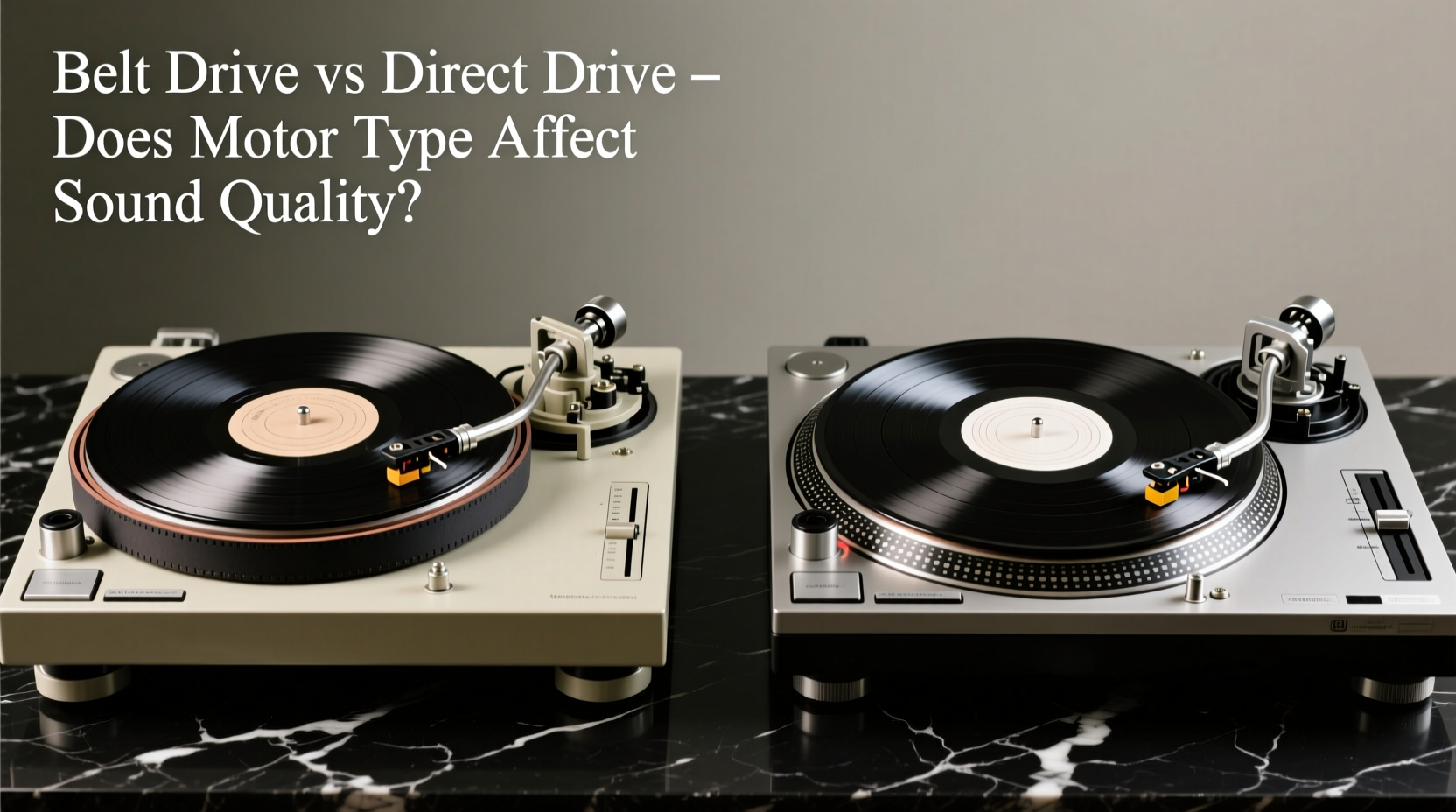
The primary function of any turntable is to rotate the platter at a consistent speed—either 33⅓ or 45 RPM—so that the stylus can accurately track the grooves of a vinyl record. To achieve this, a motor drives the platter, and the method of power transmission defines whether a turntable is belt-driven or direct-driven.
In a belt-drive system, the motor is located off-center and connected to the platter via an elastic rubber belt. The motor spins the belt, which in turn rotates the platter. This indirect coupling acts as a mechanical filter, dampening motor vibrations before they reach the platter and tonearm.
In contrast, a direct-drive system places the motor directly beneath the platter, with the platter mounted directly onto the motor shaft. This eliminates any intermediary components, allowing for immediate torque response and precise speed control. However, because there’s no physical buffer, vibration isolation becomes a critical design challenge.
Sound Quality: Separating Myth from Measurement
The central claim in the belt-drive versus direct-drive debate often revolves around perceived sound quality. Advocates of belt-drive turntables argue that their design produces warmer, more \"analog\" sound with lower noise floors. Direct-drive supporters counter that modern engineering has minimized vibration issues and that superior speed stability leads to more accurate pitch and timing.
From a technical standpoint, several factors influence how motor type affects audio output:
- Vibration transmission: Belt drives naturally decouple the motor from the platter, reducing the risk of mechanical noise reaching the stylus. This can result in lower levels of audible rumble—a low-frequency noise caused by motor irregularities.
- Speed stability: Direct-drive systems typically offer better rotational consistency, especially during start-up and under load. This reduces wow and flutter (short-term speed variations), which can subtly distort pitch and timing.
- Torque: Direct-drive motors provide higher torque, enabling faster start-up times and greater resistance to external disturbances like hand-braking or back-cueing—important for DJs.
- Maintenance and longevity: Belts are consumable parts that degrade over time, potentially affecting speed accuracy if not replaced. Direct-drive motors have fewer moving parts but can suffer from bearing wear or electronic failure over decades.
“While belt drives excel at isolating motor noise, modern direct-drive turntables with advanced damping and digital servo controls can match or exceed their analog rivals in measured performance.” — Dr. Alan Pierce, Audio Engineering Consultant
Comparative Analysis: Belt Drive vs Direct Drive
| Feature | Belt Drive | Direct Drive |
|---|---|---|
| Vibration Isolation | Excellent – rubber belt absorbs motor noise | Fair to Good – relies on internal damping materials |
| Speed Stability (Wow & Flutter) | Good – varies slightly with belt tension/age | Excellent – precise servo-controlled motors |
| Torque | Low to Moderate – slower start-up, less responsive | High – instant rotation, ideal for cueing |
| Maintenance Needs | Moderate – belts require replacement every 5–10 years | Low – no belts, but motor electronics may fail |
| DJ Suitability | Poor – not designed for scratching or back-spinning | Excellent – built for manipulation and cueing |
| Audiophile Preference | High – favored for perceived warmth and quiet operation | Growing – especially high-end models like Technics SL-1200 series |
| Price Range (Entry to High-End) | $100–$5,000+ | $300–$10,000+ |
Real-World Listening: A Mini Case Study
Consider two listeners: Maria, a classical music enthusiast who values tonal accuracy and silence between movements, and Jamal, a mobile DJ who performs live sets requiring quick cueing and beatmatching.
Maria uses a Rega Planar 3, a well-regarded belt-drive turntable known for its clean midrange and low background noise. When playing a delicate chamber recording, she appreciates the lack of mechanical hum and the sense of “space” around instruments. She rarely touches the platter and prioritizes long-term stability over responsiveness.
Jamal relies on a Technics SL-1200 MK7, a direct-drive industry standard. During a recent outdoor gig, he needed to manually adjust tempo and scratch sections of a track repeatedly. The high-torque motor allowed him to stop and restart the platter instantly without speed drift. Despite the loud environment, the built-in isolation and quartz lock ensured pitch remained stable.
Neither system failed its user—each was optimized for the intended use case. For Maria, the belt-drive’s acoustic isolation enhanced perceived sound quality. For Jamal, the direct-drive’s precision and durability were non-negotiable.
Expert Insights on Motor Design and Fidelity
Modern advancements have blurred the historical divide between the two systems. High-end direct-drive turntables now incorporate multi-rotor motors, inverted platters, and microprocessor-controlled speed regulation to minimize vibration and maximize accuracy. Similarly, premium belt-drive models use precision-machined platters, low-noise motors, and sophisticated suspension systems to enhance rigidity and reduce resonance.
According to Hi-Fi specialist Lila Nguyen, “The motor type alone doesn’t determine sound quality—it’s part of a holistic design philosophy. A poorly isolated belt-drive can be noisier than a well-damped direct-drive. What matters is how all components work together: platter mass, bearing quality, tonearm alignment, and anti-vibration feet.”
She adds, “If you’re comparing two turntables at the same price point, the one with better overall build quality will likely outperform regardless of drive type.”
Choosing the Right Turntable: A Practical Checklist
To make an informed decision based on your needs, consider the following checklist before purchasing:
- Define your primary use: Are you a home listener, collector, or performer? Audiophiles often prefer belt-drive; DJs need direct-drive.
- Assess your environment: Is your setup near speakers or on a resonant surface? Belt drives may perform better in acoustically sensitive spaces.
- Check maintenance requirements: Can you replace a belt in 5–10 years, or do you prefer a “set-and-forget” system?
- Evaluate speed accuracy specs: Look for wow and flutter ratings below 0.05% for high-fidelity playback.
- Test for vibration: Place your hand on the plinth while the turntable runs. Excessive vibration suggests poor isolation.
- Listen critically: Compare both types with familiar records. Note background noise, bass tightness, and stereo imaging.
- Consider upgrade potential: Some turntables allow motor upgrades or external power supplies to improve performance over time.
Frequently Asked Questions
Does a belt-drive turntable sound warmer than a direct-drive?
Not inherently. The perception of “warmth” often comes from reduced high-frequency noise and lower rumble, giving the impression of a smoother sound. However, this is not a universal rule—tonal balance depends more on cartridge, phono stage, and speaker pairing than drive mechanism.
Can a worn belt affect sound quality?
Yes. As rubber belts age, they can stretch, harden, or crack, leading to inconsistent platter speed. This causes pitch instability (wow) and timing inaccuracies, particularly noticeable in sustained notes or complex orchestral passages. Replacing a belt every 5–10 years restores optimal performance.
Are direct-drive turntables noisier?
Early models had higher noise floors, but modern high-end direct-drive turntables use magnetic damping, silent motors, and advanced circuitry to minimize vibration. In controlled environments, many test quieter than budget belt-drive units with poor isolation.
Conclusion: It’s About Application, Not Just Audio Specs
The debate over belt-drive versus direct-drive turntables ultimately hinges not on which is objectively “better,” but which aligns with your listening goals and usage patterns. Sound quality is influenced by a network of interdependent components—from motor design to platter material to room acoustics—and the drive system is just one element in that chain.
Belt-drive turntables continue to dominate the high-end audiophile market due to their elegant simplicity and effective vibration damping. Yet direct-drive models have evolved into precision instruments capable of rivaling—or surpassing—their belt-driven counterparts in both technical performance and musical engagement.
Rather than fixating solely on motor type, focus on overall build quality, proper setup, and compatibility with your existing audio system. Whether you choose the refined isolation of a belt-drive or the responsive control of a direct-drive, the best turntable is the one that keeps you coming back to your vinyl collection, track after track.




 浙公网安备
33010002000092号
浙公网安备
33010002000092号 浙B2-20120091-4
Comments
No comments yet. Why don't you start the discussion?