
Nostalgia is not just a feeling—it’s a sensory experience. For many gamers who grew up in the 80s, 90s, and early 2000s, the act of inserting a cartridge into a console was as much a part of gameplay as pressing Start. The click, the smell, the weight of the plastic case—each detail contributes to a memory that transcends the game itself. Today, with digital downloads dominating platforms like Nintendo Switch, PlayStation Store, and Xbox Live, accessing classic games has never been easier. But convenience doesn’t always equate to emotional resonance. When it comes to nostalgic value, retro gaming cartridges often deliver a richer, more immersive experience than their digital counterparts.
The debate isn't about which format is superior in terms of performance or accessibility—it's about what evokes deeper personal connection. While digital downloads offer instant gratification and flawless emulation, cartridges provide a tangible link to the past. This article explores the emotional, physical, and cultural dimensions of both formats, helping you understand why one might resonate more deeply with your sense of nostalgia.
The Tangible Experience of Retro Cartridges
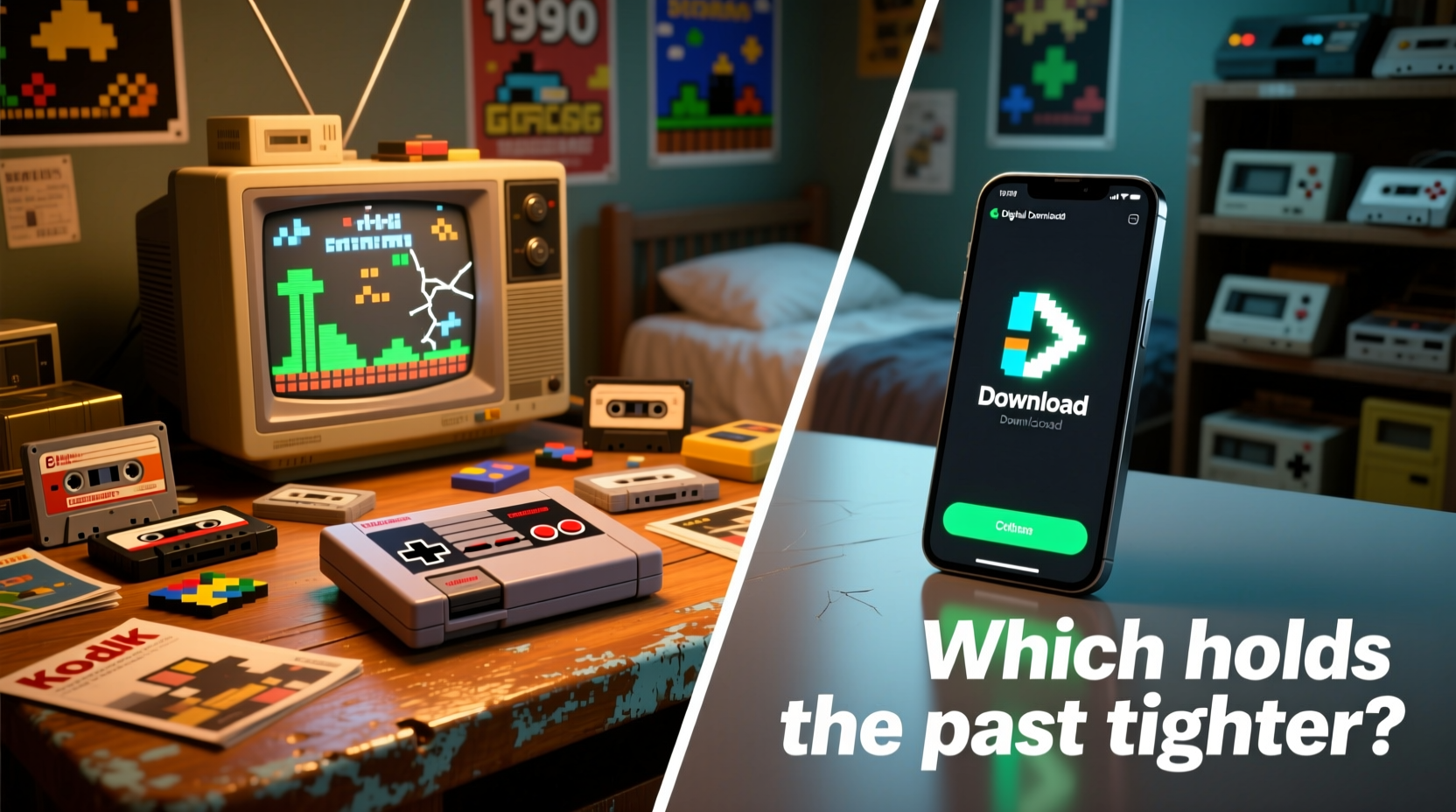
Physical media has an inherent presence that digital files lack. A retro gaming cartridge is more than just a storage device; it’s a relic. Holding a Super Nintendo cartridge of *Super Metroid* or blowing into a dusty NES *Contra* cartridge before insertion are rituals ingrained in a generation of players. These actions weren’t just functional—they were symbolic. They marked the beginning of an adventure, a moment of anticipation before the title screen appeared.
The tactile feedback of handling cartridges adds layers to the experience:
- Weight and texture: Cartridges have substance. Their heft and smooth plastic casing give them a sense of permanence.
- Visual design: Original box art, instruction manuals, and label designs on the cartridges themselves serve as visual anchors to childhood memories.
- Scent and wear: Many recall the distinct “old electronics” smell of vintage cartridges—a sensory cue that instantly triggers recollection.
These elements combine to form what psychologists call “embodied memory”—memories tied to physical interaction. Digital downloads, while efficient, exist in a vacuum. You don’t touch them, store them, or organize them on a shelf. There’s no ritual, no resistance, no imperfection. In eliminating friction, digital formats also remove some of the emotional texture that makes nostalgia so powerful.
Digital Downloads: Convenience at the Cost of Connection
Digital distribution has revolutionized how we access games. With a few clicks, you can download *The Legend of Zelda: A Link to the Past* on your Switch and begin playing within seconds. No hunting through garage sales, no risk of damaged contacts, no need to track down rare titles. Services like Nintendo’s Virtual Console, PlayStation Plus Classics, and Evercade’s curated collections make retro gaming more accessible than ever.
However, this ease comes with trade-offs. Digital versions often strip away contextual artifacts—the manual, the box, the regional variations in packaging. More importantly, they eliminate the ownership narrative. Buying a cartridge meant making a choice, saving allowance money, and cherishing the game as a prized possession. Digital purchases, by contrast, feel ephemeral. They’re stored in cloud libraries, subject to licensing changes, and easily deleted or forgotten.
As gaming historian Jeremy Parish notes:
“Digital re-releases preserve the code, but they often lose the culture around the game. The cartridge wasn’t just a delivery method—it was part of the game’s identity.” — Jeremy Parish, Retronauts Podcast Host
This distinction is crucial when evaluating nostalgic value. Nostalgia isn’t solely about the gameplay; it’s about the entire ecosystem of experience surrounding it.
Comparative Breakdown: Cartridges vs Digital
| Feature | Retro Cartridges | Digital Downloads |
|---|---|---|
| Tactile Interaction | High – physical handling, insertion, storage | None – accessed via menu |
| Ownership Feeling | Strong – tangible product, collectible | Weak – license-based, intangible |
| Setup Ritual | Pronounced – blowing, cleaning, powering on | Minimal – press play |
| Long-Term Preservation | Moderate – degrades over time if mishandled | Uncertain – depends on platform policies |
| Emotional Resonance | High – multisensory, memory-rich | Moderate – focused on gameplay only |
| Accessibility | Low – requires hardware, hunting for copies | High – instant availability |
While digital wins in practicality, cartridges consistently outperform in emotional depth. The very limitations of physical media—durability concerns, setup time, space requirements—contribute to their nostalgic power. Overcoming these small hurdles made playing the game feel earned.
A Real-Life Example: Reconnecting with Childhood Through Cartridges
Consider Mark Rivera, a 38-year-old software developer from Austin, Texas. After years of playing modern AAA titles digitally, he decided to revisit his childhood favorites. He purchased an original Game Boy Advance SP and tracked down his long-lost copy of *Pokémon Ruby*. The moment he slid the cartridge into the slot, the familiar startup chime triggered a flood of memories—he recalled playing under the covers with a flashlight, trading Pokémon with friends at school, and carefully naming each creature.
“I tried the digital version first,” Mark explains. “It played perfectly, but it felt hollow. When I finally held the actual cartridge again, it was like time travel. The scratches on the label, the way it clicked into place—it all came rushing back. That’s something no emulator can replicate.”
This anecdote illustrates a broader truth: nostalgia isn’t just about reliving the past—it’s about re-experiencing it through the same sensory channels. Digital remasters may offer better graphics or save states, but they often fail to recreate the emotional context that made the original experience meaningful.
How to Maximize Nostalgic Value: A Step-by-Step Guide
If you're seeking the fullest nostalgic experience, follow this sequence to reconnect with retro gaming in its most emotionally resonant form:
- Identify key games from your youth: Make a list of titles you associate with strong memories—birthdays, holidays, after-school sessions.
- Source original cartridges: Check local thrift stores, online marketplaces (eBay, Facebook Marketplace), or retro gaming expos. Prioritize games with intact boxes and manuals for added authenticity.
- Restore or acquire original hardware: Use working consoles like SNES, Sega Genesis, or Game Boy. Consider AV-to-HDMI upscalers if using modern TVs.
- Recreate the environment: Play in low light, use headphones, or sit in the same room where you originally played. Ambient sounds (like a fan or distant TV) can deepen immersion.
- Engage with the ritual: Clean the cartridge gently with isopropyl alcohol, blow into the connector (even if unnecessary), and power on the system deliberately.
- Reflect and journal: After playing, write down what memories surfaced. This reinforces the emotional connection and preserves the experience.
This process transforms gaming from passive entertainment into active reminiscence. Each step strengthens the neural pathways associated with memory and emotion, making the experience more vivid and lasting.
Checklist: Building a Nostalgic Gaming Setup
Use this checklist to ensure your retro gaming revival captures maximum nostalgic value:
- ☐ Original console or high-fidelity clone (e.g., Analogue systems)
- ☐ CRT television or scanline emulator for authentic display
- ☐ Genuine cartridges of your favorite childhood games
- ☐ Original controllers (worn grips add authenticity)
- ☐ Physical game boxes and manuals (optional but impactful)
- ☐ Quiet, distraction-free play environment
- ☐ Time set aside specifically for nostalgic play—no multitasking
Frequently Asked Questions
Do digital versions of retro games offer any nostalgic benefits?
Yes, but limited ones. Digital versions preserve gameplay mechanics and music, which can trigger memory recall. However, they lack the physical and ritualistic components that deepen emotional connection. For casual revisits, they’re convenient; for deep nostalgia, they fall short.
Are retro cartridges worth the investment for nostalgia alone?
For many, absolutely. Beyond monetary value, cartridges serve as personal artifacts. Their ability to transport you back to specific moments in life often outweighs cost or inconvenience. If emotional resonance matters more than efficiency, cartridges are worth it.
Can emulation replicate the nostalgic experience?
Emulation excels at accuracy but struggles with authenticity. While it can mimic graphics and sound, it cannot reproduce the tactile feedback, hardware quirks, or psychological weight of using real equipment. Some advanced setups (like FPGA-based systems) come close, but even they miss the imperfections that define original experiences.
Conclusion: Why Cartridges Still Hold the Edge
In the clash between retro gaming cartridges and digital downloads, the winner in terms of nostalgic value is clear: physical media wins by virtue of its multidimensionality. It engages sight, touch, and even smell—activating deeper layers of memory than pixels on a screen ever could. Digital downloads serve a vital role in preserving game history and expanding access, but they function more as archives than heirlooms.
Nostalgia thrives on imperfection—the scratch on the cartridge label, the slight lag when starting up, the shared excitement of trading games with a friend. These aren’t bugs; they’re features of lived experience. Cartridges embody that experience in a way that downloadable content, no matter how polished, cannot replicate.




 浙公网安备
33010002000092号
浙公网安备
33010002000092号 浙B2-20120091-4
Comments
No comments yet. Why don't you start the discussion?