
There’s nothing more frustrating than stringing up your favorite LED Christmas lights, only to find them flickering erratically. While LED technology is known for energy efficiency and long life, it’s not immune to performance issues—especially during the holiday season when multiple strings are connected and electrical loads increase. Flickering can stem from a range of causes: incompatible dimmers, voltage fluctuations, faulty connections, or even cold weather effects. Understanding the root cause is key to restoring that smooth, warm glow you expect from your holiday display.
This guide breaks down the most common reasons behind flickering LED Christmas lights, offering actionable diagnostics and fixes. Whether you're dealing with indoor mini-lights or outdoor icicle strands, these insights will help you identify, resolve, and prevent future flickering problems.
Understanding LED Light Behavior
Unlike incandescent bulbs, LEDs operate on low voltage and require precise current regulation. They use drivers (either built into the plug or integrated into each bulb) to convert standard household AC power into the DC power they need. Any disruption in this process—such as inconsistent voltage delivery or poor circuit design—can result in visible flickering.
Flickering isn’t always a sign of failure. Some minor flicker may be imperceptible under normal conditions but becomes noticeable in certain situations, like when recorded on camera or viewed peripherally. However, persistent or severe flickering usually indicates an underlying issue that should be addressed—not just for aesthetics, but also for safety and longevity.
“LEDs are sensitive to power quality. Even small voltage drops or surges can trigger visible flicker, especially in cheaper or older models.” — Dr. Alan Reeves, Electrical Systems Engineer, Smart Lighting Institute
Common Causes of Flickering and How to Diagnose Them
Flickering LED Christmas lights are rarely due to a single cause. Instead, they often result from a combination of environmental, electrical, and mechanical factors. Below are the most frequent culprits:
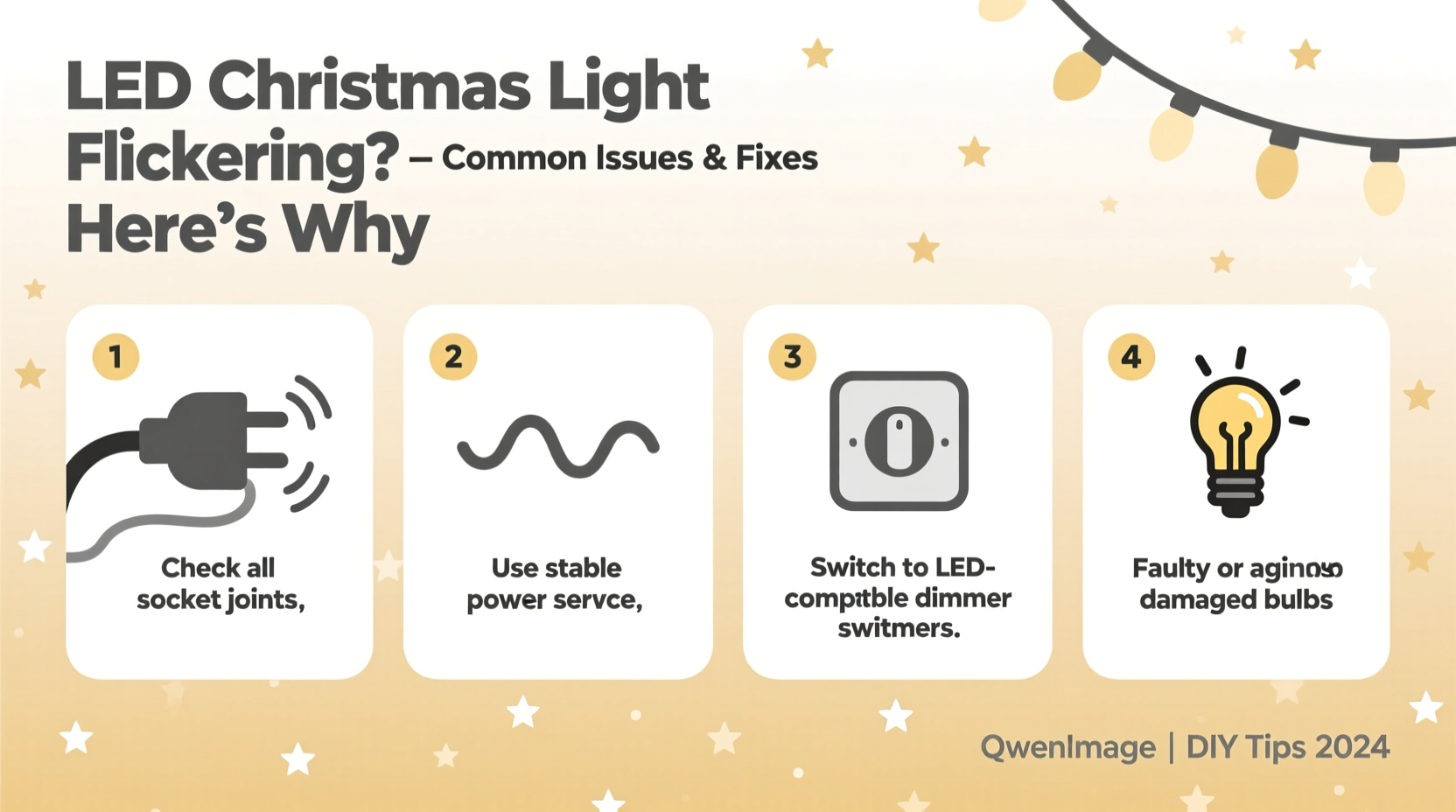
1. Loose or Poor Connections
The most common reason for flickering is a loose connection between light strings, extension cords, or outlets. Many LED sets use clip-together connectors that degrade over time, especially after seasonal storage. Corrosion, bent pins, or worn-out sockets can interrupt current flow.
2. Overloaded Circuits or Daisy-Chaining Too Many Strings
LEDs consume less power, but manufacturers still specify a maximum number of strings that can be connected end-to-end (usually 3–5). Exceeding this limit can overload the first string’s internal fuse or driver, causing intermittent operation.
Check the label on the light set for terms like “Connectable Up To: 3 Sets” or “Max Load: 21W.” Even if the total wattage seems safe, cumulative resistance in long chains can lead to voltage drop at the far end, resulting in dimming or flickering.
3. Incompatible Dimmer Switches
If your lights are controlled by a wall dimmer, this is a prime suspect. Traditional dimmers are designed for high-wattage incandescent bulbs and often don’t work well with low-draw LEDs. The dimmer may not “see” the load properly, causing erratic switching and visible flicker.
Solution: Use dimmers labeled as “LED-compatible” or “CL-rated” (for capacitive load). Alternatively, bypass the dimmer temporarily to test if flickering stops.
4. Voltage Fluctuations and Power Supply Issues
Outdoor circuits, especially on older homes, may experience voltage drops due to long wire runs, shared loads (like refrigerators or heaters), or poor grounding. LEDs react instantly to such fluctuations, unlike incandescents which have thermal inertia that masks brief dips.
Cold temperatures can also affect transformer efficiency in plug-in adapters, particularly in outdoor-rated sets. A weak power supply may struggle to maintain stable output in freezing conditions.
5. Faulty Bulbs or Damaged Wiring
A single defective LED or broken wire within a strand can disrupt the entire circuit, especially in series-wired strings. Some modern sets use parallel wiring, which isolates failures better, but many budget models still rely on series configurations.
Water ingress in outdoor lights can create short circuits or leakage paths, leading to flickering or partial outages. Look for cracked insulation or discolored connectors.
Troubleshooting Step-by-Step Guide
Follow this logical sequence to isolate and fix the cause of flickering:
- Unplug all light strings. Safety first—always disconnect before inspecting.
- Inspect connectors and cords. Look for bent pins, frayed wires, corrosion, or moisture. Clean contacts with isopropyl alcohol and a cotton swab if needed.
- Test each string individually. Plug one set directly into a known-good outlet. Observe for flicker. Repeat for each strand to identify problematic ones.
- Check daisy-chained limits. Disconnect all but one string. If it works fine alone, reconnect others one by one until flickering returns. This identifies overload issues.
- Bypass dimmers and timers. Plug directly into a wall outlet. If flickering stops, the control device is incompatible.
- Try a different circuit. Move the setup to another room or outlet to rule out household voltage issues.
- Use a multimeter (optional). Test outlet voltage under load. It should stay within 110–120V (in North America). Significant drops indicate wiring or circuit problems.
- Replace suspect components. Swap out damaged strings, connectors, or power adapters.
Do’s and Don’ts: LED Christmas Light Maintenance
| Do | Don't |
|---|---|
| Store lights on cardboard reels or in compartmentalized bins to prevent tangling and pinching. | Crush or tightly wrap lights around sharp objects, which can damage internal wires. |
| Label each string by location and color for easier setup next year. | Leave lights plugged in unattended or overnight without checking for heat buildup. |
| Use LED-rated surge protectors for outdoor displays. | Use indoor-only lights outdoors—even under eaves—as moisture can still penetrate. |
| Clean connectors annually with rubbing alcohol before installation. | Daisy-chain more than the manufacturer’s recommended number of strings. |
| Inspect fuses in plug ends; replace with identical ratings only. | Use non-polarized extension cords or adapters that compromise grounding. |
Real-World Example: The Case of the Flickering Front Porch
Mark from Denver installed new LED icicle lights on his home’s eaves every November. Last year, despite being new, the entire display flickered violently when turned on at dusk. He initially assumed the lights were defective and considered returning them.
Instead, he methodically tested each string and found that all worked perfectly when plugged directly into a garage outlet. But when connected through his outdoor timer/dimmer switch, flickering returned. Research revealed the switch was designed for incandescent loads only. Mark replaced it with an LED-compatible smart timer, and the flickering stopped immediately.
This case highlights how external controls—not the lights themselves—are often the hidden source of flicker. Testing in isolation is crucial before replacing hardware.
Prevention Checklist: Avoid Flickering Next Season
- ✔️ Verify compatibility between lights, dimmers, and controllers before installation.
- ✔️ Limit daisy-chained strings to the manufacturer’s specified maximum.
- ✔️ Use outdoor-rated GFCI outlets and surge protectors for exterior setups.
- ✔️ Inspect all connectors and cords for damage before each use.
- ✔️ Store lights properly using reels or organizers to prevent physical stress.
- ✔️ Replace blown fuses in plug ends with correct amperage (usually 3A for mini-lights).
- ✔️ Consider upgrading to commercial-grade or shunt-wired LED strings for better reliability.
Frequently Asked Questions
Can cold weather make LED Christmas lights flicker?
Yes. Extremely low temperatures can affect the performance of internal drivers and power supplies, especially in lower-quality sets. Condensation inside connectors can also create intermittent shorts. Use lights rated for outdoor/cold-weather use and ensure seals are intact.
Why do my LED lights flicker only when other appliances turn on?
This points to voltage fluctuation caused by high-draw devices (e.g., HVAC systems, refrigerators). The sudden demand drops voltage momentarily, which LEDs detect instantly. Try running the lights on a dedicated circuit or use a voltage stabilizer for critical displays.
Is flickering dangerous?
Occasional flicker due to loose plugs is usually harmless. However, persistent flickering from damaged wiring, overheating components, or water exposure can pose fire or shock risks. If you notice burning smells, discoloration, or warm plugs, discontinue use immediately.
Conclusion: Shine Bright Without the Flicker
Flickering LED Christmas lights don’t have to ruin your holiday spirit. With a systematic approach, most issues can be diagnosed and resolved in under an hour. Start simple—check connections and reduce load—before moving to complex electrical checks. Pay attention to compatibility, especially with dimmers and controllers, and invest in quality products that are built to last.
Proper care extends beyond the season. Taking a few minutes to inspect, clean, and store your lights correctly ensures reliable performance year after year. A little maintenance goes a long way toward a seamless, sparkling display that brings joy—not frustration.




 浙公网安备
33010002000092号
浙公网安备
33010002000092号 浙B2-20120091-4
Comments
No comments yet. Why don't you start the discussion?